


Partner With Us
Spring 2027 Call for Projects |
|
The Urban & Regional Planning Practicum brings together community partners, faculty, and student teams to address real planning challenges through applied research, analysis, community engagement, and collaborative problem-solving. Through these partnerships, communities gain additional planning capacity and new perspectives, while students gain meaningful experience working on real projects in a professional, client-based setting.
Benefits of Participation
Practicum partnerships are reciprocal. Community partners gain additional capacity to investigate locally identified planning issues, engage stakeholders, evaluate opportunities, and develop strategies for future action. Students apply planning knowledge and technical skills while learning to work collaboratively with clients, community members, and other stakeholders.
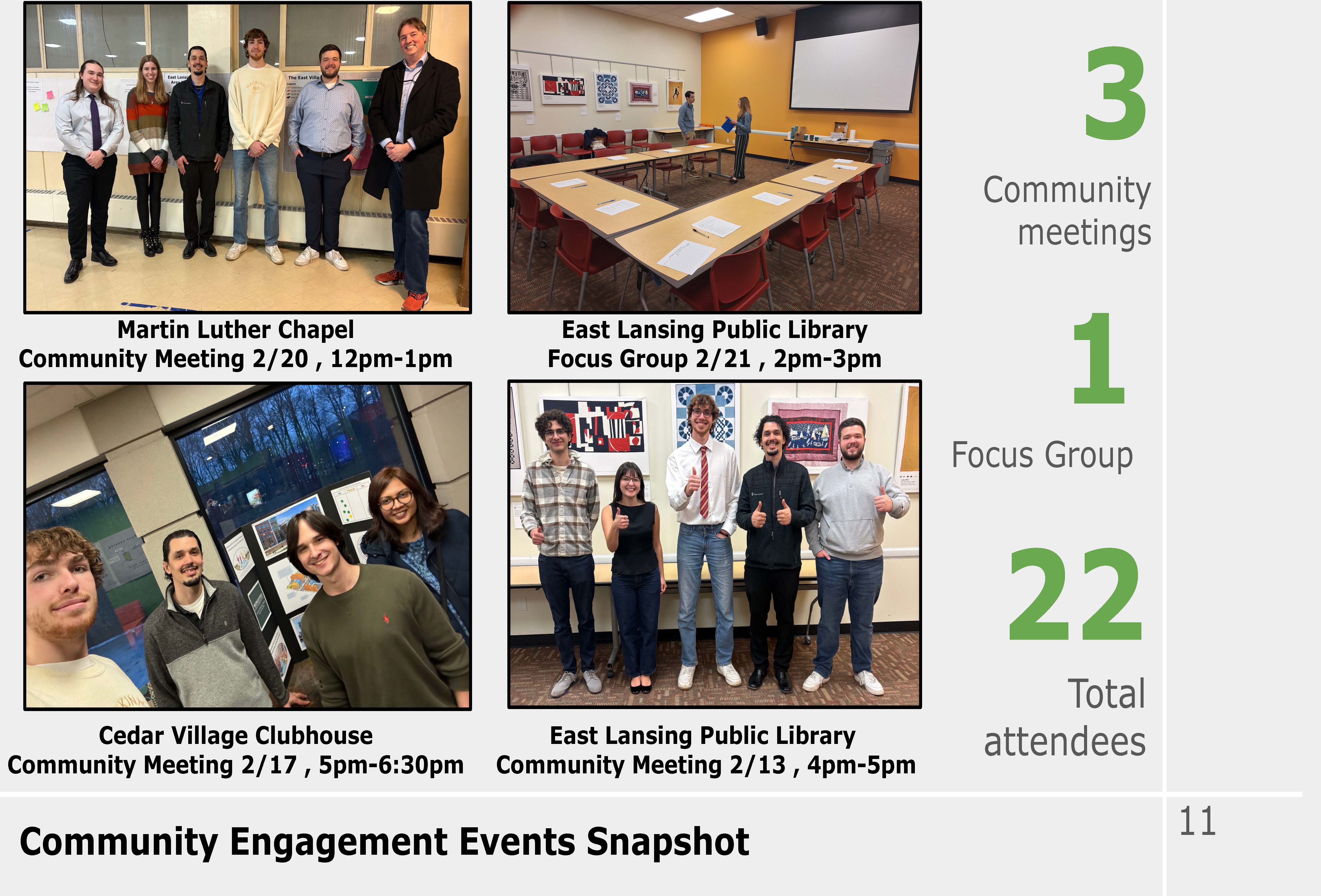
For Community Partners
- Focused research and analysis on a locally identified issue
- Additional capacity for community outreach and data collection
- New perspectives and creative planning ideas
- Opportunities to engage residents and stakeholders
- Visual materials that communicate community priorities
- Action-oriented recommendations and implementation strategies
- A documented foundation for future planning and funding efforts
The Practicum is most effective when it supports an active community initiative and complements, rather than replaces, the work of municipal staff or professional consultants.
For Students
- Contribute to and help manage a real-world planning project
- Conduct fieldwork, interviews, and community research
- Analyze qualitative, quantitative, and spatial information
- Facilitate public and stakeholder engagement
- Develop evidence-based recommendations
- Prepare professional maps, graphics, reports, and presentations
- Work collaboratively in teams and assume leadership roles
- Communicate with clients, community partners, and the public
- Apply principles of equity, inclusion, sustainability, resilience, and professional ethics
The Practicum serves as a critical bridge between academic study and professional planning practice.
What Community Partners Receive
Each project produces a set of professional planning products tailored to the client’s goals, community priorities, and project scope. Deliverables are developed through research, analysis, community engagement, and client feedback so that final recommendations are practical and responsive to local needs.
Depending on the project, deliverables may include:
- A comprehensive final planning report
- An executive summary
- Maps, diagrams, photographs, and data visualizations
- Community-engagement findings
- Planning, policy, design, or program recommendations
- An implementation strategy or action plan
- A professional presentation
- A project poster or other visual summary
- Digital copies of final project materials
Final products are intended to serve as practical community resources and may help inform future planning initiatives, public discussions, policy development, grant applications, capital improvements, or subsequent professional studies.
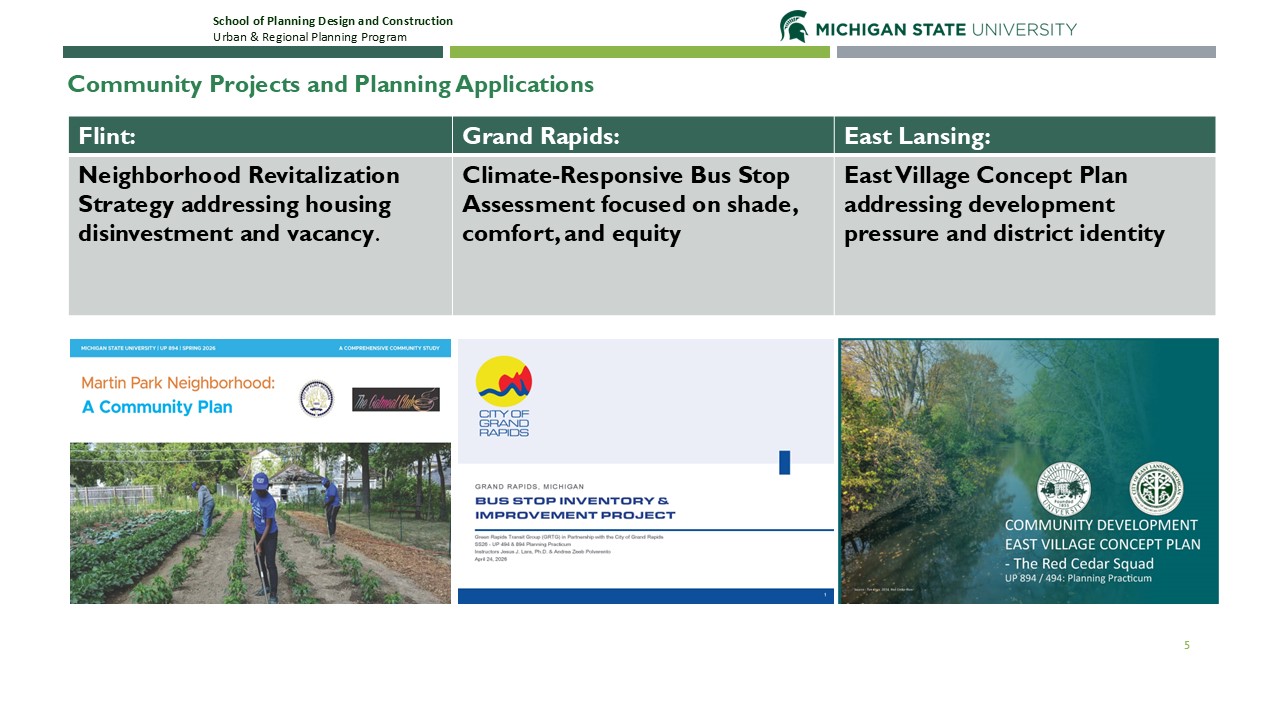
Is Your Project a Good Fit?
Strong Practicum projects begin with a clearly identified community planning need and provide meaningful opportunities for student learning and applied planning practice. Faculty review proposals based on educational value, community benefit, feasibility, scope, and alignment with the Urban and Regional Planning Program.
What Makes a Strong Practicum Project?
Strong proposals generally:
- Address a clearly defined and significant planning need
- Can be completed within one academic semester
- Have a realistic geographic and substantive scope
- Support an active community initiative or decision-making process
- Provide opportunities for research, analysis, community engagement, and implementation planning
- Have relevant background information, data, and community contacts available
- Have an identified client representative who can participate throughout the semester
- Allow students to produce professional-quality reports, maps, graphics, and presentations
The program welcomes projects representing urban, suburban, small-town, metropolitan, and rural communities across Michigan.
Community Partner Responsibilities
Successful projects depend on active collaboration among the client, faculty, and student team. Community partners provide the local knowledge, information, connections, and feedback necessary to keep the project relevant and responsive to community priorities.
Participating partners are expected to:
- Designate a primary project contact
- Participate in developing and confirming the scope of work
- Provide relevant plans, datasets, studies, maps, and background materials
- Assist students in identifying stakeholders and community contacts
- Help coordinate site visits, meetings, and engagement activities
- Attend key project reviews and presentations
- Provide timely and constructive feedback on draft materials
- Help ensure that the project remains responsive to community needs
- Provide an agreed-upon project contribution to support travel, printing, engagement, and production expenses
|
Active and timely client participation is essential to producing a useful and successful final project. |
Project Timeline
Call for Projects → Selection → Project Launch → Research & Engagement → Final Presentation
The Practicum follows an annual schedule that allows projects to be identified and scoped during the fall semester before student teams begin work in January. Community partners remain involved throughout the spring semester, providing information, facilitating engagement, and reviewing work at key stages.
| Period | Activity |
| Early Fall | The Urban and Regional Planning Program releases its annual call for Practicum project proposals. |
| Fall Semester | Faculty review proposals, communicate with prospective partners, clarify project scopes, and select projects for the upcoming Practicum. |
| January | Student teams are formed, projects begin, and clients participate in orientation and project-scoping meetings. |
| January-April | Students conduct research, fieldwork, data analysis, engagement, concept development, and implementation planning. Clients review materials and provide feedback at key points. |
| Late April-Early May | Teams submit final products and present their recommendations to clients and community partners. |
Submit a Project Proposal
The Urban & Regional Planning Practicum welcomes proposals from municipalities, public agencies, nonprofit organizations, neighborhood and community organizations, and other public-serving partners seeking assistance with planning challenges or opportunities.
We encourage proposals that address current planning needs, emerging opportunities, or longer-term community priorities. Projects should provide opportunities for applied research, community engagement, analysis, and the development of recommendations that can inform future decision-making and implementation.
A proposal should briefly describe:
- The community or organization
- The planning issue or opportunity
- The geographic study area
- The desired project outcomes
- Available data and background materials
- Opportunities for community participation
- The primary client contact
- How the final work may be used after the Practicum
Submitting a proposal does not guarantee selection. Faculty evaluate proposals based on scope, educational value, community benefit, feasibility, available program capacity, and alignment with the Urban and Regional Planning Program..
| Date | Milestone |
| December 1, 2026 | Project proposal deadline |
| December 9, 2027 | Preliminary project selections announced (subject to final enrollment and team capacity). |
| January 19, 2027 | MSU Spring semester begins |
| January 25, 2027 | Partner/team scoping and project launch |
| March 6-14, 2027 | MSU Spring Break |
| April 30, 2027 | Practicum final presentations, 9:30 AM-12:00 PM ET |
"Download Project Request Form" "Submit A Project Proposal"
Building Partnerships for Community Impact
The Practicum is built on the belief that meaningful planning begins with strong community partnerships. By bringing together local knowledge, community priorities, student perspectives, and faculty guidance, each project creates opportunities to address challenges and develop practical strategies for the future. These partnerships support communities across Michigan while preparing the next generation of planners for collaborative, responsive, and community-engaged professional practice.
 Print
Print Email
Email