


About
Overview
The Michigan State University Urban and Regional Planning Practicum connects communities with faculty-guided teams of undergraduate and graduate planning students. During the spring semester, students work directly with municipalities, public agencies, nonprofit organizations, and community groups to address real-world planning challenges and develop practical, community-informed recommendations.
The Practicum is a cornerstone of the Urban and Regional Planning Program’s outreach mission, integrating teaching, applied research, and community engagement. Students gain experience applying planning knowledge in an authentic client-based setting, while community partners receive focused research, analysis, engagement, and planning assistance to help advance locally identified priorities.
What Practicum Teams Can Do
Every community faces unique opportunities and challenges. The Urban and Regional Planning Practicum provides flexible, client-centered planning assistance tailored to local needs. Working closely with community partners, student teams apply research, analysis, public engagement, and planning and design methods to address issues at the neighborhood, corridor, district, and community scales.
Each project combines professional planning methods with local knowledge to produce practical, evidence-based recommendations that can support decision-making, future planning, and implementation.
Practicum projects may address:
- Corridor and district planning
- Downtown and commercial-area revitalization
- Land-use and redevelopment studies
- Housing and neighborhood stabilization
- Transportation, mobility, and nonmotorized planning
- Public-space and placemaking strategies
- Parks, recreation, and green infrastructure
- Climate resilience and environmental justice
- Economic development and implementation planning
- Zoning, development regulations, and policy analysis
- Community engagement and stakeholder research
- Site feasibility and adaptive reuse planning
Projects typically combine qualitative, quantitative, spatial, and community-engagement methods. The specific research approach and final products are determined collaboratively based on the project scope, available information, community priorities, and semester timeline.
A Collaborative, Client-Based Planning Experience
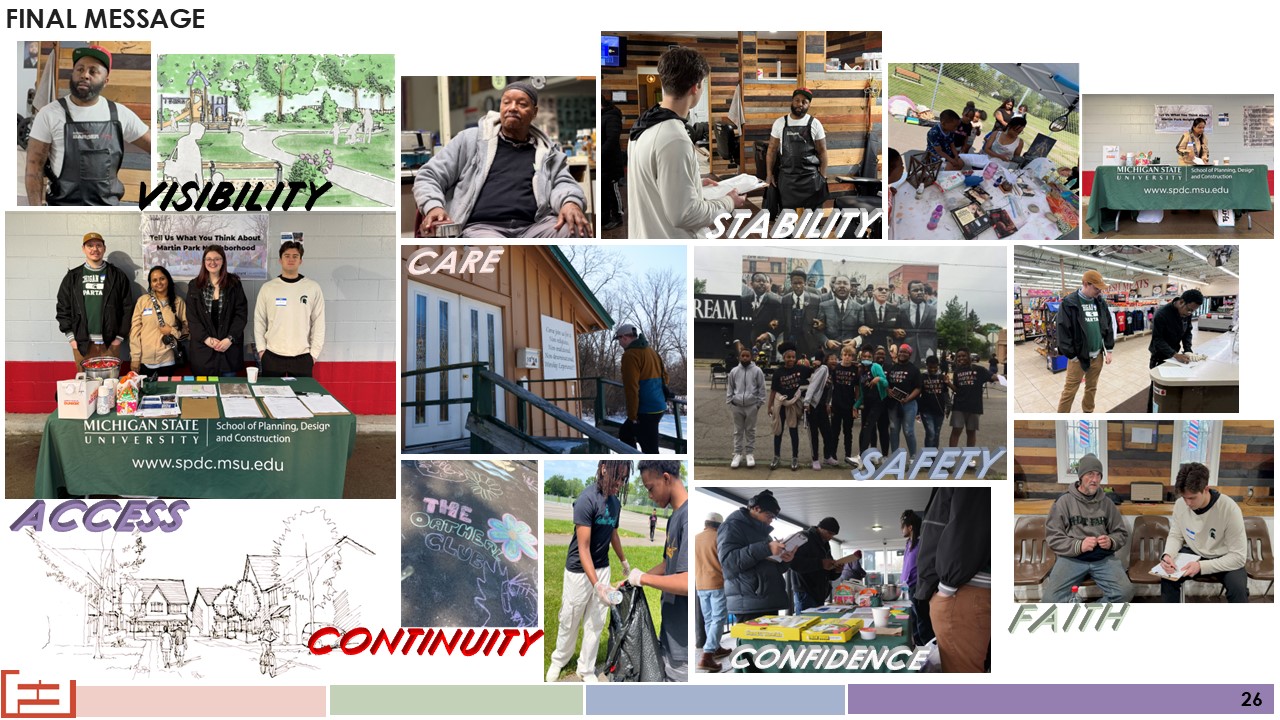
Each Practicum project is developed in partnership with a community client and completed during the spring semester. Faculty and students work closely with the client throughout the process to define the scope of work, conduct research and analysis, gather community input, review findings, evaluate alternatives, and refine recommendations.
Projects are structured to address client needs while remaining achievable within an academic semester. Rather than completing a traditional classroom exercise, students work in faculty-guided planning teams on real projects for real clients, following a structured professional planning process and producing materials intended to inform future community decision-making and implementation.
Community partners may include:
- Municipalities and county governments
- Planning and economic development agencies
- Neighborhood and community organizations
- Nonprofit organizations
- Transit, housing, environmental, and public service agencies
- Regional authorities and other public-sector partners
Planning Together for Community Impact
Through these partnerships, the Practicum creates a shared learning experience that benefits both communities and students. Community partners gain new perspectives, research, analysis, and planning strategies to help advance local priorities, while students develop the professional skills and experience needed to address complex planning challenges. Together, these collaborations demonstrate how university-community partnerships can translate planning knowledge into meaningful, locally relevant action.
 Print
Print Email
Email