While MSU greenhouse updates spark innovative research, needs remain
 Print
Print Email
EmailAfter the most recent phase of the project, 60% of the MSU Plant Science Research Greenhouse Complex has been renovated. Funding is needed to address the remaining 40% and provide all greenhouse users access to the latest tools and environmental controls.
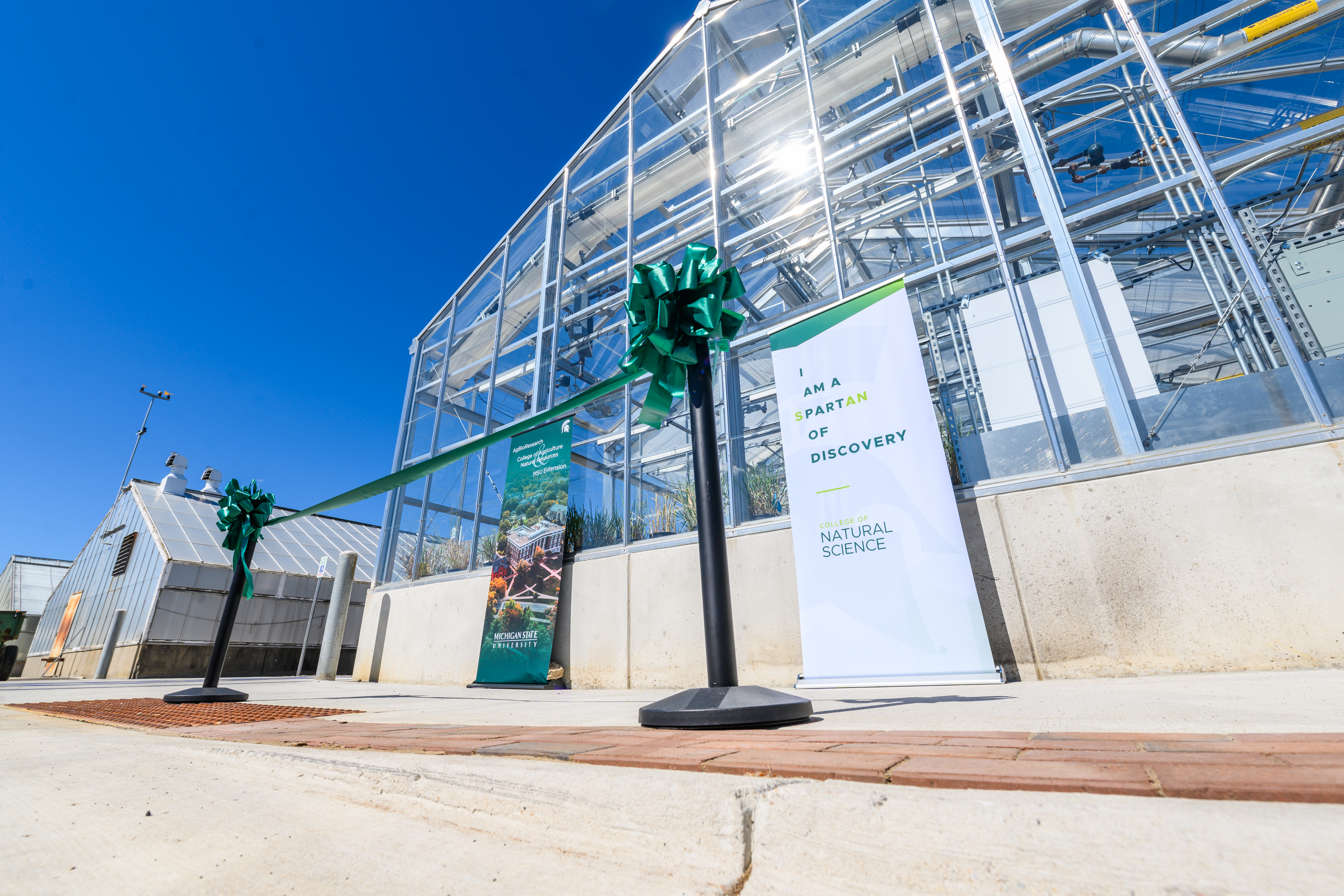
EAST LANSING, Mich. — On May 14, Michigan State University leaders welcomed more than 100 stakeholders and partners to campus to commemorate the opening of the partially renovated Plant Science Research Greenhouse Complex.
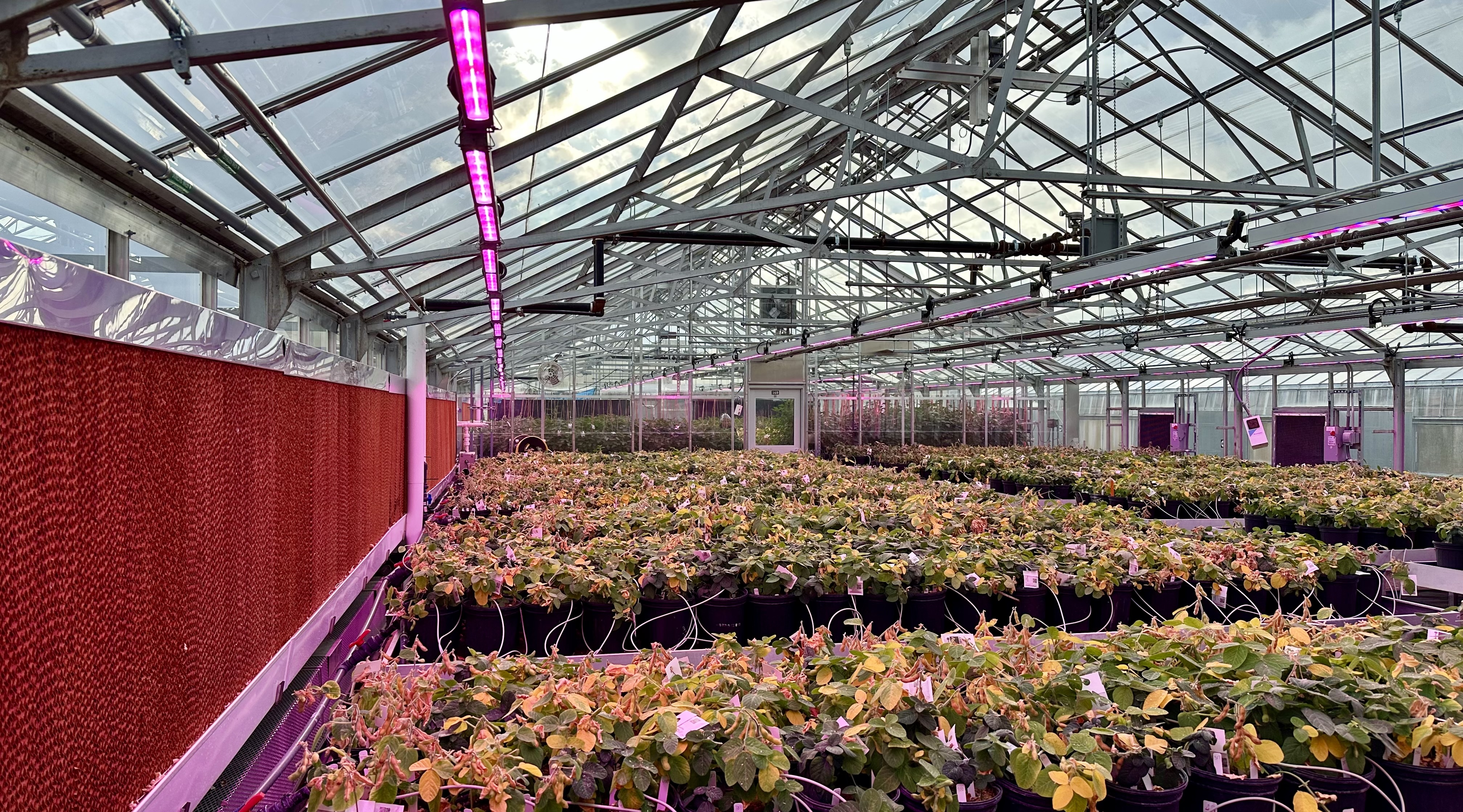
The event recognized the first phases of needed infrastructure improvements that bolster MSU’s world-class plant science research, including installation of LED lighting, environmental control systems, new glazing panels to replace the aging glass shell of the greenhouses, and a new headhouse that serves as the facility’s center of operations. Taller ceilings also allow for the uninhibited growth of crops such as corn and sorghum.
Thus far, the roughly $35 million project has been supported by the State of Michigan and units across MSU. While additional funding is needed to complete the entire facility renovation, progress to this point has been substantial.
Each of Michigan’s plant commodities is represented in the research greenhouses, ranging from corn and soybeans to blueberries, potatoes and several floriculture crops. Nearly 70 faculty members from the College of Agriculture and Natural Resources and College of Natural Science utilize the facility alongside hundreds of staff and students, bringing the total number of facility users to more than 400.
Roberto Lopez, an associate professor and MSU Extension specialist in the Department of Horticulture, is an expert in controlled-environment research with leafy greens, strawberries and floriculture crops. Partnering with Josh Vander Weide, an assistant professor of horticulture who specializes in blueberry and strawberry production, Lopez has been investigating the interactive effect of vapor pressure deficit, as well as day and night air temperatures, on strawberry production in greenhouses.
Vapor pressure deficit is the difference between the moisture in the air and the maximum amount of moisture the air can hold at a particular temperature, which has major implications on water movement, nutrient uptake and plant performance.
The study necessitates a fogging system and venting, along with precise environmental controls to manage temperature. Prior to renovations, the study would have faced insurmountable hurdles to obtaining usable information.
“The new Plant Science Research Greenhouses have enabled us to conduct studies to determine how temperature and vapor pressure deficit interact to influence strawberry growth, development and yield,” Lopez said. “This was not previously possible due to the lack of temperature and moisture control, but now we can evaluate all sorts of production challenges, particularly those that require simulating very specific environmental conditions.”
Research from the College of Natural Science is examining the effect of drought on biofuel crops, a project propelled by new technology in the greenhouses. Berkley Walker, an associate professor in the Department of Plant Biology and the MSU-Department of Energy Plant Research Laboratory, is demonstrating how switchgrass grown in drought conditions poses problems for ethanol production.
“It’s hard to study the mechanisms behind this in the field because you have to wait until a drought comes along, so we have developed a system to do this in the greenhouse,” Walker said. “We can detect water content and irrigate to individual pots so that we can perform a ‘programmable drought’ in a controlled way. The problem with our old greenhouse spaces is that the roofs dripped water into our pots during drought experiments.”
Although the facility upgrades thus far are a sign of tremendous progress, MSU leaders and researchers understand there’s work to be done. Upon completion of this phase of the project in April, approximately 60% of the complex has been addressed. The remaining 40% is operating with minimal to no upgrades.
“In the renovated space, we not only have the height to perform this work on many different species, but we have more appropriate infrastructure to run our advanced irrigation system and much-improved temperature control,” Walker said. “We have ethernet so we can monitor the experiment in real time, and we have good monitoring and recording of greenhouse conditions as well. We are grateful to be in this space, but all MSU researchers deserve similar access by renovating the entire complex.”
Fundraising will continue in order to procure the investment required to bridge that gap. MSU staff are actively pursuing federal and state grants, as well as seeking financial support from private donors and industry organizations.
MSU AgBioResearch Associate Director Kang Xia said university leaders are committed to helping secure the resources that will provide scientists with the highest-quality facilities to drive Michigan agriculture forward.
“The upgraded greenhouses are a testament to what can be accomplished through our great partnerships across Michigan agriculture,” Xia said. “Our partners have helped us emphasize the importance of this project for our state and beyond, but our work is not finished. To reap the full benefit, and to meet the needs throughout Michigan agriculture now and in the future, the entire facility must adhere to this new quality standard.”
Delivering solutions for Michigan agriculture
One of Michigan agriculture’s defining attributes is the unwavering partnerships that benefit all industries, according to Kelly Turner, executive director of the Michigan Potato Industry Commission (MPIC). She mentioned industry support was instrumental in securing state funding for the greenhouse project, and continued advocacy will be crucial.
Michigan ranks eighth nationally in total potato production, but the state’s spud status as the leading producer of chipping potatoes is its calling card. Roughly 70% of the state’s crop is specifically for chips, and according to MPIC estimates, one of every four bags of chips produced in the U.S. contains Michigan potatoes.
For decades, the research greenhouses have served as the catalyst for hundreds of projects, many of which have moved to field testing and, ultimately, implementation by Michigan growers and beyond. The potato industry has seen a multitude of advancements from this work, notably from MSU’s internationally renowned Potato Breeding and Genetics Program.
Led by Dave Douches, a professor in the Department of Plant, Soil and Microbial Sciences, breeding efforts have generated several new varieties that improve traits such as yield potential, size, quality, insect and disease resistance, and storage capacity. Turner said MSU research has changed the game for Michigan potato growers, and the greenhouses are an essential element.
"The greenhouse facilities at MSU are a critical component of the research and innovation pipeline that supports Michigan's potato industry and the broader specialty crop sector,” Turner said. “From plant breeding and variety development to disease management and emerging production technologies, these facilities provide researchers with the controlled environments necessary to address some of agriculture's most pressing challenges.
“For Michigan's potato growers, continued investment in greenhouse infrastructure directly supports the development of improved varieties, stronger pest and disease resistance, and production systems that help farms remain competitive in an increasingly complex marketplace. These advancements ultimately benefit not only growers, but also processors, consumers and rural communities across the state.”
As the obstacles facing agriculture mount, Turner said investing in modernized research infrastructure such as the greenhouses becomes even more necessary.
“As agriculture faces growing pressures from climate variability, resource management challenges and evolving market demands, modern research facilities are more important than ever,” Turner said. “Ensuring that MSU has the greenhouse capacity needed to conduct world-class research will strengthen Michigan's leadership in agricultural innovation and help deliver practical solutions that benefit producers for generations to come. Funding support for these renovations is an investment in the future competitiveness, sustainability and resilience of Michigan agriculture.”
Like potatoes, the soybean industry has seen substantial gains from MSU research. According to the Michigan Soybean Committee (MSC), the crop covers roughly 2.2 million acres around the state. Including production and processing, the Michigan Ag Council indicates soybeans contribute about $1.5 billion to the state’s economy each year.
MSU soybean research tackles issues such as variety development for Michigan’s unique and varied climates, nutrient management, and mitigating insect, disease and weed pressures. Many of these advancements rely on the greenhouses.
“The greenhouses at MSU are critical to soybean research,” MSC Research Director Mark Seamon said. “They allow for controlled growing conditions and production in the offseason. The greenhouses are especially important to the soybean breeding program to add multiple generations of new genetic lines per year instead of only relying on one generation per year in the field. The continued investment in reliable facilities, up-to-date technology and professional management are critical to future success.”
Along with food crop commodities, the Michigan turfgrass industry trusts MSU research to uncover answers to its most pressing challenges. Turfgrass activities generate $1.86 billion in statewide economic activity, according to the Michigan Turfgrass Foundation (MTF).
The MSU Turfgrass Management Program is lauded as an international powerhouse, providing advancements to turf management for recreational areas, residential lawns, golf courses and some of the world’s most prominent sporting events.
In collaboration with the University of Tennessee and the International Federation of Association Football, also known as FIFA, MSU experts have helped develop high-quality playing surfaces for this year’s World Cup. These accomplishments are rooted in applied research at the MSU Hancock Turfgrass Research Center and greenhouse-based studies.
“The turfgrass industry relies heavily on MSU for critical research,” MTF Executive Director Carey Mitchelson said. “Our worldwide recognition for the World Cup turf pitches is just one example of the university's impact. Many of our members support the Foundation because MSU serves as a vital connection for everyone in the green industry. The greenhouses perfectly illustrate how MSU brings together a wide variety of partners to improve campus research. I was fortunate to attend the greenhouse complex groundbreaking and am thrilled to see this project come to fruition with further investment.”
Michigan State University AgBioResearch scientists discover dynamic solutions for food systems and the environment. More than 300 MSU faculty conduct leading-edge research on a variety of topics, from health and agriculture to natural resources. Originally formed in 1888 as the Michigan Agricultural Experiment Station, MSU AgBioResearch oversees numerous on-campus research facilities, as well as 15 outlying centers throughout Michigan. To learn more, visit agbioresearch.msu.edu.