MSU opens newly renovated $35-million Plant Science Greenhouses
 Print
Print Email
EmailMichigan State University partners gathered May 14 on the East Lansing campus for a ribbon-cutting to celebrate transformative renovations
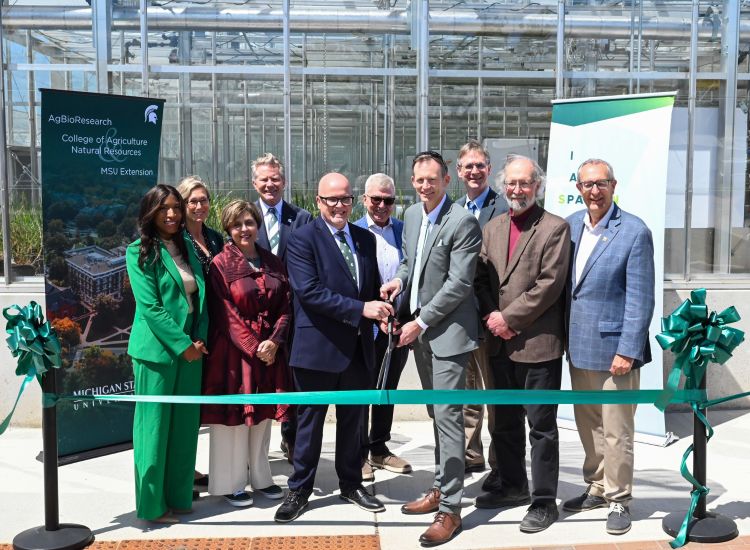
Michigan State University leadership hosted more than 100 stakeholders and friends of the university on May 14 to celebrate the opening of the newly renovated MSU Plant Science Research Greenhouse Complex.
Upgrades to the greenhouse complex, through a combination of renovations and additions, include state-of-the-art environmental controls and LED lighting configured to respond to varying external climate conditions. New greenhouses will allow Spartan scientists and students to conduct controlled experiments under a variety of growth, environmental and stress conditions.
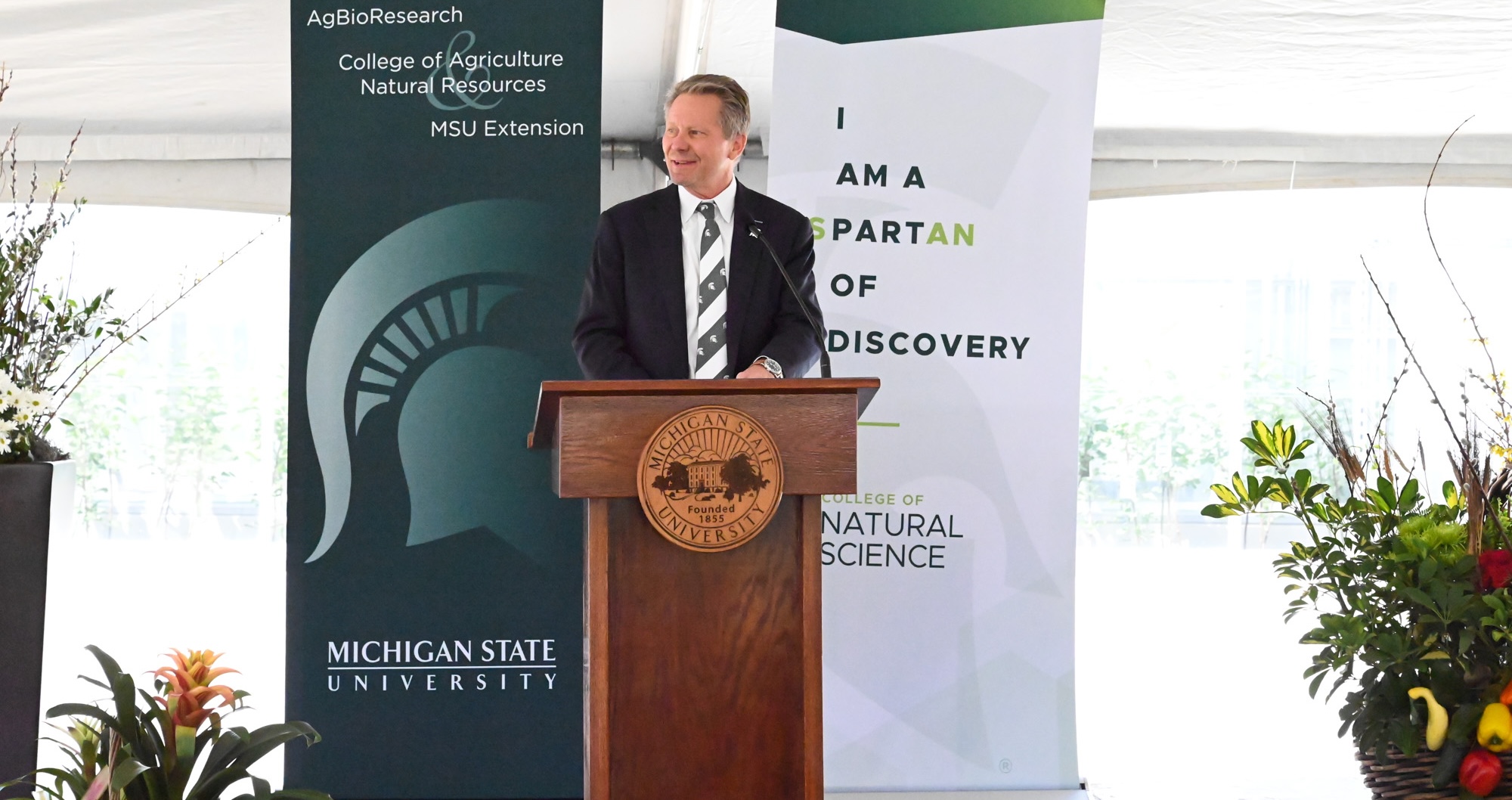
“The challenges these upgraded greenhouse facilities will answer have only grown since we gathered here two years ago to break ground for this project,” said MSU President Kevin M. Guskiewicz, Ph.D. “As the global population continues to rise, estimated to exceed 10 billion people in the next 50 years, we need to grow our food supply with no more land or water — perhaps even less — than we have today. Michigan State was built for this challenge. Few institutions in the world possess the breadth of knowledge, assets like these greenhouses and the sheer Spartan will to answer such daunting challenges.”
The updates at the greenhouses are supported, in part, by $53 million allocated by the Michigan legislature in July 2022 for upgrades to the greenhouse and the construction of a new dairy facility. MSU contributed $12 million to the greenhouse project, totaling $35 million in upgrades.
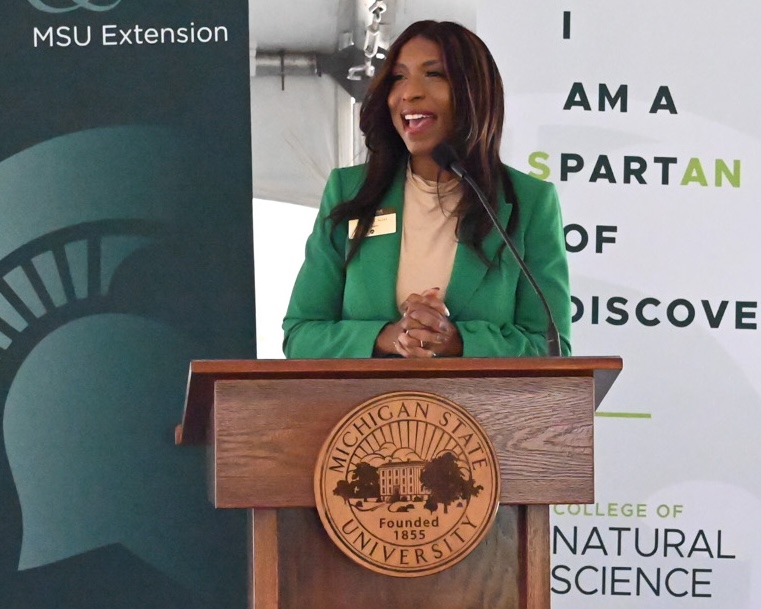
“I would like to thank our partners in Michigan's agricultural community, and Gov. Gretchen Whitmer and the Michigan legislature for their bipartisan backing of this advancement of Michigan State’s research infrastructure,” said MSU Board of Trustees Chairperson Brianna T. Scott. “Our celebration today marks a significant step forward for the state’s collective commitment to Michigan’s agricultural industry, and it serves as another demonstration of the power of collaboration and community.”

More than 400 people use the greenhouses for research and learning, according to Chrislyn Particka, Ph.D., director of the MSU Plant Science Research Greenhouse Complex, who led a tour of the new greenhouses. As director, it is Patricka’s job to ensure the operation runs smoothly for nearly 70 researchers and hundreds of students.
The new greenhouses allow faculty, like MSU Department of Horticulture Assistant Professor Joshua Vander Weide, Ph.D., to continue research and outreach on seasonal crops year-round as well as provide information to Michigan growers on the benefits of greenhouse operations. His research and Extension program encompasses commercial berry crop production and management, with a focus on blueberries and strawberries.
Students in academic departments across the College of Agriculture and Natural Resources and College of Natural Science use the greenhouses to learn and begin their own research programs aimed at addressing the latest issues in Michigan agriculture.
“The academic impact of the renovations and additions to the MSU Plant Science Greenhouses will be significant and far-reaching – supporting learning, research, and outreach across multiple departments, colleges, and areas of inquiry,” said MSU Provost Laura Lee McIntyre, Ph.D. “The new headhouse isn’t just a place to transplant seedlings, take measurements of plants’ height and stem diameters, and wash roots. This is a gathering place where our researchers from different disciplines and greenhouse staff can come together in collaboration and friendship.”

The new headhouse hosts workstations that advance innovative research across the greenhouses, including a conference room, equipment workshop, soil mixing and fertilizer room, plant photography room, potting room, pot- and root-wash rooms, vernalization room, and pesticide mixing and storage rooms.
“MSU’s global reputation for excellence in plant science represents generations of Spartan scientists who have lived and worked right here,” said Associate Provost and Dean of the College of Agriculture and Natural Resources Matthew Daum, Ph.D. “It is our people who get this work done – but they need the tools to meet the moment. These facilities mean that world-class researchers and plant breeders will have the freedom to think bigger and bolder than ever before.”
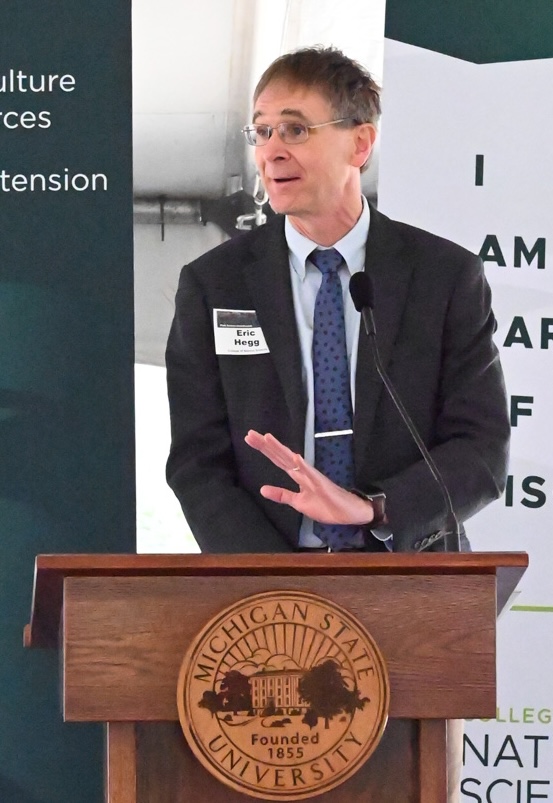
“This new facility supports research 12 months a year,” said Dean of the College of Natural Science Eric L. Hegg, Ph.D. “By maintaining stable growing conditions regardless of Michigan’s outdoor climate and seasonal changes, breeding programs can more effectively develop new varieties of wheat, beans, blueberries, and other Michigan crops. This work connects directly to Michigan agriculture, where understanding how plants respond to real-world stressors is critical to improving crop yield, stability, and long-term food security.”
The initial greenhouse upgrades cover renovation of approximately 60 percent of the nearly 90,000-square-foot complex. At the conclusion of the project in 2026, 40 percent of greenhouse space will remain untouched.
Campus units, including the College of Natural Science, Infrastructure Planning and Facilities, MSU AgBioResearch, Office of the Provost, Office of the Vice President for Research and Innovation, and Plant Science Research Greenhouse User Committee, have joined Particka over the years in raising awareness about the need to invest in the greenhouse complex.
MSU AgBioResearch Director George W. Smith, Ph.D., said continued backing for the greenhouses is needed to guarantee MSU scientists are provided with reliable spaces to conduct their research and fully modernize the MSU plant science greenhouses.
“All of Michigan agriculture came together to make this milestone possible,” Smith said. “I’m grateful to our agriculture partners and our partners in the Michigan Legislature for recognizing the importance of this work to our state and beyond. With these new and updated greenhouses — and with continued support building on this momentum — MSU is poised to cultivate the next generation of research, innovation, opportunity, and scientists for Michigan agriculture and the global food system.”
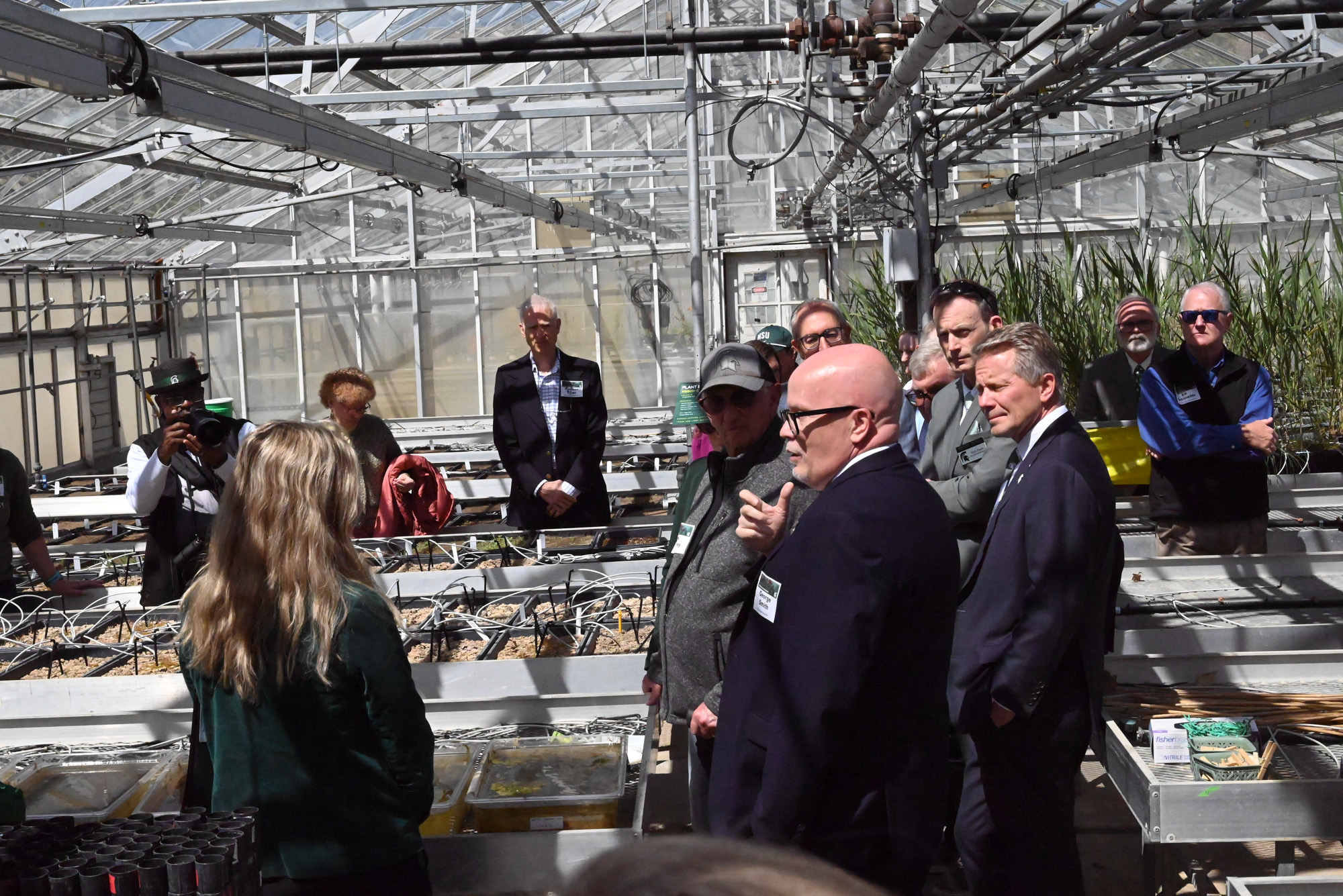
Prior to renovations, two-thirds of the MSU greenhouses had been built before 1980, with the oldest having been built in the 1950s. The improvements being made address issues that MSU scientists have experienced with their research due to aging infrastructure, such as leaky roofs and walls, and an inability to properly control temperature inside greenhouses.