Bulletin E2948
Wildfire-resistant Landscape Plants for Michigan
DOWNLOAD
August 4, 2026 - Mark Hansen, R. Thomas Fernandez, Michael Penskar, Nathaniel Walton
 Print
Print Email
EmailIntroduction
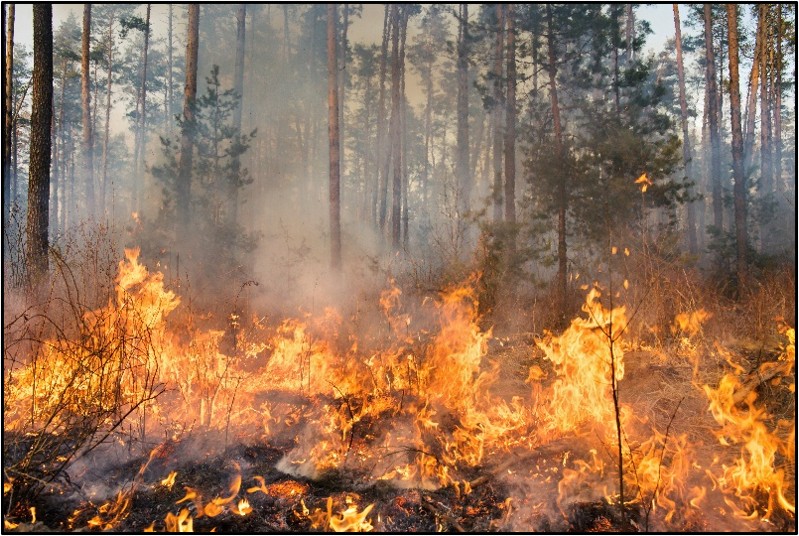
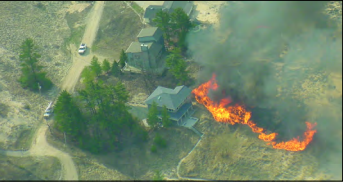
Selecting the correct landscape plants to place next to or near your home could save it from catching fire. When wildfires occur, the fire moves along the ground or through brush or forests by igniting the vegetation or fuels ahead. If flammable vegetation is planted too close to a home or building and the vegetation ignites, it could also ignite the structure. Figure 1 depicts how coniferous trees can ignite and “torch” during a wildfire. If these trees were growing next to a house or building, the structure would surely ignite. This is why it is important to select fire-resistant plants when landscaping around the home.
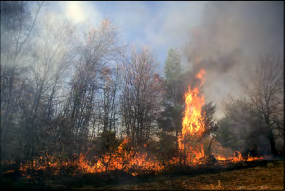
Most Michigan residents are surprised to learn that Michigan experiences as many as 8,000 to 10,000 wildland fires each year. These forest fires, brush fires and grass fires destroy or severely damage 100 to 200 homes, barns and outbuildings annually. This can happen when firebrands (floating embers or pieces of burning debris) land in dry leaves that have collected under decks, around landscape plants and in rain gutters, setting the leaves on fire. Firebrands can also ignite a wood roof. Many structures also catch fire when flames or intense heat from burning vegetation catches the deck or sides of the house on fire. Firefighters at a wildfire in dune grass near Shelby, Michigan, in 2005 (Figure 2) reported flames as high as 20 feet. Two homes were destroyed in the fire, and a number of others had fire damage. In these situations, vegetation planted or allowed to grow too close to the house served as fuel, igniting the wooden stairways, decks and siding.
To help prevent homes and buildings from catching fire — i.e., to make them ”firewise” — simply eliminate these ignition points by creating defensible space around the home. This can be achieved, in part, through proper landscape plant selection and placement. Plants that do not burn easily are less likely to set a building on fire.
Any Plant Can Burn
It is important to understand that any plant can burn if the plant is dry enough or if it is exposed to intense heat long enough. This is true even of plants that are defined as fire-resistant. A fire-resistant plant possesses several characteristics that make it less likely to ignite. For example, conifers and certain other plants contain resins and can ignite even when green; they also produce intense flames and heat. Plants such as maple, dogwood and Michigan holly do not contain such resins. Fire-resistant plants also have foliage and stems that retain moisture, such as hostas. Plants that retain dead leaves or needles, such as juniper, are not considered fire-resistant because these dead plant parts can serve as ignition points or intensify a fire. Fire-resistant landscape plants should be your first choice if you live in a rural area or an urban community bordered by natural vegetation where wildfire is a possible threat.
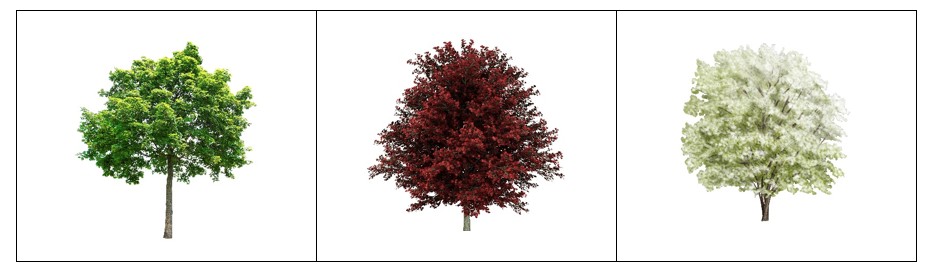
Even before homeowners consider the right trees, shrubs and ground covers, they should look at all landscape issues. For example, a dry lawn can burn and carry a fire to the home or other structure. Lawns should be watered, and dead lawn litter should be raked and either removed from the property or composted. A green lawn will not carry a fire.
Wildfire-resistant Plant Species
The species of trees, shrubs and ground covers in Table 1 are considered wildfire-resistant and are recommended for Michigan's climate. Remember that any plant may burn if the plant tissue becomes very dry and if the vegetation is exposed to intense heat for a period of time. Therefore, no plant is completely fireproof. In addition, some plants containing resins will burn even when green. The term “fire-resistant” in this bulletin refers to plants that will not ignite easily as long as they are alive, green and watered. It does not apply to dead plants or dead leaves and plant debris from these plants.
The plants and trees listed were selected after the authors reviewed and compared 15 fire-resistant plant lists from the United States, Canada and Tasmania. Because basic research where plants were exposed to fire in a laboratory setting is limited, most of the species are listed on the basis of observations of survival after being exposed to real wildfire or structural fire situations. In some cases, an entire genus is listed in the table; in other genera, only selected species are listed. One must also recognize that although the canopy of Quercus species (oak trees) will typically not ignite, dead oak leaves on the ground do not decompose quickly and are very flammable. Oak leaves serve as one of the more common fuel threats in Michigan wildfires. Therefore, it is important to keep oak leaves and other dead leaves, needles and plant debris from collecting around foundations and under decks.
Your local lawn and garden centers may sell or have access to many of the fire-resistant plant species mentioned in this publication. An excellent source of information on local landscape dealers is the MSU Extension office in your county. Both the landscape dealer and the Extension Educator can provide information on growing characteristics, required growing conditions, winter hardiness and planting sites required for various species.
Locating Shrubs and Trees in the Landscape
Where you locate ornamental plants is just as critical as the species selected. Spacing between trees and shrubs is important so that fire cannot jump from a plant to a structure or from one plant to another and finally to your home. Spacing depends on the species selected. It is also important to remember that the distance between two plants will decrease as they grow larger. Space plants according to their mature size, not their size at planting. The spruce trees shown in Figure 3 were planted too close to the home and are now a threat because of direct flames and radiant heat if the trees ignite.
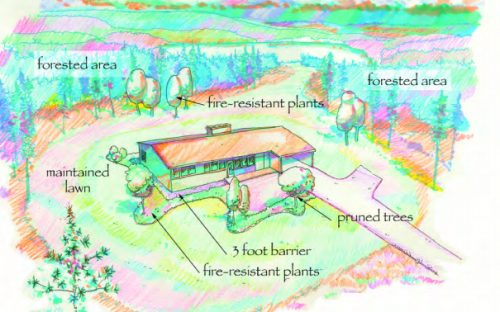
When creating defensible space in the yard, provide a minimum of 3 feet of clearance between the building and landscape plants. Non-flammable landscape material such as limestone, marble chips or even mineral soil can be used in this area. Avoid using organic mulch such as peat or wood chips within the 3-foot barrier. These materials can ignite when dry.
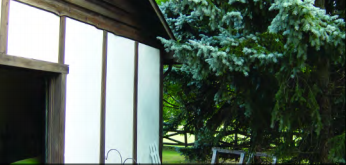
Table – Wildfire-resistance landscape plants for Michigan: Groundcovers
|
Groundcover’s Botanical name |
Groundcover’s Common name |
Winter hardiness zones[1] |
Native to Michigan[2] |
Descriptors |
|---|---|---|---|---|
|
Achillea tomentosa |
Woolly yarrow |
zones 3-7 |
No |
herbaceous perennial |
|
Arctostaphylos uva-ursi |
Kinnikinnick or bearberry |
zones 2-6 |
Yes |
Evergreen |
|
Armeria maritima |
Sea pink thrift |
zones 4-8 |
No |
Herbaceous perennial |
|
Asarum canadense |
Canadian ginger |
zones 3-7 |
Yes |
Herbaceous perennial |
|
Cotoneaster adpressus praecox |
Early cotoneaster |
zones 5-7 |
No |
Deciduous |
|
Epimedium spp. |
Barrenwort |
Most spp in zone 5-9 |
No |
Herbaceous perennial |
|
Festuca cinerea |
Blue fescue |
zones 5-9 |
No |
Herbaceous perennial |
|
Festuca rubra |
Red fescue |
Species and/or cultivar dependent |
Species and/or cultivar dependent |
Herbaceous perennial |
|
Fragaria spp. |
Wild strawberry |
Species and/or cultivar dependent |
Species and/or cultivar dependent |
Perennial |
|
Gaultheria procumbens |
Wintergreen |
zones 4-8 |
No |
Evergreen |
|
Hosta spp. |
Plaintain lily/ hosta lily |
zones 3-9 |
No |
Herbaceous perennial |
|
Iberis sempervirens |
Evergreen candytuft |
zones 3-8 |
No |
Herbaceous perennial |
|
Pachysandra terminalis |
Japanese pachysandra |
zones 4-9 |
No |
Herbaceous perennial |
|
Phlox subulata |
Creeping phlox |
zones 2-8 |
No |
Herbaceous perennial |
|
Potentilla neumanniana |
Spring cinquefoil |
zones 4-7 |
No |
woody perennial |
|
Sedum spathyuifolium |
Stonecrop |
zones 6-9 |
No |
Herbaceous perennial |
|
Thymus praecox |
Mother of thyme |
zones 5-8 |
No |
Herbaceous perennial |
|
Thymus praecox arcticus |
Creeping thyme |
zones 5-8 |
No |
Herbaceous perennial |
|
Thymus pseudolanuginosus |
Woolly thyme |
zones 5-8 |
No |
Herbaceous perennial |
[1] Winter hardiness refers to the ability of the plant to withstand average low winter temperatures. Winter hardiness zones listed in the table refer to the USDA Plant Hardiness Zone Map (see appendix A) which can also be found at https://planthardiness.ars.usda.gov. Other factors will also affect the suitability of a plant for a particular climate, such as heat, humidity, soil characteristics, and water availability.
[2] Michigan’s critical dune guidelines allow only native plants to be used within 100 feet of the crest of a dune. In addition, any alteration on the lake side of the dune requires a permit, including establishing or reestablishing.
Table – Wildfire-resistance landscape plants for Michigan: Perennials
|
Perennial’s Botanical name |
Perennial’s Common name |
Winter hardiness zones[3] |
Native to Michigan[4] |
Descriptors |
|---|---|---|---|---|
|
Achillea filipendulina |
Fernleaf yarrow |
zones 3-8 |
No |
Herbaceous perennial |
|
Achillea millefolium |
White yarrow |
zones 3-9 |
Yes |
Herbaceous perennial |
|
Achillea spp. |
Yarrow |
Species and/or cultivar dependent |
Species and/or cultivar dependent |
Herbaceous perennial |
|
Allium schoenoprasum |
Chives |
zones 4-7 |
Species and/or cultivar dependent |
Herbaceous perennial |
|
Antennaria spp. |
Pussytoes |
Species and/or cultivar dependent |
Species and/or cultivar dependent |
Herbaceous perennial |
|
Aquilegia canadensis |
Columbine |
zones 3-8 |
Yes |
Herbaceous perennial |
|
Arabis alpina |
Rock cress |
zones 5-7 |
No |
Herbaceous perennial |
|
Artemisia caucasica |
Silver spreader or Caucasian sagebrush |
zones 5-9 |
No |
Herbaceous perennial |
|
Aurinia saxatilis |
Basket of gold |
zones 3-7 |
No |
Herbaceous perennial |
|
Bergenia cordifolia |
Heartleaf bergenia |
zones 4-8 |
No |
semi-evergreen herbaceous perennial |
|
Bergenia spp. |
Bergenia |
Species and/or cultivar dependent |
No |
semi-evergreen herbaceous perennial |
|
Campanula poscharskyana |
Serbian bellflower |
zones 3-7 |
No |
Herbaceous perennial |
|
Campanula rotundifolia |
Harebell |
zones 2-7 |
No |
Herbaceous perennial |
|
Carex pensylvanica |
Pennsylvania sedge |
zones 3-8 |
Yes |
Herbaceous perennial |
|
Carex eburnea |
Ivory sedge |
zones 2-8 |
Yes |
Herbaceous perennial |
|
Carex stricta |
Tussock sedge |
zones 3-8 |
Yes |
Herbaceous perennial |
|
Caryopteris x clandonensis |
Blue mist spirea |
zones 5-9 |
No |
herbaceous to woody perennial |
|
Cerastium tomentosum |
Snow in summer |
zones 2-10 |
No |
Herbaceous perennial |
|
Coreopsis auriculata nana |
Dwarf coreopsis |
zones 4-9 |
No |
Herbaceous perennial |
|
Coreopsis spp. |
Coreopsis |
Species and/or cultivar dependent |
Species and/or cultivar dependent |
Herbaceous perennial |
|
Dianthus deltoides |
Maiden pinks |
zones 3-8 |
No |
Herbaceous perennial |
|
Dianthus plumarius |
Pinks |
zones 3-8 |
No |
Herbaceous perennial |
|
Epilobium angustifolium |
Fireweed |
zones 3-7 |
Yes |
Herbaceous perennial |
|
Erigeron hybrids |
Fleabane |
zones 4-7 |
Species and/or cultivar dependent |
Herbaceous perennial |
|
Fragaria chiloensis |
Wild strawberry |
zones 4-8 |
No |
Herbaceous perennial |
|
Gaillardia x grandiflora |
Blanket flower |
zones 2-9 |
No |
Herbaceous perennial |
|
Geranium maculatum |
Wild geranium |
zones 3-11 |
Yes |
Herbaceous perennial |
|
Geranium cinereum |
Hardy geranium |
zones 5-7 |
No |
Herbaceous perennial |
|
Geranium sanguineum |
Blood red geranium |
zones 3-8 |
No |
Herbaceous perennial |
|
Geranium spp. |
Geranium |
zones 3-8 |
Species and/or cultivar dependent |
Most species perennial, some annual |
|
Helianthemum nummularium |
Sunrose |
zones 5-7 |
No |
Mounding |
|
Heuchera sanguinea |
Coral bells |
zones 3-8 |
No |
Herbaceous perennial |
|
Iberis sempervirens |
Candytuft |
zones 3-8 |
No |
Herbaceous perennial |
|
Iris missouriensis |
Wild blue iris |
zones 3-8 |
No |
Herbaceous perennial |
|
Iris virginica |
Southern blue flag iris |
zones 5-9 |
Yes |
Herbaceous perennial |
|
Iris spp. |
Iris |
Species and/or cultivar dependent |
No |
most species perennial, some annual |
|
Lavandula angustifolia |
Lavender |
zones 5-9 |
No |
Herbaceous perennial |
|
Leucanthemum xsuperbum |
Shasta daisy |
zones 4-9 |
No |
Herbaceous perennial |
|
Liriope muscari |
Blue lily-turf |
zones 6-9 |
No |
Herbaceous perennial |
|
Lupinus spp. |
Lupine |
Species and/or cultivar dependent |
Species and/or cultivar dependent |
not strong performers in Michigan |
|
Oenothera macrocarpa |
Evening primrose |
zones 4-7 |
No |
Herbaceous perennial |
|
Oenothera spp. |
Primrose |
Species and/or cultivar dependent |
Species and/or cultivar dependent |
Herbaceous perennial |
|
Papaver spp. |
Poppy |
Species and/or cultivar dependent |
No |
most species perennial, some annual |
|
Penstemon spp. |
Beard tongue |
Species and/or cultivar dependent |
Species and/or cultivar dependent |
most species perennial, some annual |
|
Phlox drummondii |
Creeping phlox |
zones 4-9 |
No |
Herbaceous perennial |
|
Phlox pilosa |
Prairie phlox |
zones 4-9 |
Yes |
Herbaceous perennial |
|
Potentilla spp. |
Potentilla |
Species and/or cultivar dependent |
Species and/or cultivar dependent |
most species perennial, some annual |
|
Salvia spp. |
Sage |
Species and/or cultivar dependent |
No |
most species perennial, some annual |
|
Santolina chamaecyparissus |
Lavender cotton |
zones 6-10 |
No |
Mounding |
|
Sempervivum tectorum |
Hens and chicks |
zones 3-7 |
No |
Herbaceous perennial |
|
Solidago spp. |
Goldenrod |
Species and/or cultivar dependent |
Species and/or cultivar dependent |
Herbaceous perennial |
|
Stachys byzantina |
Lamb's ear |
zones 4-7 |
No |
Herbaceous perennial |
|
Thymus praecox arcticus |
Creeping thyme |
zones 5-8 |
No |
Herbaceous perennial |
[3] Winter hardiness refers to the ability of the plant to withstand average low winter temperatures. Winter hardiness zones listed in the table refer to the USDA Plant Hardiness Zone Map (see appendix A) which can also be found at https://planthardiness.ars.usda.gov. Other factors will also affect the suitability of a plant for a particular climate, such as heat, humidity, soil characteristics, and water availability.
[4] Michigan’s critical dune guidelines allow only native plants to be used within 100 feet of the crest of a dune. In addition, any alteration on the lake side of the dune requires a permit, including establishing or reestablishing.
Table – Wildfire-resistance landscape plants for Michigan: Shrubs
|
Shrub’s Botanical name |
Shrub’s Common name |
Winter hardiness zones[5] |
Native to Michigan[6] |
Descriptors |
|---|---|---|---|---|
|
Amelanchier alnifolia |
Alder-leaved serviceberry |
zones 4-5 |
No |
deciduous, also small tree |
|
Amelanchier spp. |
Serviceberry |
zones 4-9 |
Species and/or cultivar dependent |
deciduous, also small tree |
|
Arctostaphylos uva-ursi |
Bearberry |
zones 2 - 6 |
Yes |
creeping shrub |
|
Aronia arbutifolia |
Red chokeberry |
zones 5-8 |
No |
deciduous, also small tree |
|
Aronia melanocarpa |
Black chokeberry |
zones 3-8 |
Yes |
deciduous |
|
Chaenomeles speciosa |
Flowering quince |
zones 4-8 |
No |
deciduous |
|
Clethra alnifolia |
Summersweet |
zones 4-9 |
No |
deciduous |
|
Cornus sericea |
Yellowtwig dogwood/ red osier dogwood |
zones 2-8 |
No |
deciduous |
|
Corylus avellana |
European filbert |
zones 4-8 |
No |
deciduous, also small tree |
|
Corylus americana |
American hazelnut |
zones 4-9 |
Yes |
deciduous |
|
Cotinus coggygria |
Royal purple smoketree |
zones 5-8 |
No |
deciduous |
|
Cotoneaster apiculatus |
Cranberry cotoneaster |
zones 4-7 |
No |
deciduous |
|
Cotoneaster divaricatus |
Spreading cotoneaster |
zones 4-7 |
No |
deciduous |
|
Cotoneaster horizontalis |
Rock cotoneaster |
zones 5-7 |
No |
deciduous |
|
Cotoneaster spp. |
Cotoneaster |
Species and/or cultivar dependent |
No |
Species and/or cultivar dependent |
|
Daphne xburkwoodii |
Burkwood daphne |
zones 4-7 |
No |
semi-evergreen |
|
Deutzia gracilis |
Slender deutzia |
zones 4-8 |
No |
deciduous |
|
Forsythia xintermedia |
Lynwood border forsythia |
zones 5-8 |
No |
deciduous |
|
Hibiscus syriacus |
Rose of Sharon |
zones 5-8 |
No |
deciduous, also small tree |
|
Hydrangea macrophylla |
Bigleaf Hydrangea |
zones 5-8 |
No |
deciduous |
|
Hydrangea quercifolia |
Oakleaf hydrangea |
zones 5-9 |
No |
deciduous |
|
Ilex verticillata |
Michigan holly |
zones 3-9 |
Yes |
deciduous |
|
Mahonia repens |
Creeping mahonia |
zones 5-7 |
No |
evergreen, also ground cover |
|
Mahonia spp. |
Creeping grape holly |
Species and/or cultivar dependent |
No |
evergreen |
|
Myrica pensylvanica |
Northern bayberry |
zones 3-6 |
No |
Deciduous |
|
Philadelphus spp. |
Mock orange |
Species and/or cultivar dependent |
No |
deciduous |
|
Potentilla fruticosa |
Shrubby cinquefoil |
zones 2-6 |
Yes |
deciduous |
|
Prunus americana |
Native plum |
zones 3-8 |
Yes |
deciduous, also small tree |
|
Prunus besseyi |
Sand cherry |
zones 3-6 |
No |
deciduous |
|
Prunus tomentosa |
Nanking cherry |
zones 3-7 |
No |
deciduous |
|
Pyrancantha spp. |
Pyracantha |
Species and/or cultivar dependent |
No |
can have fireblight problems on more vigorous selections |
|
Rhus spp. |
Sumac |
Species and/or cultivar dependent |
Species and/or cultivar dependent |
Species and/or cultivar dependent |
|
Ribes alpinum |
Green mound Alpine currant |
zones 2-7 |
No |
deciduous |
|
Rosa carolina |
Carolina rose |
zones 4-9 |
Yes |
deciduous |
|
Rosa wichuriana |
Memorial rose |
zones 5-8 |
No |
semi-evergreen |
|
Rubus spp. |
Raspberry |
Species and/or cultivar dependent |
Species and/or cultivar dependent |
deciduous |
|
Sheperdia canadensis |
Russet buffaloberry |
zones 2-6 |
Yes |
deciduous |
|
Shepherdia argentea |
Silver buffaloberry |
zones 2-6 |
No |
deciduous, also small tree |
|
Spiraea japonica |
Daphne spiraea |
zones 4-8 |
No |
deciduous |
|
Spiraea nipponica |
Snowmound Nippon spiraea |
zones 4-8 |
No |
deciduous |
|
Spiraea xvanhouttei |
Vanhoutte spiraea |
zones 3-8 |
No |
deciduous |
|
Symphoricarpos albus |
Snowberry |
zones 3-7 |
Yes |
deciduous |
|
Syringa spp. |
Lilac |
Species and/or cultivar dependent |
No |
deciduous |
|
Syringa vulgaris |
Common lilac |
zones 3-7 |
No |
deciduous |
|
Syringa xprestoniae |
Preston lilac |
zones 3-7 |
No |
deciduous |
|
Viburnum trilobum |
American cranberrybush viburnum |
zones 2-7 |
Yes |
deciduous |
|
Viburnum trilobum 'Compactum' |
Dwarf American cranberrybush viburnum |
zones 2-7 |
No |
deciduous |
|
Viburnum carlesii |
Korean spice viburnum |
zones 4-8 |
No |
deciduous |
|
Viburnum dentatum |
Arrowwood viburnum |
zones 2-8 |
No |
deciduous |
|
Viburnum lentago |
Nannyberry |
zones 3-7 |
Yes |
deciduous |
|
Viburnum plicatum var. tomentosum |
Doublefile viburnum |
zones 5-8 |
No |
deciduous |
|
Viburnum prunifolium |
Blackhawk viburnum |
zones 3-9 |
Yes |
deciduous |
|
Viburnum xburkwoodii |
Burkwood viburnum |
zones 5-8 |
No |
deciduous |
|
Viburnum xrhytidophylloides |
Willowwood or Allegheny viburnum |
zones 5-8 |
No |
deciduous |
|
Weigela florida |
Old fashioned weigela |
zones 5-8 |
No |
deciduous |
[5] Winter hardiness refers to the ability of the plant to withstand average low winter temperatures. Winter hardiness zones listed in the table refer to the USDA Plant Hardiness Zone Map (see appendix A) which can also be found at https://planthardiness.ars.usda.gov. Other factors will also affect the suitability of a plant for a particular climate, such as heat, humidity, soil characteristics, and water availability.
[6] Michigan’s critical dune guidelines allow only native plants to be used within 100 feet of the crest of a dune. In addition, any alteration on the lake side of the dune requires a permit, including establishing or reestablishing.
Table – Wildfire-resistance landscape plants for Michigan: Trees
|
Tree’s Botanical name |
Tree’s Common name |
Winter hardiness zones[7] |
Native to Michigan[8] |
Descriptors |
|---|---|---|---|---|
|
Acer campestre |
Hedge maple |
zones 4-8 |
No |
deciduous |
|
Acer griseum |
Paperbark maple |
zones 5-7 |
No |
deciduous |
|
Acer palmatum |
Japanese maple |
Species and/or cultivar dependent |
No |
deciduous |
|
Acer rubrum |
Red maple |
Species and/or cultivar dependent |
Yes |
deciduous |
|
Acer saccharum |
Green Mountain sugar maple |
zones 4-8 |
Yes |
deciduous |
|
Acer spp. |
Maple |
Species and/or cultivar dependent |
Species and/or cultivar dependent |
deciduous |
|
Aesculus hippocastanum |
Horsechestnut |
zones 4-7 |
No |
deciduous |
|
Alnus cordata |
Italian alder |
zones 5-7 |
No |
deciduous |
|
Betula nigra |
River birch |
zones 3-9 |
No |
deciduous |
|
Carpinus betulus |
Upright European hornbeam |
zones 4-7 |
No |
deciduous |
|
Catalpa speciosa |
Northern catalpa |
zones 4-8 |
Yes |
deciduous |
|
Celtis occidentalis |
Common hackberry |
zones 2-9 |
Yes |
deciduous |
|
Cercis canadensis |
Eastern redbud |
zones 5-9; best from local seed source |
Yes |
deciduous |
|
Cornus florida |
Flowering dogwood |
zones 5-8; best from local seed source |
Yes |
deciduous |
|
Crataegus phaenopyrum |
Washington hawthorn |
zones 4-8 |
No |
deciduous |
|
Crataegus spp. |
Hawthorn |
zones 4-7 |
Species and/or cultivar dependent |
deciduous |
|
Fagus spp. |
Beech |
Species and/or cultivar dependent |
Species and/or cultivar dependent |
deciduous |
|
Fagus sylvatica |
European beech |
zones 4-7 |
No |
deciduous |
|
Gleditsia triacanthos |
Honeylocust |
zones 4-9 |
Species and/or cultivar dependent |
deciduous |
|
Gymnocladus dioicus |
Kentucky coffee tree |
zones 3-8 |
Yes |
deciduous |
|
Juglans spp. |
Walnut |
zones 4-7 |
Yes |
deciduous |
|
Liquidambar styraciflua |
American sweetgum |
zones 5-9 |
No |
deciduous |
|
Liriodendron tulipifera |
Tulip tree |
zones 4-9 |
Yes |
deciduous |
|
Magnolia stellata |
Star magnolia |
zones 4-9 |
No |
deciduous |
|
Magnolia xsoulangiana |
Saucer magnolia |
zones 4-9 |
No |
deciduous |
|
Malus spp. |
Crabapple |
Species and/or cultivar dependent |
Species and/or cultivar dependent |
deciduous |
|
Nyssa sylvatica |
Black gum |
zones 4-9 |
Yes |
deciduous |
|
Plantanus occidentalis |
Eastern sycamore |
zones 4-9 |
Yes |
deciduous |
|
Platanus xacerifolia |
London planetree |
zones 4-8 |
No |
deciduous |
|
Populus spp. |
Aspens, cottonwoods, poplars |
Species and/or cultivar dependent |
Species and/or cultivar dependent |
deciduous |
|
Populus tremuloides |
Quaking aspen |
zones 1-6 |
Yes |
deciduous |
|
Prunus cerasifera 'Atropurpurea' |
Flowering plum |
zones 5-8 |
No |
deciduous |
|
Prunus serrulata |
Kwanzan Oriental cherry |
zones 5-7 |
No |
deciduous |
|
Prunus subhirtella |
Higan cherry |
zone 5-8 |
No |
deciduous |
|
Prunus virginiana |
Chokecherry |
zones 2-6 |
Yes |
deciduous |
|
Prunus xyedoensis |
Yoshino cherry |
zones 5-8 |
No |
deciduous |
|
Quercus alba |
White oak |
zones 3-9 |
Yes |
deciduous |
|
Quercus macrocarpa |
Bur oak |
zones 3-8 |
Yes |
deciduous |
|
Quercus rubra |
Red oak |
zones 3-7 |
Yes |
deciduous |
|
Quercus spp. |
Oak |
Species and/or cultivar dependent |
Species and/or cultivar dependent |
deciduous |
|
Salix spp. |
Willow |
Species and/or cultivar dependent |
Species and/or cultivar dependent |
deciduous |
|
Sorbus aucuparia |
European Mountain ash |
zones 3-7 |
No |
deciduous, several pest problems |
[7] Winter hardiness refers to the ability of the plant to withstand average low winter temperatures. Winter hardiness zones listed in the table refer to the USDA Plant Hardiness Zone Map (see appendix A) which can also be found at https://planthardiness.ars.usda.gov. Other factors will also affect the suitability of a plant for a particular climate, such as heat, humidity, soil characteristics, and water availability.
[8] Michigan’s critical dune guidelines allow only native plants to be used within 100 feet of the crest of a dune. In addition, any alteration on the lake side of the dune requires a permit, including establishing or reestablishing.
Table – Wildfire-resistance landscape plants for Michigan: Vines
|
Vine’s Botanical name |
Vine’s Common name |
Winter hardiness zones[9] |
Native to Michigan[10] |
Descriptors |
|---|---|---|---|---|
|
Clematis hybrids |
Clematis |
Species and/or cultivar dependent |
No |
deciduous |
|
Lonicera sempervirens |
Trumpet honeysuckle |
zones 4-9 |
No |
deciduous |
|
Lonicera xheckrottii |
Goldflame honeysuckle |
zones 4-9 |
No |
semi-evergreen |
|
Parthenocissus quinquefolia |
Virginia creeper |
zones 4-9 |
Yes |
deciduous |
[9] Winter hardiness refers to the ability of the plant to withstand average low winter temperatures. Winter hardiness zones listed in the table refer to the USDA Plant Hardiness Zone Map (see appendix A) which can also be found at https://planthardiness.ars.usda.gov. Other factors will also affect the suitability of a plant for a particular climate, such as heat, humidity, soil characteristics, and water availability.
[10] Michigan’s critical dune guidelines allow only native plants to be used within 100 feet of the crest of a dune. In addition, any alteration on the lake side of the dune requires a permit, including establishing or reestablishing.
Leave at least 30 feet of defensible space between the building and solid stands of natural vegetation. Studies from two major wildfires in the western United States have shown that 85 to 90 percent of homes that survived those wildfires had 30 to 50 feet of defensible space and fire-resistant roofing materials. Liquid propane tanks, stacks of firewood and other potential fuels should also be located outside of this perimeter.
Houses and structures built at the crest of a hill should have 60 feet of defensible space because fire traveling uphill will move faster, be more intense and radiate more heat than a wildfire moving on level ground.
The term “ladder fuels” describes low-hanging branches and limbs that could catch fire from a wildfire moving across the ground. If the tree is combustible, such as a spruce or pine, the fire will ignite the lower branches and move upward. Should this happen, the radiant heat given off could set a nearby house or building on fire. Remove limbs and branches of combustible ornamental landscape trees within 6 to 8 feet of the ground so that fire cannot move from the ground to the lower branches of the tree and then into the canopy.
When you're planting any tree or shrub, it is important to match the species with the conditions in the planting site. Some species may grow better in sandy soils than in heavy clay soils. Some will do better than others in poorly drained areas. Other species may do better in the sun than in the shade. This information is often included on a tag attached to the tree or shrub at the garden center. If there is no tag, ask an informed employee about the preferred environment before purchasing. Again, your local Extension office will likely have this information as well. To obtain more information on planting landscape plants, visit the Gardening in Michigan website (MIgarden.msu.edu).
Maintaining the Yard and Shrubbery
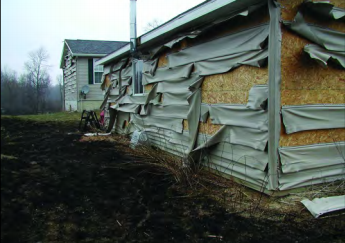
If the landscape is not maintained properly, a wildfire can move across the yard and ignite a home and other structures. To decrease this possibility, keep your lawn mowed and watered. A green lawn is unlikely to catch fire and will typically serve as a protective barrier around the home. On the other hand, a yard that is managed in natural vegetation or a lawn that has become very dry could allow a wildfire to move across it and pose a danger of igniting a deck or wood siding and then the house. The home and garage shown in Figure 4 were damaged because tall grass was allowed to grow too close to the structures.
It is also important to provide adequate water for newly planted trees and shrubs. Once these plants have grown and have established extensive root systems, they should usually be able to absorb sufficient nutrients from the soil and from lawn fertilizers. Regular watering will still be necessary, however, to reduce the possibility of ignition. Ornamental plants may or may not need special fertilization. This can be determined by a soil test, which is available through your local Extension office (https://www.canr.msu.edu/outreach/county) or through the MSU Extension Bookstore (https://spartanspiritshop.msu.edu/).
Summary
Each year in Michigan, wildfires damage or destroy homes and other structures. A firewise home requires adequate defensible space, fire-resistant building materials, and rain gutters and spaces around and under the base of the home kept clean of accumulated plant litter and debris. Firewise homeowners also place other fuels such as LP tanks and firewood stacks at a safe distance from the home (Figure 5). Adding fire-resistant plants and pruning trees can greatly increase the chances that a home or outbuilding will still be standing after a wildfire passes, while also providing the esthetics that the homeowner desires.
An illustration showing how to landscape around a home to reduce wildfire damage.
Authors
This publication was developed in collaboration by:
Mark F. Hansen, MSU Extension, Michigan State University
Thomas Fernandez, Department of Horticulture, Michigan State University
Michael R. Penskar, Michigan Natural Features Inventory, MSU Extension, Michigan State University
Nathaniel J. Walton, MSU Extension, Michigan State University
To find contact information for authors or other MSU Extension experts use this web page: https://www.canr.msu.edu/outreach/experts/.
This publication was funded and done in cooperation with Michigan Dept. of Natural Resources and the USDA Forest Service.
Appendix A – Supporting Resources
- Firewise USA firewise.org
- Firewise Plant Materials https://extension.colostate.edu/resource/firewise-plant-materials/
- Firewise Maryland https://dnr.maryland.gov/forests/pages/fire/firewise.aspx
- Protecting and Landscaping Homes in the Wildland/Urban Interface https://www.uidaho.edu/extension/publications/sb-0067
- Fire-Resistant Plants for Home Landscapes https://extension.oregonstate.edu/catalog/pub/pnw-590-fire-resistant-plants-home-landscapes
- Fire Resistant Landscaping for Your Home https://firesmartalberta.ca/wp-content/uploads/2023/09/Fire-Resistant-Landscaping-for-Your-Home.pdf
- USDA Plant Hardiness Zone Map https://planthardiness.ars.usda.gov