Shepherd’s purse
September 4, 2015
Capsella bursa-pastoris (L.) Medicus
Life cycle
Erect winter or summer annual.
Leaves
Leaves initially develop from a basal rosette. Basal leaves are stalked and highly variable in shape; young leaves are first rounded and elongated, becoming variously lobed, toothed to wavy. Smaller stem leaves are alternate with smooth to toothed margins and clasping bases.
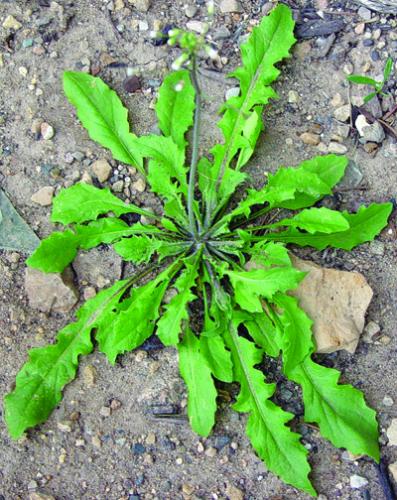
Shepherd’s purse rosette.
Stems
Erect, slender, hairy, up to 2-foot-tall stems bolt from a basal rosette to flower. Flower stems are usually unbranched with few to no leaves.
Flowers and fruit
White flowers with four small petals are found in terminal clusters. Fruit are distinctly heart-shaped to triangular pods found on elongated, unbranched stems.
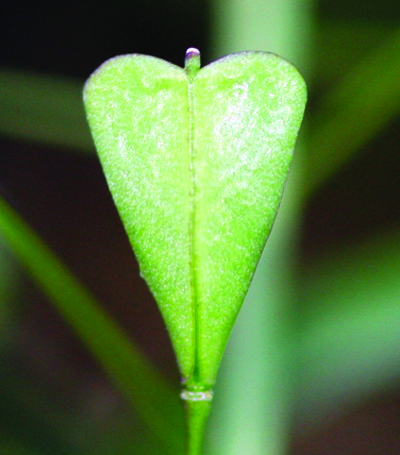
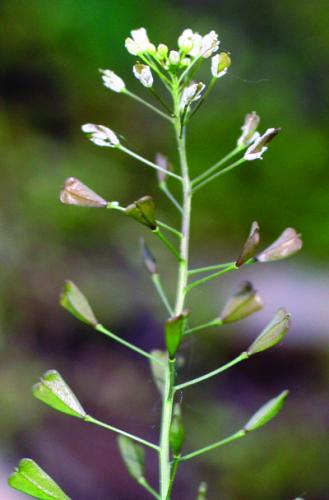
Shepherd’s purse fruit (left) and flowering cluster (right).
Reproduction
Seeds.
Print a PDF of this page: Shepherd’s purse
Other Documents in this Series
You Might Also Be Interested In
-
MSU research team receives USDA grant to evaluate effectiveness, cost of new blueberry pest management strategies
Published on February 19, 2021
-
MSU named Top 10 agriculture and forestry college in new report
Published on March 23, 2021
-
Tools for Assessing Economic Impact: A Primer for Food System Practitioners
Published on July 11, 2017
-
Economic Impacts of Local and Regional Food Systems: Response to Questions from May 20, 2013 Webinar
Published on August 5, 2013
-
Farmers Markets as Engines of Economic Activity: Power in Numbers
Published on September 14, 2017
-
Economic Analysis of Local and Regional Food Systems Webinar
Published on May 20, 2013
Accessibility Questions:
For questions about accessibility and/or if you need additional accommodations for a specific document, please send an email to ANR Communications & Marketing at anrcommunications@anr.msu.edu.