Horseweed (marestail)
August 10, 2015
 Print
Print Email
EmailConyza canadensis (L.) Cronq.
Life cycle
Erect winter or summer annual.
Leaves
Cotyledons are egg- to spatula-shaped and hairless. Seedling leaves initially develop from a basal rosette; mature leaves are alternate and numerous, and crowded along an erect central stem. Leaves are hairy and linear to lance-shaped with smooth to toothed margins, gradually becoming smaller toward the top of the plant.
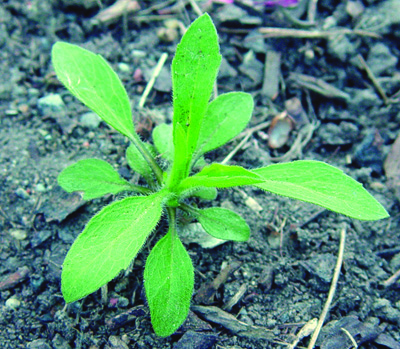
Horseweed rosette.
Stems
Erect, hairy central stem arises from a basal rosette, then branches to flower, reaching up to 7 feet tall. Flowering branches resemble a horse’s tail.
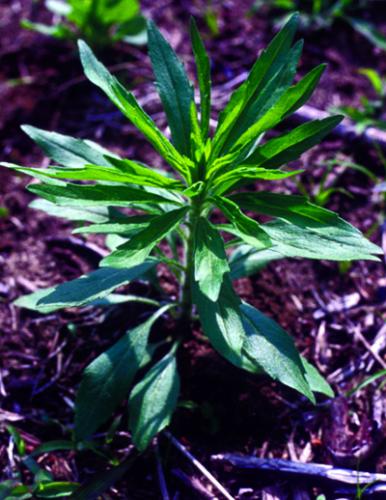
Erect central stem of horseweed.
Flowers and fruit
Numerous clusters of small, white flower heads are found on many short branches near the top. Each seedhead is capable of producing thousands of small seeds; each seed is enclosed in a single-seeded, wind-disseminated fruit.
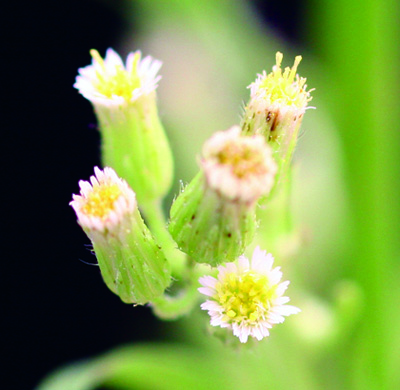
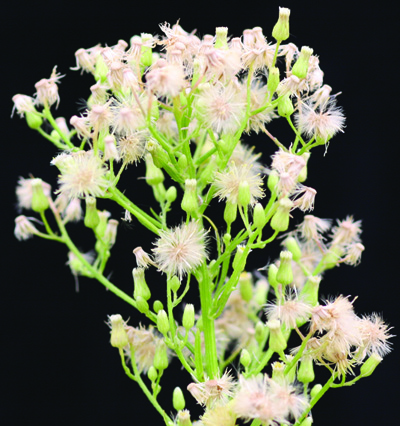
Horseweed flowers (left), and seedhead (right).
Reproduction
Seeds.
Print a PDF of this page: Horseweed (marestail)