Flint: Martin Park Neighborhood Revitalization Plan
DOWNLOADSeptember 21, 2026 - Steven Crawley, Jackson Frisinger, Ava Woodward, Ankita Shukla, Ryan Shields, John Benedetto, Sydney Schewe, Lucas Claborn, Poorna Vemulakonda, Emma Borgens, Jared Surian, Ryan Jessar
 Print
Print Email
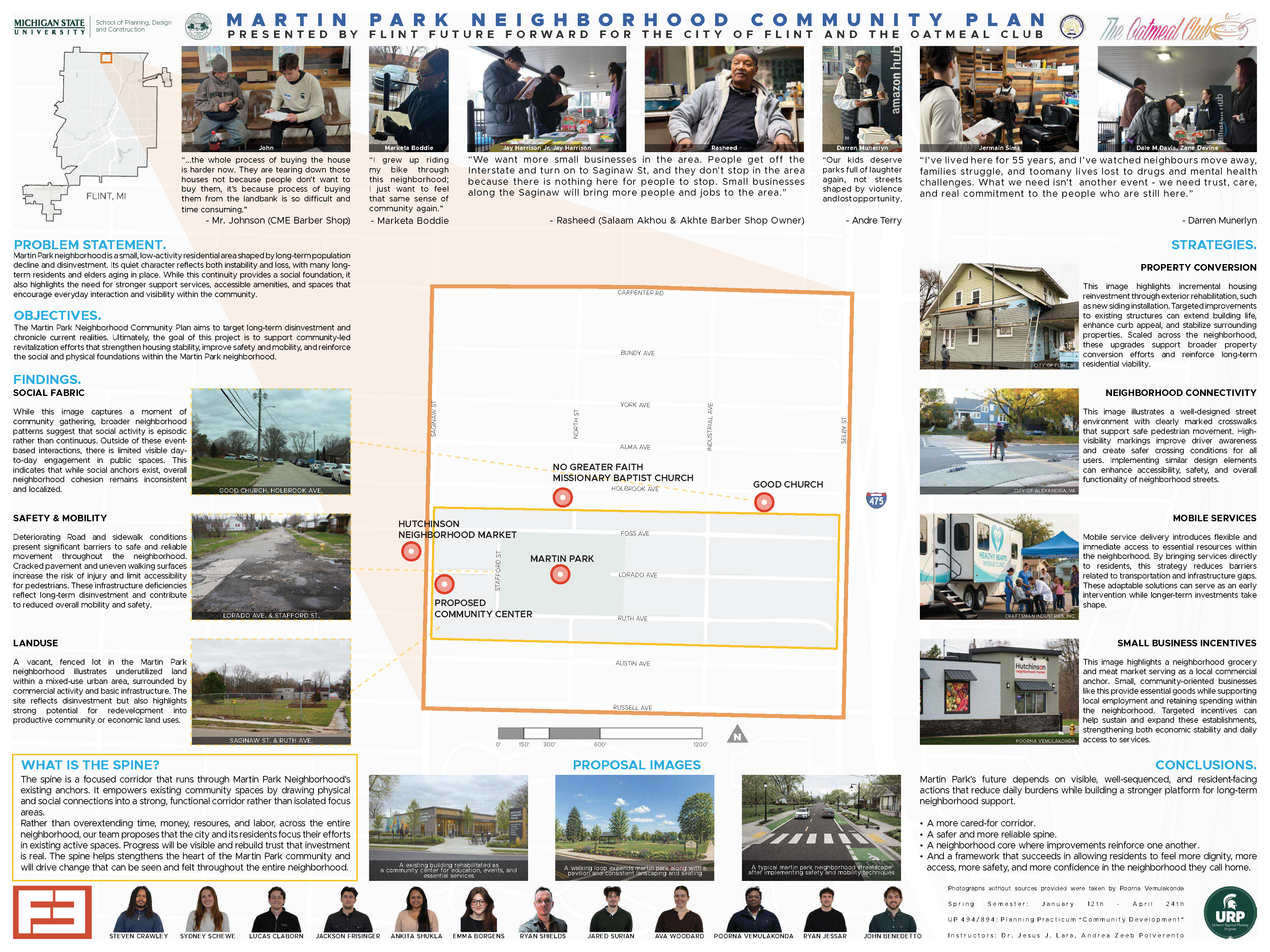
EmailThis project was developed in partnership with the City of Flint, Martin Park residents, local businesses, and The Oatmeal Club to address long-term disinvestment in the Martin Park neighborhood. The purpose of the project was to evaluate existing neighborhood conditions, identify resident priorities, and develop a practical plan to improve quality of life. Martin Park is located near downtown Flint and a major corridor, yet the neighborhood continues to face visible vacancy, aging housing, limited access to everyday services, and unsafe walking conditions. Rather than assuming large-scale redevelopment will occur all at once, the plan focuses on realistic, visible improvements that can strengthen safety, services, and neighborhood stability over time.
The Flint Future Forward team used a combination of field observations, survey material, spatial and demographic analysis, and community engagement to understand both physical conditions and lived experience. Our qualitative analysis documented housing decline, weak pedestrian conditions, and limited access to services, while our quantitative analysis confirmed broader patterns related to population change, land use, mobility, and neighborhood constraint. Community outreach, intercept surveys, and stakeholder conversations reinforced these findings and also highlighted concerns related to substance use, rising insurance costs, limited neighborhood services, and the need for stronger support systems and long-term stewardship.
Several key findings shaped the direction of the plan. First, vacancy and deteriorating structures remain some of the most visible signs of neighborhood distress. Second, safety and mobility are major concerns, with broken sidewalks, poor lighting, limited crossings, and weak pedestrian connections affecting how residents move through the neighborhood. Third, residents expressed the need for more youth programming, family activities, neighborhood businesses, and accessible community services. Together, these findings made clear that Martin Park’s challenges are interconnected and cannot be solved through isolated projects alone. Long-term recovery depends not only on physical improvements, but also on rebuilding the conditions that support community life, local activity, and social support systems.
In response, the team developed a concept plan informed by local conditions and precedent studies of neighborhoods facing similar patterns of disinvestment, infrastructure decline, and limited formal support systems. The plan established both a physical and strategic framework for revitalization, centered around a visible neighborhood core anchored by Martin Park, Hutchinson Market, nearby churches, and a spine running from Saginaw Street on the west to Selby Street on the east, between Foss and Ruth Avenue. Rather than spreading limited resources across the entire neighborhood, the plan focuses investment where challenges
overlap so that improvements can reinforce one another. Within this framework, four priorities guide the revitalization strategy: improving access to services through mobile and flexible delivery models, stabilizing vacant and underused properties, supporting neighborhood-scale economic activity, and improving safe connectivity throughout the area.