East Lansing: East Village Concept Plan
DOWNLOADSeptember 21, 2026 - Rachel Oelsner, Jack Shannon, Evan Stowell, Ben Hamrick, Clinton E. Mireles, Youssef El Hout, Nahid Ferdous Dristy, Terry Smith, Luke Dillon, Evan Blake, Max Levinson, Emma Lacross
 Print
Print Email
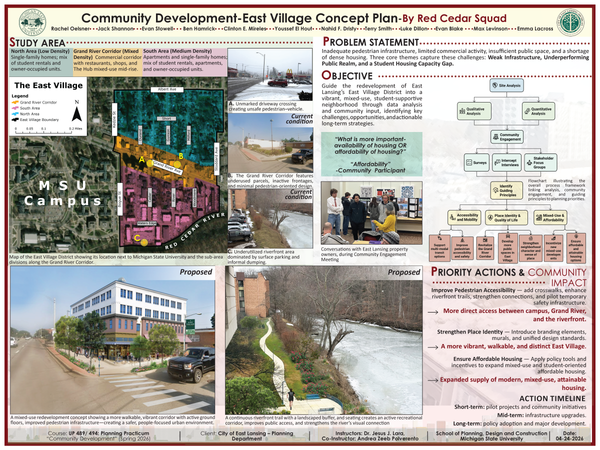
EmailThe East Village district faces three critical challenges: a student housing capacity gap, weak infrastructure, and an underutilized public realm. These findings were realized throughout a multi-phased research process involving site visits, informal interviews, demographic data, and thorough community engagement. To address these issues, this report prioritizes four recommendations: (1) improve pedestrian accessibility and safety, (2) revitalize the Grand River corridor through mixed-use development and public realm activation, (3) add character to East Village through enhanced public spaces and placemaking, and (4) expand attainable housing options to meet growing demand.
This project was conducted in partnership with the City of East Lansing to evaluate existing conditions and develop actionable strategies for transforming East Village into a more livable and vibrant district. The study used site analysis, spatial analysis, and community engagement—including surveys, intercept interviews, and stakeholder discussions—to identify key challenges and opportunities.
Findings show that limited pedestrian connectivity, inactive streetscapes, and insufficient housing supply reduce accessibility, safety, and overall quality of life. In response, this plan identifies three guiding principles: Access & Mobility, Place Identity & Quality of Life, Mixed Use & Affordability—which inform seven planning priorities that directly respond to the data and resident experience we learned during our research phases. Each planning priority has a dedicated timeline with actionable recommendations that use a variety of planning tools, including zoning amendments, public-private partnerships, and a new neighborhood committee.
The report recommends targeted investments in pedestrian infrastructure, streetscape improvements along Grand River, activation of public spaces to strengthen neighborhood identity, and policies that support higher-density mixed-use development with affordable housing. Together, these strategies provide a clear, implementation-oriented framework to guide future development and position East Village as a walkable, inclusive, and economically active district.
East Village can be the mixed-use, walkable, vibrant community residents desire. Based on our research and community engagement, this strategic framework can achieve these goals and make East Village a neighborhood where students, longtime residents, and business owners can thrive.
This report is designed to be a strategic framework for planning purposes. While many community members are familiar with the ideas and concepts presented in this document, the intention of this document is to provide research on East Village and data about transportation patterns, current conditions of the built environment, and public opinions on different development styles and economic revitalization strategies. Our recommendations work as a guideline for professional committees and government departments to directly act on, as well as to begin further research and later actions.