


Research
Research Overview
At APEX Lab, we work on packaging problems that don't have easy answers. Our focus is sustainable plastics, paper, and hybrid packaging systems — approached by combining materials science, engineering, and AI-driven tools to move faster from discovery to real-world impact.
We've built this program through collaboration: with Fortune 500 companies across the packaging value chain, U.S. national laboratories, and research universities nationwide. That network, combined with sustained federal funding from NSF, USDA, DOE, and EPA, means our research is grounded in what industry actually needs and what federal priorities demand.
Our work spans six research thrusts — restoring the performance of recovered plastics, developing recyclable high-barrier packaging, eliminating PFAS from paper and hybrid systems, enabling compostable packaging that performs at scale, advancing bio-based materials, and developing active packaging systems. Across all six, machine learning is integrated as a practical tool: reducing experimental cost, predicting outcomes earlier, and accelerating translation to manufacturing.
110+Peer-reviewed publications |
70+U.S. & international patents |
40+Undergraduate researchers trained |
|---|
🔗 Publications & citations (Google Scholar):
https://scholar.google.com/citations?user=marn2rMAAAAJ
🔗 NSF IUCRC Center for Circular Packaging (C3PS):
https://c3ps.org/
🔗 MSU Faculty Profile:
https://www.canr.msu.edu/people/rabnawaz
🔗 Media & Research News:
https://www.canr.msu.edu/rabnawaz/news
Machine Learning as a Core Research Tool
Across all six research thrusts, machine learning is a critical feature — it is how we compress timelines. Physical sample fabrication and barrier testing can take months per iteration. We use ML to front-load the decision-making: structure-property models predict barrier performance before synthesis, contamination tolerance models define acceptable input ranges before trials run, and degradation kinetics models estimate composting behavior before field studies begin. This approach routinely reduces experimental cycles.
Six Research Thrusts — Overview
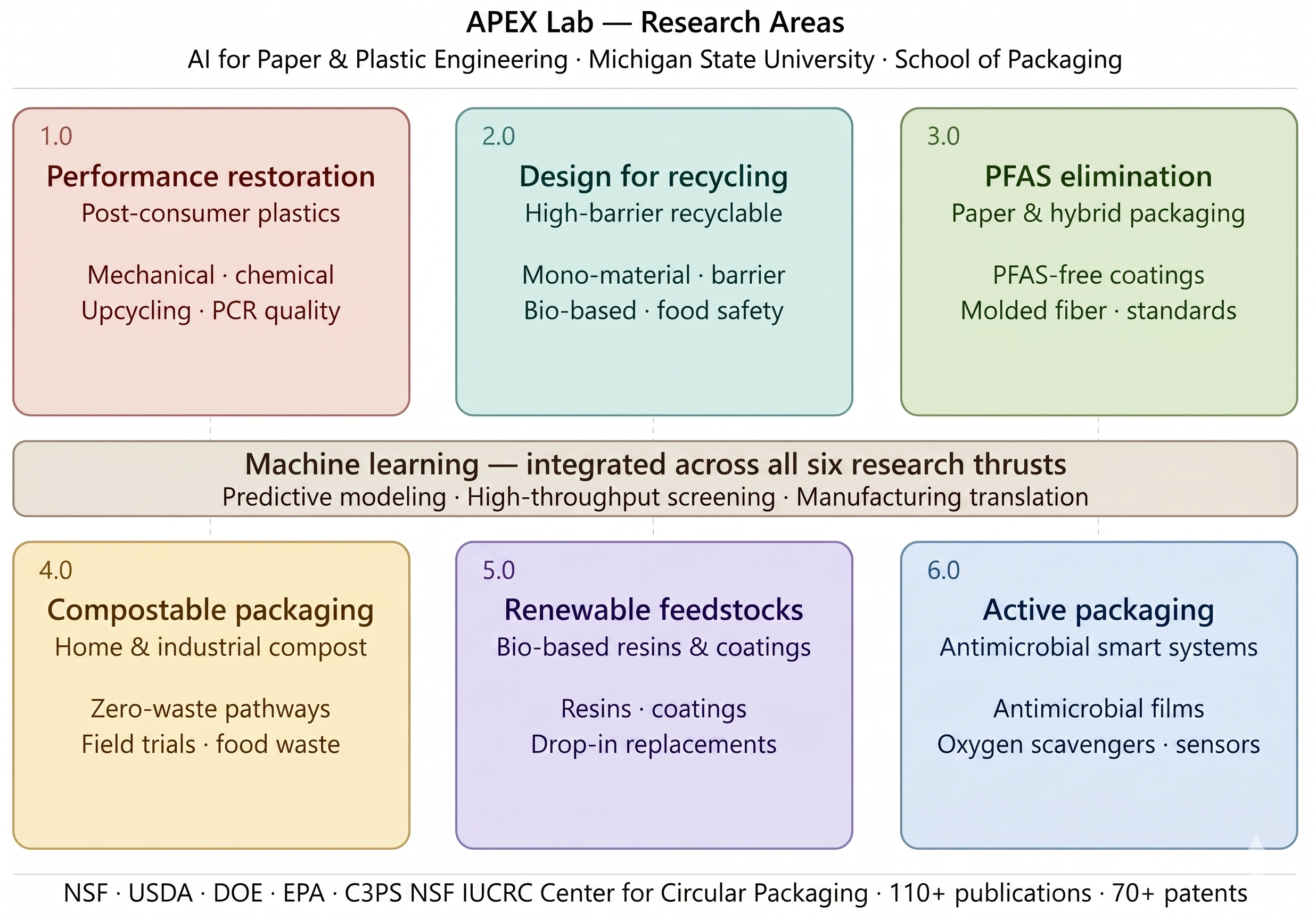
1.0 — Post-Consumer Plastic Recycling: Performance Restoration
Recovered plastic degrades mechanically and chemically with each processing cycle. Contamination — residual food, adhesives, incompatible polymers — compounds the problem. The result is PCR material with unpredictable properties and limited end-use options, which drives down economic value and limits recycled content adoption. We develop processing routes and additive strategies that restore the performance of mechanically recycled plastics, and define quantitative contamination tolerance thresholds for specific recycling streams. For flexible packaging that can't be mechanically recycled, we develop alternative chemical and upcycling routes with viable economics.
🔗 Media highlights:
- The quest to recycle the unrecyclable (MSU Today)
- Table salt could improve plastic recycling (ChemEurope, Sustainable Plastics, WLNS)
2.0 — High-Barrier Recyclable Packaging: Design for Recycling
Achieving high oxygen and moisture barrier in flexible packaging has historically required multi-material laminates — structures that protect the product well but cannot be recycled in any existing stream. The industry is being asked to abandon that trade-off without a viable alternative. We develop mono-material packaging structures — single-polymer systems with engineered coatings or surface treatments — that meet real barrier requirements for food and pharmaceutical applications while remaining sortable and recyclable in existing infrastructure.
🔗 Selected news coverage:
- MSU researchers develop recyclable solution for multilayer plastics (MSU Today)
- All-polyolefin high-barrier recyclable films (Packaging Strategies) MSU Researchers Develop Recyclable Solution for Multilayer Plastics | Packaging Strategies
- All polyester recyclable films: Researchers develop easier-to-recycle multilayer plastics | MSUToday | Michigan State University
3.0 — Paper and Paper-Hybrid Packaging: PFAS Elimination
PFAS-based and polymer coatings have been the default solution for grease and moisture resistance in paper packaging for decades. Regulatory bans are now in effect or imminent across multiple jurisdictions, and industry needs replacements that perform to the same standard, survive recycling and composting streams, and can be adopted at commercial cost. We develop PFAS-free coating and additive systems for paper packaging, coated boards, and molded fiber that meet functional performance requirements without sacrificing recyclability or compostability. We also develop updated test methods for coated papers, because existing standard protocols were not designed for the material systems now entering the market.
🔗 Media relevance:
- Paper without the microplastics (MSU Today)
- Using soybean oil in paper coating (European Coatings)
- New EPA PFAS ruling – MSU experts explain impacts (MSU Today)
4.0 — Compostable Packaging: Home and Industrial
We develop compostable packaging structures that meet real barrier requirements and validate their end-of-life behavior under actual composting conditions, not just controlled laboratory standards. This includes field trials with food waste co-composted, characterization of residual material and ecotoxicity, and performance validation across both industrial and home-compost temperature profiles.
🔗 Media highlights:
- Does “compostable” plastic actually break down? (Washington Post)
- Why plastic alternatives aren’t always simple (Washington Post)
5.0 — Bio-Based Materials: Renewable Feedstocks
We develop bio-based resins, coatings, and additives derived from renewable feedstocks that are designed for drop-in compatibility — meaning they run on existing equipment, match or approach the performance of fossil-based materials, and meet defined end-of-life requirements.
6.0 — Active Packaging
Most packaging is passive — it creates a barrier and stops there. In food, pharmaceutical, and cold-chain applications, passive barrier performance is often insufficient: product is lost to spoilage, safety failures carry regulatory and liability cost, and there is no in-package signal when conditions have been compromised. We develop active packaging systems including antimicrobial films, oxygen scavengers, moisture regulators, and freshness indicators, using bio-based and sustainable base materials wherever possible.
Why APEX Lab
- Depth over breadth — our six research thrusts share experimental infrastructure, ML modeling capabilities, and a common goal of foundational and commercial translation. Results in one thrust inform the others.
- Federal funding track record — active funding from NSF, USDA, DOE, and EPA reflects a sustained record of delivering on federal research priorities.
- Translation as a design constraint — every project is scoped with manufacturing scale-up in mind. We do not optimize for laboratory performance metrics that don't survive transition to real processing conditions.
Sponsor Engagement
APEX Lab welcomes research partnerships with federal agencies and industry sponsors whose priorities align with our six research thrusts.
What sponsors receive
- Direct access to research outputs, data, and findings as they are generated
- IP licensing opportunities on patentable discoveries developed within the partnership
- Ability to propose and co-scope specific research questions within an active thrust
- Access to graduate and undergraduate researcher talent
Contact
rabnawaz@msu.edu
 Print
Print Email
Email