MSU scientists developing tools that help farmers improve irrigation, energy efficiency
 Print
Print Email
EmailResearch is showing how Michigan growers can save money, improve crops and protect valuable water resources.
This story is part of a series highlighting the impact of MSU AgBioResearch’s work with Michigan agriculture and natural resources that includes our stakeholders' perspectives. Through partnerships with the State of Michigan and industries, MSU AgBioResearch is finding solutions to some of the most timely problems facing our state. To view the entire series, visit agbioresearch.msu.edu.
EAST LANSING, Mich. — July 2026 was among the driest on record across many parts of Michigan, according to National Weather Service data, putting the state’s agriculture sector in a precarious position. Plant growth is severely hindered by these conditions, forcing growers to rely on irrigation to supplement the lacking precipitation.
When irrigation is desperately needed, growers seek to use water resources as precisely as possible, said Younsuk Dong, an assistant professor and irrigation specialist in the Michigan State University Department of Biosystems and Agricultural Engineering.

Dong is an expert in affordable and accessible efficient irrigation technology that’s applicable to numerous crops. Without this precision, farmers can experience cascading negative effects.
Not enough water results in depleted soil moisture and stunted plant development. Too much can heighten disease pressure while saturating the soil, which leads to nutrient runoff and money lost. Either scenario hurts farmers’ bottom lines, presenting a difficult situation for businesses that operate on thin margins.
“Many farmers in Michigan recognize the value of supplementing rainfall with irrigation to increase profitability and protect against seasonal weather challenges,” said Laura Campbell, senior conservation and regulatory relations specialist with Michigan Farm Bureau. “Our farmgate value for irrigated land shows this. While we irrigate less than 10% of Michigan agricultural land, it produces nearly 40% of our farmgate value.
“Irrigation equipment and the power to run it are big investments, so MSU’s work to help farmers make the most of their irrigation is very important even in a state with less challenge in water availability than states in the western U.S. Additionally, because we are surrounded by the Great Lakes, farmers have important considerations to protect water quality as well as their own pockets by not wasting inputs like pesticides or fertilizers, and efficient irrigation helps with that.”
Alongside a variety of other tools, Dong and his team pioneered the Low-Cost Monitoring System (LOCOMOS), which positions in-field sensors to monitor soil moisture, leaf wetness and several other environmental conditions. Software then analyzes the data to generate precise recommendations that are delivered to growers via a mobile app.
“A low-cost, easy-to-use irrigation monitoring system is badly needed because most of the commercial systems currently available are prohibitively expensive,” said Dong, whose work is also supported by MSU AgBioResearch. “Since nearly everyone has a smartphone, LOCOMOS data and recommendations are accessible to growers. We’ve been able to expand this research over the past few years to provide accurate information that helps growers make informed decisions.”
For a project from 2021 to 2024 funded by the U.S. Department of Agriculture Natural Resources Conservation Service, Dong reported that LOCOMOS boosted irrigation efficiency in corn and soybean systems. Martin Chilvers, a professor and field crops pathologist in the Department of Plant, Soil and Microbial Sciences, and Brenden Kelley, MSU Extension agriculture water use efficiency and irrigation educator in Mason County, also contributed to the project.
Using the growers’ normal irrigation schedule as a comparison, LOCOMOS enhanced annual profits in a 100-acre field by $7,700 for corn and $1,300 for soybeans based on yield increases and reduced energy costs. Dong said these significant savings warranted further investigation into other cropping systems. But before growers consider the plethora of available MSU tools, checking their irrigation system’s performance is a top priority.
Providing on-farm irrigation system testing
In 2023, Dong began creating an MSU Extension-based resource called the Mobile Irrigation Lab with partners Molly Sears, an assistant professor in the Department of Agricultural, Food and Resource Economics; Lyndon Kelley, an MSU Extension irrigation educator; and Eric Anderson, an MSU Extension field crops educator.
The effort was initially funded by Project GREEEN, a partnership among MSU, the Michigan Plant Coalition, and the Michigan Department of Agriculture and Rural Development (MDARD) that provides grants to tackle short-term plant agriculture production issues.
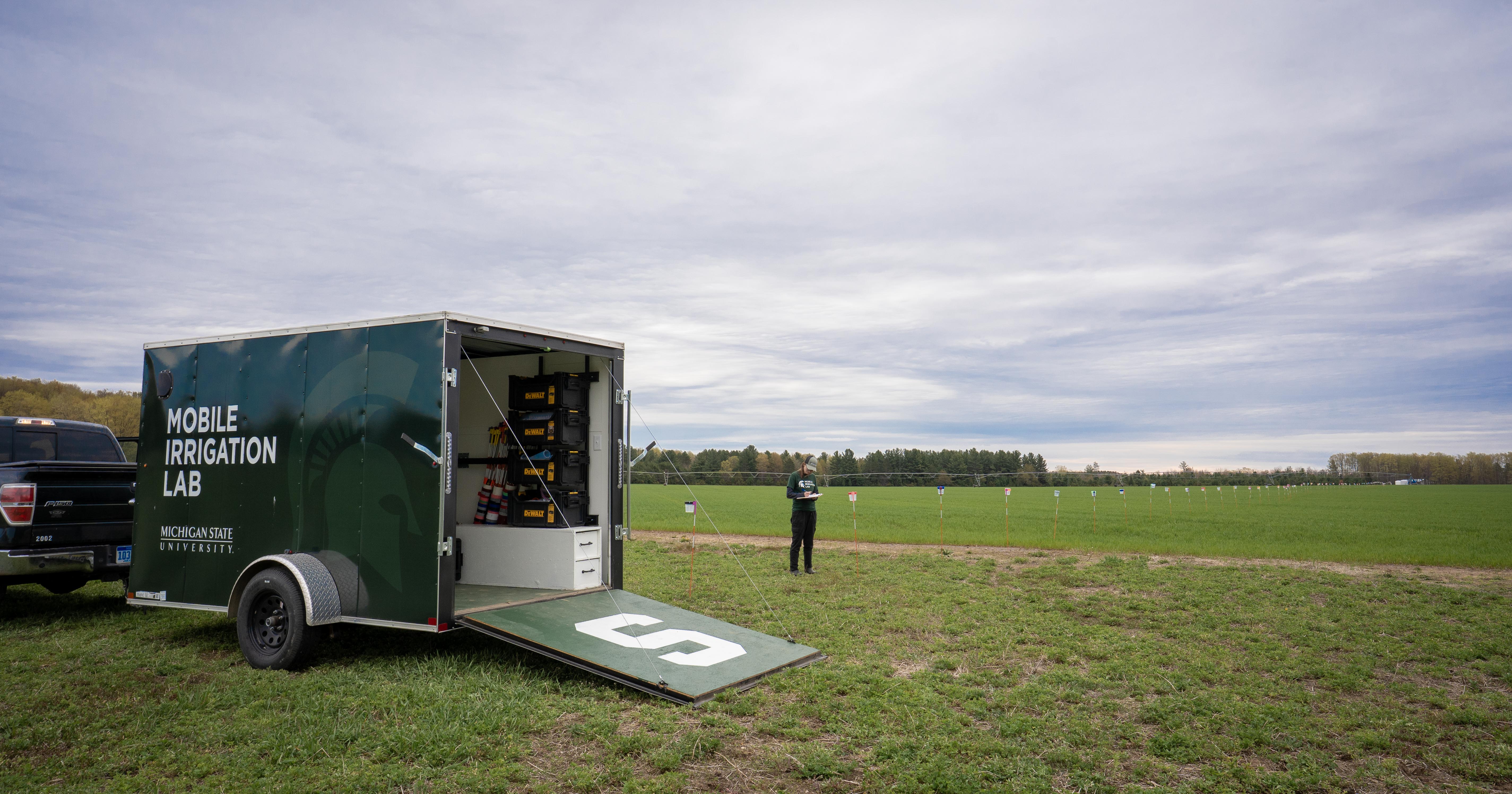
Through the Mobile Irrigation Lab, MSU experts perform a preliminary test of participating farms’ center-pivot irrigation systems, inspecting water application uniformity, water pressure, flow rate, and sprinkler and end gun function. Faulty equipment can lead to wasted water and energy, as well as nutrient leaching and underperforming crops.
Growers receive a detailed report and recommendations, at which point a cost-sharing program helps pay for upgrades to sprinklers or other equipment as needed. Lastly, a follow-up evaluation measures efficiency improvements.
In addition to MSU Extension-based outreach, statewide partners are making growers aware of this resource. Campbell has worked with MSU since 2012, most notably through her role with the Michigan Water Use Advisory Council, a group that advises legislators and the Department of Environment, Great Lakes and Energy (EGLE) on water use in the state. Campbell said one of her main priorities is to guide farmers toward voluntary programs that help them reach on-farm stewardship goals.
“I represent farmers on several committees and councils, including Michigan’s Water Use Advisory Council, to provide farmer perspectives to regulators and decision makers and help craft policy that is both protective of the environment and feasible for farms,” Campbell said. “I encourage farmers to take advantage of both the educational tools and the Mobile Irrigation Lab through conversations and presentations on water use and through our newsletters that are available to every Farm Bureau member across the state — more than 40,000 farming families.”
In 2025, findings from Project GREEEN-funded research on the Mobile Irrigation Lab led to $600,000 in additional support from EGLE to launch a pilot program that serves farms around the state.
“The personalized, on-farm service from the Mobile Irrigation Lab is invaluable to farmers because it takes education out of the classroom or computer and into a practical, workable solution for farmers that not only addresses their specific needs but also produces measurable, immediate impacts they can see when it comes to maximizing yield benefits, minimizing costs and loss, and protecting their investments,” Campbell said. “The fact that the service is also free and available to any farmer in Michigan is a huge benefit.”
To date, the Mobile Irrigation Lab team has conducted more than 20 on-farm assessments across nine Michigan counties. Riley Johnson, manager of the Mobile Irrigation Lab, said one grower replaced the system’s sprinkler package and saw a 12% boost in irrigation uniformity. Researchers estimate the upgrades could save the grower roughly 4.7 million gallons of water and $950 in energy costs annually. These savings estimates vary depending on the size of the irrigated field and the typical amount of water applied each year.
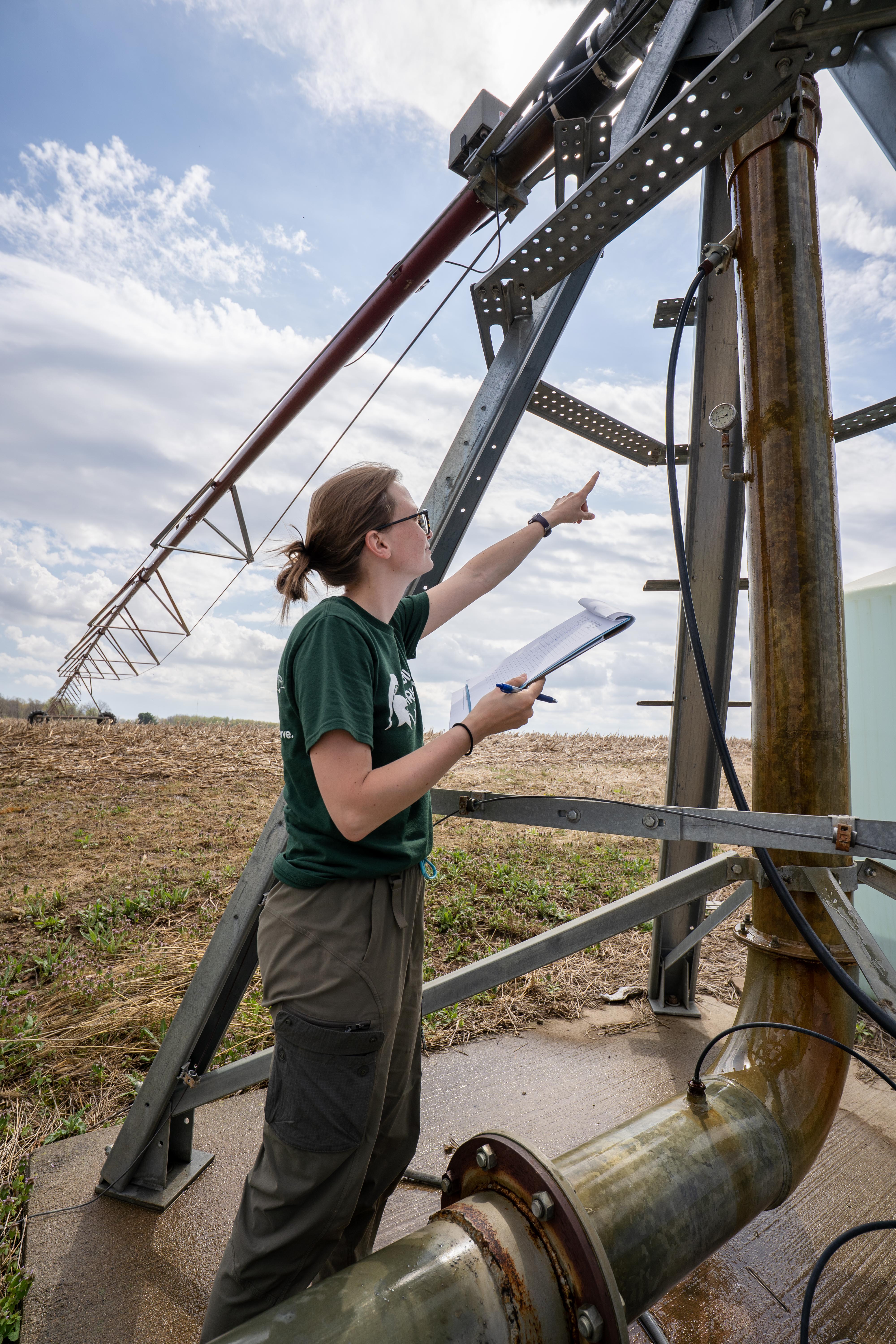
Karl Ritchie, agronomist at Walther Farms — a third-generation potato farm headquartered in Three Rivers, Michigan, that operates in eight states — said the Mobile Irrigation Lab has generated positive results.
“Potatoes and other specialty vegetable and fruit crops are highly dependent on irrigation for the quality needed to delight the consumer,” Ritchie said. “In a dry year, our crops are at risk of being unmarketable without irrigation. We rely on MSU irrigation research — along with irrigation service providers — to use water efficiently and to help preserve our ability to irrigate when and how we need to.”
Working with Dong and Angie Gradiz, MSU Extension agriculture water use efficiency and irrigation educator in Branch County, Ritchie said the team’s efforts have made water use predictions for potatoes much more accurate.
“Water use efficiency all starts with testing an irrigation system for uniformity,” Ritchie said. “For us, center-pivot water application uniformity increased from about 60% to over 90% in testing done in spring 2026. We also know energy efficiency has greatly improved.
“The group at MSU was great to work with, and they’re very professional, helpful and accommodating. The irrigation system uniformity testing is a great way to apply the principles that have been learned from the research. We appreciate their hard work in doing research on how we can irrigate more efficiently and conserve water.”
Evaluating irrigation strategies for Michigan tree fruit growers
Beyond field crops, Dong received one of the first four grants from the Agricultural Resiliency Program in 2024 that delves into tree fruit, a major component of Michigan’s specialty crops sector. The Agricultural Resiliency Program is a partnership among MSU, the Michigan Plant Coalition and MDARD aimed at long-term plant agriculture challenges with water and extreme weather.
Dong is also among a group of MSU scientists supported by the program’s cluster hire initiative, which uses $1 million annually from the State of Michigan to help fund faculty and MSU Extension educator positions.
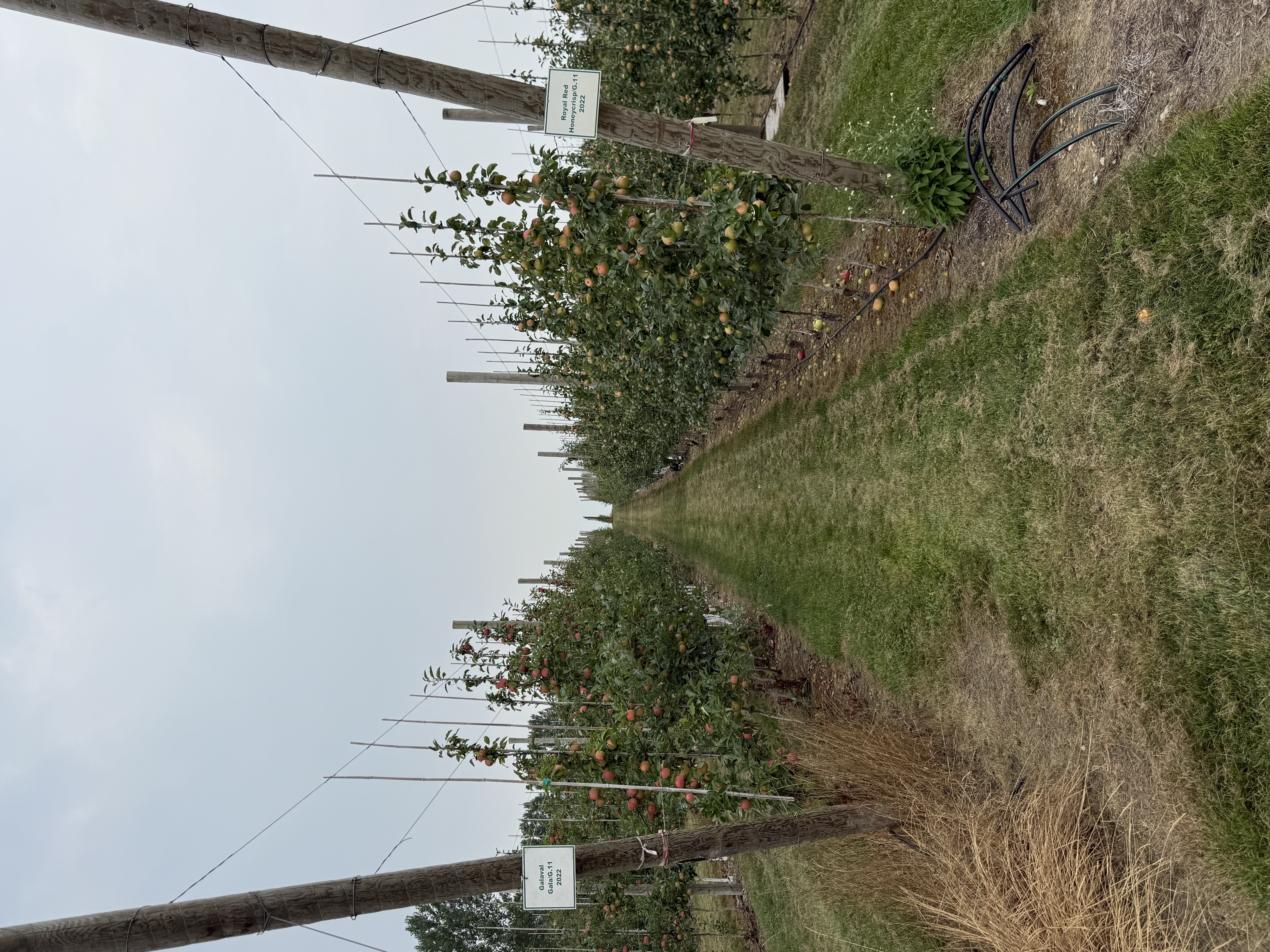
The goal of Dong’s ongoing three-year project is to increase the resiliency of tree fruit production using a holistic approach to water, nutrient and soil management. Dong and Emily Lavely, an MSU Extension tree fruit educator, are evaluating the efficacy of precision irrigation technologies such as soil moisture sensors and data-driven modeling to determine which approaches are most effective and economically feasible for Michigan growers.
“Ultimately, we want to provide growers with recommendations that save money by saving on water and energy costs, while also producing quality fruit,” Dong said. “We’re hopeful these solutions are applicable across many commodities, particularly the specialty crop industries that face so many pressures today.”
While LOCOMOS utilizes soil moisture sensor data, a newer tool created by Dong and his team called MSU Irrigation relies on evapotranspiration (ET) calculations that stem from data collected on water movement from the land to the atmosphere.
MSU Irrigation includes an app that provides real-time irrigation recommendations and notifies users when soil moisture drops below a given threshold. The app factors in soil type and crop-specific information while integrating data from the National Weather Service.
Research using MSU Irrigation started with funding from Project GREEEN, and the app currently has more than 450 users and covers roughly 60,000 acres of irrigated fields.
In the Agricultural Resiliency Program project’s first year of testing, Dong discovered that irrigation scheduling performance was similar between the soil sensors and ET modeling, while sap flow sensors — which track water movement through plants — were less successful. The team also found that fertigation, a process in which fertilizers are applied through irrigation systems, and mulch applications are worthwhile strategies.
Apples have been the focus of the project thus far, but Dong said the findings should translate to other crops. In coming years, researchers will collect information on fruit quality to determine which approaches yield the best product.
“It’s especially encouraging to see that growers are not simply downloading the MSU Irrigation app but are actively using it on a regular and, in many cases, daily basis to support their irrigation management decisions,” Dong said. “This level of continued engagement demonstrates the value and practical impact of translating our research into a tool that growers can use directly in the field.”
Michigan State University AgBioResearch scientists discover dynamic solutions for food systems and the environment. More than 300 MSU faculty conduct leading-edge research on a variety of topics, from health and agriculture to natural resources. Originally formed in 1888 as the Michigan Agricultural Experiment Station, MSU AgBioResearch oversees numerous on-campus research facilities, as well as 15 outlying centers throughout Michigan. To learn more, visit agbioresearch.msu.edu.