Improving dairy calf pain mitigation
 Print
Print Email
EmailA machine-learning system works to identify calves experiencing pain post-disbudding.
In dairy farming, hot-iron disbudding is a common calf management practice used to prevent horn growth. It is carried out to protect both workers and cattle from injury and to reduce housing space needs. However, the practice causes burn injuries around the horn bud, leading to significant pain and inflammation. This pain can compromise calf welfare, suppress the immune system, increase susceptibility to disease, and reduce growth performance.
Together, these animal welfare, health and production concerns can reduce farm efficiency and influence how the public views dairy farming. Both the American Veterinary Medical Association and the American Association of Bovine Practitioners recommend multimodal pain management, which combines local anesthesia with non-steroidal anti-inflammatory drugs (NSAIDs), to alleviate disbudding-related pain.
However, not all calves experience pain the same way. Pain perception and responses to pain medication vary among animals, meaning that even when the same analgesic protocol is used, some calves may still experience pain after disbudding. Therefore, effective pain relief depends on the ability to accurately and continuously identify which calves are still in pain.
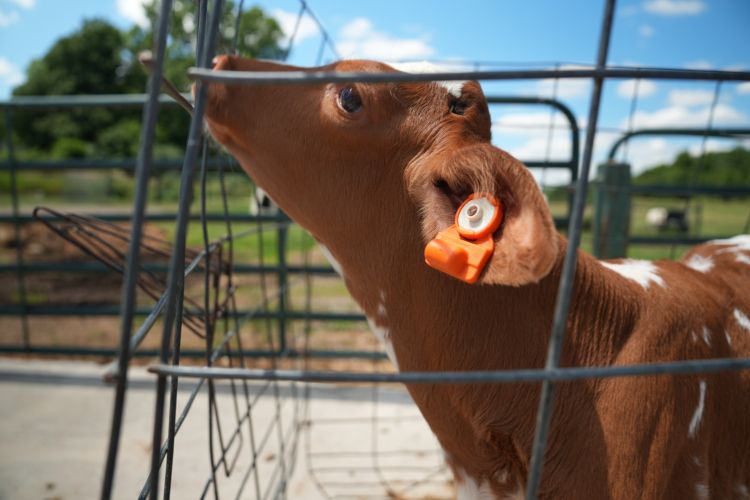
The Trindade lab at Michigan State University and collaborators have developed a machine-learning system that can automatically detect pain in calves. This system uses minute-by-minute activity behavior patterns collected from commercial ear-tag sensors that are already used on many farms.
In preliminary results with 40 calves, the system showed strong performance in distinguishing between painless calves (pre-disbudding) and painful calves (post-disbudding), achieving:
- 91% overall accuracy
- 86% sensitivity (correctly identifying calves with pain)
- 82% specificity (correctly identifying calves without pain)
Importantly, at 24, 48 and 72 hours after disbudding, the system identified about 25% of calves as still experiencing pain, even after receiving the multimodal analgesic protocol. This suggests that a meaningful number of calves may benefit from an additional dose of NSAIDs to support welfare, health and optimal growth.
Looking ahead, this technology will support the development of a user-friendly mobile app that flags calves likely experiencing pain after disbudding. The app will provide producers and veterinarians with actionable information to make targeted pain treatment decisions, rather than relying on herd-level assumptions.
This approach has the potential to:
- Improve calf welfare
- Lower disease risk
- Reduce labor demands
- Reduce wound healing time and post-disbudding complications
- Decrease unnecessary mediation use
- Support optimal calf growth performance
- Enhance public confidence in early-life dairy calf care
Do you use commercial ear-tag sensors and want to test this pain monitoring system on your farm? Contact Pedro Trindade, DVM, at trindad4@msu.edu.