Early Care and Education Nutrition and Physical Activity
Early childhood is a critical window for developing lifelong habits. Early Childcare and Education (ECE) settings play a powerful role in shaping daily routines and creating positive experiences with food and movement.
Community champions in ECE environments recognize that it is never too early to develop healthy patterns.
- Physical, social-emotional, and behavioral development in young children
- An increased chance of children staying healthy throughout adulthood
- Healthy routines that families often carry home, and into schools and communities
You do not need a new program or a big initiative to get started. The Early Care and Education Nutrition and Physical Activity Support Guide, which follows MSU Extension's six-step model to Community Change, can help. With a clear plan and practical examples, you can take meaningful steps to strengthen nutrition and physical activity opportunities for young children.
Here's how:
Step 1: Identify the Need
Recommended best practices are based on research. They start with the “why” of changes and then guide people on the “what” to do.
For ECE community champions, the “what” of making changes — and the right questions to ask — are already organized for you. Go NAPSACC, or “Go Nutrition and Physical Activity Self-Assessment for Child Care,” is a free, online program used across the US. It guides ECE programs through the process of improving their nutrition and physical activity policies and practices. It can help you assess the nutritional quality of food served, the amount and quality of physical activity, staff-child interactions, and facility nutrition and physical activity policies and practices.
Tools for Identifying the Need
Create an account with Go NAPSACC and fill out the self-assessments. For more information on Go NAPSACC, how to create an account, and how to connect with a consultant for personalized support — all free of cost — check out our Go NAPSACC starter guide. It outlines easy steps to get your ECE program started on identifying and addressing its nutrition and physical activity needs!
Use the “Identify the Need” guide and worksheet for suggested questions, ideas, and examples of how to clarify a specific need, why it matters, and what benefits it could have for staff, families, and volunteers.
Step 2: Bring People Together
Start by identifying two to four people who care about the issue and have influence in the setting you want to improve. Ask: who are your stakeholders? Depending on your focus, this could include classroom teachers, administrative staff, recess supervisors, school nurses, nutrition specialists, food service staff, after-school staff, building leaders, families of enrolled children, or community volunteers.
This does not need to be a formal committee. A “movement team” can start with one short conversation and a shared goal around:
What is the need we are trying to address?
What is one realistic change we can try?
How will we communicate the goal and encourage participation?
Who or what will help support the change, so it does not rely on one person?
Not every ECE program can form a team right away. If you are leading the change alone, that is still a strong place to start. One person’s first step can inspire others and build support over time.
Ways to Build Buy-In
Share one key message, such as “Movement supports learning” or “Removing sweetened juice helps children drink more water and milk.”
Ask staff what feels realistic before choosing your first quick win.
Start with one classroom, grade level, or program team, then expand.
Include children’s input when you can. Ask what activities feel fun and inclusive.
When a few people share the message and support the effort, it becomes part of the school culture and is more likely to last over time.
Tools for Bringing People Together
Use the “Bring People Together” guide and worksheet to identify people to include in your action team.
Consider completing the Organizational Readiness to Implement Change (ORIC) Assessment with your action team. The ORIC measures how ready your team is to make a change, like sourcing locally or adding another outdoor recess to the schedule. A high score means people think the change is important and are motivated. A lower score may mean people don't understand why the change is needed. In this case, more communication and relationship-building may be needed to build buy-in before implementing a change.
Step 3: Explore What’s Working
Looking at best‑practice recommendations can spark many ideas for improving nutrition and physical activity in ECE settings. Many changes are low‑ or no‑cost, as outlined in the Go NAPSACC Starter Guide. Sometimes one change helps meet several recommended practices. For example, gardening can teach children about nutrition and also help them be more active outdoors. A no‑screen policy can reduce screen time and help children stay active by using their time for other activities.
For more high‑impact change ideas, check out MSU Extension’s Action Steps for Child Care Providers: Meeting Best Practices in Nutrition and Physical Activity.
What Works: Real changes ECEs have made in partnership with MSU Extension
Example 1: Family-style dining
[Hold for image]
Children serve themselves at mealtimes from communal trays or bowls and use age-appropriate, short-handled and smaller sized spoons and tongs. They are guided on taking one portion, then can go back for seconds if they are still hungry. A program policy is written to support this practice continuously.
Why it works: This provides opportunity for children to learn portion control.
Source: Foundations for Families (2019) Family-Style Dining Policy sample
Example 2: Recess cart system
[Hold for image]
An ECE provider sets up a recess cart with ropes, balls, cones, chalk, and other supplies that can be used indoors or out across the various seasons. There is also a simple plan for storage, monitoring, and rotation of equipment. A program policy is written to support provision of equipment and/or a maintenance plan.
Why it works: Equipment is easier to access, and staff have a simple system to support active recess.
Example 3: Classrooms engage children in farm-to-table practices
[Hold for image]
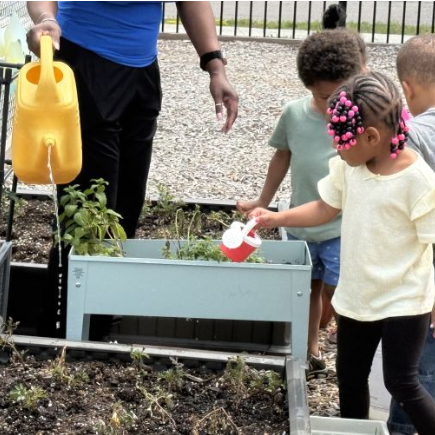
Children participate in gardening and other food and agricultural activities. They help plant, weed, water, harvest, and taste local produce, learning not only about the growing process but also about the value of having wholesome, natural foods for their growing bodies.
Why it works: It creates a hands-on application of how everyone can achieve better nutrition.
Source: Bright Futures Daycare and Preschool plants seeds of health and hope in Muskegon
Example 4: Incorporate movement into learning
[Hold for image]
Outside of nap or mealtimes, children should not remain seated for more than 15 minutes at a time. This gives the teacher time to explain a lesson or demonstrate an activity, but the rest of the lesson should be based on movement and hands-on learning. Such practice can be supported in a physical activity policy.
Why it works: Physical activity is incorporated into every part of the day, establishing it as a norm for children and helping them reach recommended amounts of physical activity.
Tools for Exploring What’s Working
Use the “Explore What’s Working” guide and worksheet to guide you through this conversation.
Check out MSU Extension’s SNAP-Ed Success Stories for more ideas.
Read success stories from around the US at Healthy Kids, Healthy Futures
Step 4: Gather Resources
These resources provide helpful background, messaging, and practical ideas to support nutrition and physical activity priorities in ECE settings.
Michigan State University ECE Resources
Go NAPSACC Starter Guide: An overview of Go NAPSACC and how to get started. Learn how the free tool supports education and quality rating standards, plus how to set up an account and receive ongoing consultation.
Action Steps for Child Care Providers: Meeting Best Practices in Nutrition and Physical Activity: Two companion resources with clear, practical steps ECE programs can take to meet Go NAPSACC best practices. Covers breastfeeding, infant feeding, child nutrition, farm‑to‑ECE, physical activity, outdoor play, and screen time reduction.
Farm to Early Childhood Programs: A Step-by-Step Guide: A practical guide from MSU’s Center for Regional Food Systems that helps ECE programs learn how to buy and use local foods for meals and snacks.
Get Moving Early Childhood Facilitator Guide: Ready‑to‑use lessons from MSU Extension that help 3‑to‑5‑year‑olds build healthy movement habits. Includes activity ideas, printable teaching tools, and family newsletters.
Healthier Child Care Environments Toolkit: A curated collection of resources organized by topic and Go NAPSACC best practices, including teaching materials, activity ideas, family communication tools, and real‑world examples from child care programs.
Screen Time Reduction Early Childhood Facilitator Guide: Ready‑to‑use lessons from MSU Extension that help children ages 2‑to‑5 build healthy habits as alternatives to screen time. Includes activities, teaching supports, and family newsletters.
Healthy Kids Healthy Drinks: MSU Extension toolkits for leading community‑informed education that promotes water as the best choice and explains the health impact of sugary drinks. Includes lessons, discussion prompts, and movement activities.
Other ECE Resources
Child and Adult Care Food Program (CACFP): A federal program that reimburses child care programs for nutritious meals and snacks. Includes menu templates, nutrition standards, and guidance to improve menu quality.
Go Nutrition and Physical Activity Self-Assessment for Child Care (Go NAPSACC): A national toolkit that helps ECE providers improve policies, environments, and practices related to child health. Consultants help set up accounts and provide access to self‑assessments, planning tools, and implementation resources.
National Farm to School Network: Resources that support farm‑to‑ECE efforts such as local food purchasing, gardening, and food education. Includes starter guides, webinars, and curated educational materials.
Tools to Gather Resources
Use the “Gather Resources” question guide and worksheet to focus your goals and find reliable resources to help you implement your change.
For an extensive list of resources designed to help you reach each of the nutrition and physical activity best practices, check out MSU Extension’s Healthier Child Care Environments Toolkit.
Step 5: Make a Plan and Act
A strong plan does not need to be complicated. The most effective approach is to choose one goal, pick one strategy, and test it for four to six weeks. Go NAPSACC provides editable planning templates for each goal, and each recommended goal is based on best practices and your program’s current strengths and areas for growth. To customize your plan, consider the following:
1: Choose the system you want to improve. For example:
My classroom
My grade level
My after-school program
Lunch time
Recess time
The kitchen
The whole school
2: Pick one clear goal in the specific setting. This helps prevent the process from feeling overwhelming and supports steady progress.
Offer vegetables, other than potatoes, corn, or green beans one or more times per day
Caregivers do not use food to encourage positive behavior
Children move more during the school day
Recess includes more active outdoor play
Children are introduced to a new food monthly
Gardening (indoors or out) becomes part of the classroom routine
Screens are not used for infants or toddlers at all, and only 30 minutes or less for preschool children
3: Choose a win that is realistic. Here are some high-impact, no- or low-cost starter options recommended by Go NAPSACC:
Classroom ideas
Children are never given sweet or salty snacks outside of meal and snack times, and are given sweet and salty snack less than one time per week.
Television and videos are never on during meal or snack times.
Teachers enthusiastically model healthy nutrition and physical activity habits.
Teachers always praise children for trying new and less-preferred foods.
Outside of nap and mealtimes, children are not expected to sit for more than 15 minutes at a time. This includes infants never being placed in seats or swings.
Children do a variety of activities to help plan, plant, care for, harvest, and learn from the garden.
Recess ideas
Outdoor playtime is provided for preschool children 3 times a day or more.
Outdoor playtime is provided for preschool children for a total of 90 minutes or more, or for toddlers for a total of 60 minutes or more, each day.
Portable play equipment is always available to children during outdoor active playtime.
There is a written policy regarding outdoor play and weather safety.
Kitchen practice ideas
Fried or pre-fried meats or fish are offered less than 1 time per week or never.
Children are offered dark green, orange, red, or deep yellow vegetables (not including corn) once or more per day.
High-sugar, high-salt, and/or high-fat foods are never offered, or are offered less than one time per week.
Sugar drinks are never offered.
Breastmilk storage is provided and communicated to families to support food safe breastfeeding of infants.
The program communicates to families about local foods included in meals or snacks through menus, farm information, recipes, signs, etc.
4: Make the change last. Look for ways to build it into everyday practice in these three main categories:
Policy: written documents that share expectations and consistent messages with staff and families
Systems: routines and schedules that make movement easier to maintain
Environment: spaces and equipment that support physical activity
To make changes to those areas last in the long-term, use sustainability strategies. You may use all of the below, or may choose just one or two as you are starting out:
Leadership commitment: visible support, shared expectations, and follow-through
Clear ownership: maintenance is integrated into a specific job description or an existing team's official responsibilities
Training and onboarding: new staff learn the approach as part of normal onboarding or professional development
Communication and reinforcement: reminders, signage, shared norms, and consistent messaging are used with staff, families, and other stakeholders
Tools for Making a Plan and Taking Action
Use the “Make A Plan and Act” guide and worksheet to map out an action plan and identify simple steps to start.
Access Go NAPSACC’s customizable planning tool after taking the self-assessments and choosing your goal.
Step 6: Reflect and Share What You Learned
Ongoing reflection helps you monitor your progress. You and your team can look at what went well and what still needs work. Recording your progress, especially after key milestones, can also help with future reporting to administrators or for grants or accreditation.
You can reflect on your progress by retaking the Go NAPSACC self‑assessment for the nutrition or physical activity topic you chose. Comparing your new assessment with your earlier one will show where you met recommended changes and where you might focus next. As you compare, you might ask:
Which policy sections improved?
What implementation practices got stronger?
What challenges remain?
What supports were most helpful?
What should be prioritized next?
There is no limit to how many times you can take the Go NAPSACC self‑assessments. To sustain changes, consider completing them once a year as part of your annual review. Remember to share your successes and next steps with families and community members. Involving them in celebrating progress can help them feel part of a healthy culture. It may also encourage their interest and future support. You and your team should be proud of your commitment to improving children’s health, and it is worth sharing that pride with others.
Tools for Reflecting and Sharing
The Reflect and Share Guide and Worksheet can guide you through this step.