Manure Management for Fairs and Exhibitions
DOWNLOADMay 14, 2026 - Sarah Zeiler, MSU Extension
 Print
Print Email
EmailThis resource is a comprehensive guide to planning for manure management at fairs and expos that gets used and is environmentally responsible. Please note that this comprehensive guide replaces four older guides that individually covered manure storage, manure storage planning, emergency spill responses and hauling, spreading and composting manure.
Fairground Resource Inventory
By doing this initial exercise, you will develop an informed perspective as a starting point. In this factsheet we will discuss how to collect fairground resource inventory information. An example is included. Finally, we will consider emergency spill response.
Before deciding on a manure storage site location(s), think about what encompasses your fairgrounds:
- Describe your fairgrounds: Identify the goals, objectives, size, historical management, available land base, and number of animals that reside at your fair each year.
- Consider the areas where manure tends to accumulate: Stalls/pens, wash racks, riding/show arenas, and other areas where animals are walked between these places on the fairgrounds.
- Consider the environmental impact of potential storage locations: Identify surface water, drains, buildings without gutters, and high foot traffic areas
Number of Animals Exhibited at Your Event
To determine the number of animals exhibited on the fairgrounds, you can use previous fair information as well as counting the designated spaces that each livestock species is provided while at the fair. For example, knowing the number of horse stalls on the premises as well as the number of pens for livestock and poultry projects will give you a good estimation of the number of animals. Knowing the maximum capacity helps in identifying how much manure could be produced during your event.
After establishing the maximum number of animals that can be held on site, you can think about the volume of manure each animal produces. Remember: Each animal will produce a different amount of manure and will have different concentrations of nutrients in the manure.
Storage Locations
It is important to consider the collection of manure on the premises; try to identify all the possible scenarios of where manure may potentially collect. Some examples are:
- stalls/pens: manure and bedding are collected from stalls 2-3 times per day
- wash racks: manure is collected as needed
- riding/show arenas: manure is collected as needed
- other walkways around fairgrounds: manure is collected as needed
Manure management storage location practices should take environmental stewardship into account. Follow these recommendations from the Michigan Department of Agriculture & Rural Development’s Generally Accepted Agricultural and Management Practices (https://www.michigan.gov/mdard/ environment/rtf/gaamps).
For each storage location, ask yourself:
- Is the storage 150 ft from surface water?
- Is the storage 75 ft from wells?
- Is the storage 50 ft from property lines?
- Is the storage 150 ft from residences?
Are the storage locations easily and conveniently accessible to where most of the manure is produced?
Example of a Site Map
When determining or evaluating manure storage areas, here are some helpful steps to take as you go through the process:
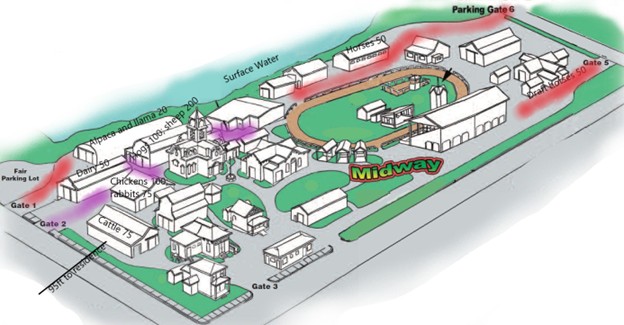
- Mark the buildings on the site map with the number of animals and the species expected.
- Locate wash racks and arenas.
- Locate high traffic areas (foot and vehicle) where manure could be a problem. In the example, the foot traffic is purple and the vehicle traffic is red.
- Locate surface water.
- Consider where water will run-off of buildings and across pavement. Consider where manure will run during a rain event.
- Locate wells.
- Locate property lines and residences.
Once you have determined the number of animals, the amount of manure they produce, and where that manure tends to accumulate, that allows you to make decision as to where manure storage should be located.
It is likely that the stalls and pens used during a fair will accumulate the most manure and bedding waste, so locating storage that is easily accessible from those areas might make more sense than right next to a wash rack. If we use the example map above, we can see that many of the livestock barns are in high traffic areas where people are likely to be walking. Additionally, we have a body of water that lines one side of the grounds as well. Because of this layout, it would be beneficial to locate a manure storage for the barns that are closer to Gate 1. This storage would be out of the main traffic areas and at least 150 ft from the nearby water. It would also be beneficial to have a manure storage site for the barns located near Parking Gate 6 so that manure from these barns is not hauled across the grounds. Again, this storage would need to be located out of high traffic areas as well as at least 150 ft from the nearby water. This may be a good situation to utilize temporary, haul-away storage that can be placed in appropriate areas and then removed at the end of the fair.
Manure Storage Checklist
When storing manure, you will want to consider how the location may affect daily task efficiency. The storage needs to have a practical, easily understood approach that is economically responsible.
Manure management storage location practices should take environmental stewardship into account as well. For each storage site ask yourself:
- Is the manure storage base material concrete or asphalt?
- Does the storage have walls?
- Does the storage have a small curb on the entrance to keep manure contained and prevent runoff from the pile?
- Do you have gutters on the buildings to prevent clean rainwater from entering the manure storage?
- Is the storage site equipped with sumps to provide a place for wastewater to collect?
Calculating the Size of a Manure Storage
If you plan to build or have an existing manure storage structure, the capacity (volume) of the manure storage can be calculated in cubic feet (ft3).
Capacity = Length * Width * Height
Refer to Table 1, which shows how much manure can be produced by animal per day. Realistically, consider how manure will be managed and build a structure to the appropriate (or even excess of 20%) volume carrying capacity.
Capacity needed = Number of each animal species (cubic ft produced) * Number of days before removed
Table 1. Manure Production and Characteristics
|
|
Nutrient Content, lbs/day |
|||||
|
Animal |
Size, lbs. |
lb./day |
ft3/ day |
N |
P2O5 |
K2O |
|
Lactating cow |
88 lb. milk/day |
150 |
2.4 |
0.990 |
0.389 |
0.276 |
|
Swine – growing and finishing |
154 |
10 |
0.167 |
0.083 |
0.032 |
0.044 |
|
Horse (average sed-entary & exercised) |
1,100 |
57 |
0.910 |
0.270 |
0.117 |
0.252 |
|
Finishing beef |
750– 1,250 |
64 |
1.00 |
0.350 |
0.110 |
0.298 |
|
Poultry – broiler |
2.6 |
0.23 |
0.004 |
0.0025 |
0.0017 |
0.0017 |
|
Lamb – feeder |
100 |
1.05 |
0.060 |
0.040 |
0.020 |
0.040 |
(Source: American Society of Agricultural and Biological Engineers [ASABE], March 2005, R2014, D384.2) The standard can be obtained by contacting ASABE in St. Joseph, Michigan. Presented as bolded text in the table is from the Midwest Plan Service Publication MWPS–18, Section 1 (2000).
For example, one feeder lamb around 100 lbs., will produce 1.05 lbs. of manure per day, which means that over the course of seven days, 7.35 lbs. total. If we look at the total nutrients over the course of seven days, we would see the following: 0.28 lb. of N, 0.14 lb. of P2O5, and 0.28 lb. of K2O. Now think about how these numbers will increase when considering all feeder lambs present at the fair for one week.
Stockpiling as an Alternative to Storage
Temporarily stockpiling manure, a practice where manure is piled on the ground for a limited amount of time outside of a storage facility, is an acceptable practice with appropriate management. The following points for this practice are outlined in the Michigan Department of Agriculture & Rural Development’s Generally Accepted Agricultural and Management Practices (https://www.michigan.gov/mdard/ environment/rtf/gaamps):
- Can the stockpile locations be rotated, completely removing manure from the location after the event?
- For locations that are reused each year, are they reseeded after removal to allow vegetation to take up the nutrients that have accumulated in the soil?
- Are records kept to document timing of removal and the location used?
- Do the stockpile locations prevent runoff from flowing onto neighboring property or into surface waters?
- Are the manure stockpiles at least 50 ft away from property lines or 150 ft from residences?
Dumpsters as an Alternative Storage
Large dumpsters may be a viable option for some, especially during the winter months of the year. However, this type of manure storage, which includes removal, can be expensive. If you consider this option, choose a location where driveway accessibility is appropriate for the truck to pick up and deliver dumpsters during times of the year when weather is inclement. Be sure to work with your waste disposal company to make sure that manure is an acceptable waste for their landfill.
On-Site vs. Off-Site Treatment of Manure
When deciding on waste disposal, it is important to consider all options or a combination of the options. Also consider who will be the lead on manure decisions. Additional on-site options include spreading manure, if the land base is available, or composting. Each of these options have benefits and drawbacks. You may also haul all the manure produced to an off-site location for disposal.
Keep in mind that spreading raw manure in combination with soiled bedding (stall waste) on your pasture is not an advisable practice, whether on- or off-site. Spreading raw manure on your pasture or crop fields may spread parasites and weed seeds. Barn waste with wood products such as sawdust or wood shavings can deplete the soil of nitrogen (needed for grass to grow) due to the breakdown of carbon. This can result in an undesired outcome when attempting to grow forage.
Transfer of disease or infection between humans and animals, or zoonosis, is important to consider when dealing with manure, especially when it has inputs from multiple species. To prevent the transfer of diseases or infections when handling manure, you can:
- Practice proper cleaning and disinfecting of equipment used to haul or transfer manure.
- Have dedicated routes of travel with manure on the fairgrounds to limit the amount of area that is exposed.
- Carefully consider manure storage site locations to minimize the amount of contact necessary for hauling and transferring manure.
- Avoid excessive application rates and follow the Manure Management and Utilization Generally Accepted Agricultural Management Practices (GAAMPs) for application best practices.
- Keep records of manure removal, locations the manure is taken, and where and when the manure is applied.
Composting on-site relieves some of the issues discussed above but is also more time and labor-intensive. It can be an alternate income source for the fair or expo or an associated group.
Hauling and Spreading Checklist
Preparing to dispose of waste ahead-of-time is important and allows you to make the best plans for your fair or expo. Collect the following useful information:
- the type of spreader or transfer equipment you plan to use
- the volume of the manure in the spreader
- how you plan to put manure into the spreader
- the route to the farm or field, which should avoid sensitive areas (surface water and wetlands, limited-weight traffic roads, sensitive neighboring facilities, including schools and hospitals)
- records of who took the manure, the route, and their agreement to apply it according to GAAMPs standards
The Manure Management and Utilization GAAMPs (https://www.michigan.gov/ mdard/environment/rtf/gaamps) describe recommendations for best management practices backed by scientific research. These practices help to prevent manure from impacting the environment as well as unplanned manure releases. Additionally, they promote good neighbor relations and garner community support, which is particularly important for fairs and expos.
Take the manure application conditions into account when planning a destination for the manure:
- Slope and drainage of fields: Consider how much of a slope exists and how likely the manure is to run off.
- Weather forecasts and seasonal conditions: Pay attention. Conditions will differ in the spring and fall because of soil temperature and saturation. In the summer, heavy rain can be an issue. The Michigan EnviroImpact Tool https://enviroimpact.iwr.msu.edu/ which shows daily runoff risk across Michigan, will help aid in your manure application decision.
- Snow and water saturation levels in fields: Examine field conditions. If the ground is wet, this can cause issues with ruts from tractor tires, compaction of the soil, and possible runoff of manure nutrients.
- Soil analysis results: If manure is being taken off-site, encourage the landowner to have regular soil tests. If the fair or expo site has its own fields, regular soil testing is important.
Those who are involved in overseeing manure disposal may be responsible for ensuring proper application. It is in the best interest of the fair or expo to ensure manure disposal is done according to best practices. The recipient of the manure is also responsible for proper application.
Composting Manure
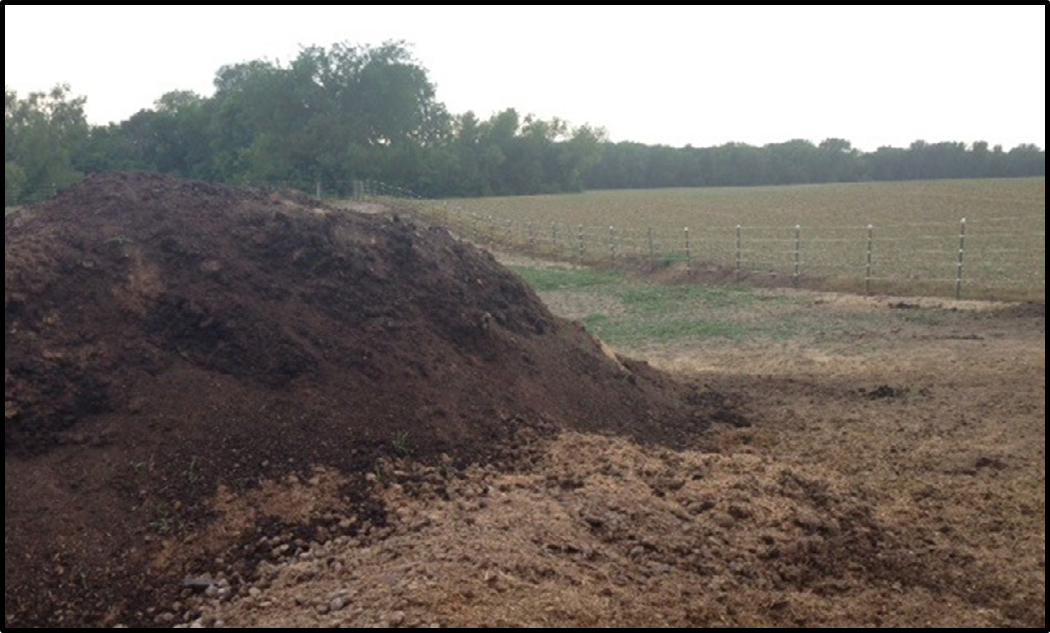
Composting (https://www.canr.msu.edu/resources/one_horse_or_a_hundred_what_is_composting_anyway_wo1022) is a managed biological decomposition process that converts organic matter into stable, soil-like material. Bacteria and fungi break down organic components of manure and bedding into smaller particles. The resulting compost is a dark, earthy-smelling product like potting soil. (See Figure 2.)
Four key factors will determine the success of your composting efforts:
- Keep it green. Less bedding in the compost results in a faster process. A carbon-to-nitrogen (C:N) ratio between 15:1 and 40:1 is ideal. If you need to add nitrogen to the mixture, you can accomplish this by adding higher N content materials such as grass clippings (17:1), wasted hay (15–32:1), or N fertilizer to the pile (1 lb of urea nitrogen per cubic yard of collected waste).
- Keep it wet. Generally, compost should be moist to the touch and feel like a damp sponge. A moisture content range of 40% to 60% is the goal. If the pile is too wet, aeration by turning, mixing, or moving the pile must be done to restart active composting. If too dry, water should be added, preferably by a uniform, consistent spray.
- Get it hot. The rise in temperature is a result and an indicator of composting activity and microbial respiration. Temperatures within 100 degrees Fahrenheit to 150 F enhance microbial reproduction. At 140 F or higher, pathogens, weed seeds and fly larvae in the composting materials are destroyed. However, temperatures above 150 F kill composting organisms and, therefore, are not desirable. Use a long-stem thermometer to monitor internal temperature.
- Keep it moving. Aeration by turning, mixing or moving the compost pile promotes the growth of hardier, more robust aerobic bacteria by infusing air into the materials and providing a desirable oxygen concentration of 5%–20%. (Guthrie & Rozeboom, 2012).
A concrete base is an excellent choice for composting because it is easy to clean and maintain, while also being impermeable to prevent the leaching of nutrients from the compost pile into groundwater. When selecting a site for composting manure, always remember to follow environmental stewardship practices and be aware of factors such as prevailing winds, distance to property lines, wells, neighboring residences, slope of the site, and distance away from any surface water.
Emergency Spill Response Planning
Although solid manure is not commonly involved in large spills, you should have an emergency spill response plan in place that considers human safety as well as environmental safety. Additionally, the biohazards of a manure spill, such as disease potential, are important to consider in a response plan.
Prevention is the most important way to avoid a possible manure spill. Practice prevention techniques in these areas where manure spills are most likely to occur:
- Loading area: Keep the loading areas around storage sites and stalls as clean as possible.
- Local transport: Only fill wheelbarrows and skid loaders to capacity so they will not be losing manure as they travel to the storage area. Any dropped manure should be immediately picked up and put in the storage.
- Long-distance hauling: Only fill spreaders to their potential (as outlined by the specs from the manufacturer) and do not overload; inspect equipment before using to make sure everything is in proper working order.
- Field spreading/land application: Over-application of manure to a field can turn into an emergency response situation, especially if a large rain or snowmelt event occurs shortly after application.
- Have spill kits available in nearby barns, so they are convenient, and people know where they are.
A spill kit should be kept in a closable, sturdy plastic container and contain the following:
- personal protective equipment (PPE): chemical-resistant gloves, boots, protective suit, safety glasses
- absorbent material, such as absorbent clay, sawdust, pet litter, activated charcoal, vermiculite, paper, or spill pillows to soak up liquid spills
- fire extinguisher rated for all types of fires
- other spill cleanup items specified on the labels of products used regularly
- emergency telephone numbers
- non-sparking shovel (for fuel spills), broom, and dustpan
- sweeping compound for dry spills and heavy-duty detergent for liquid spills (which are properly disposed of after collection)
- a first-aid kit and a change of clothes in the event clothing becomes contaminated