Liquor Stores
 Print
Print Email
Email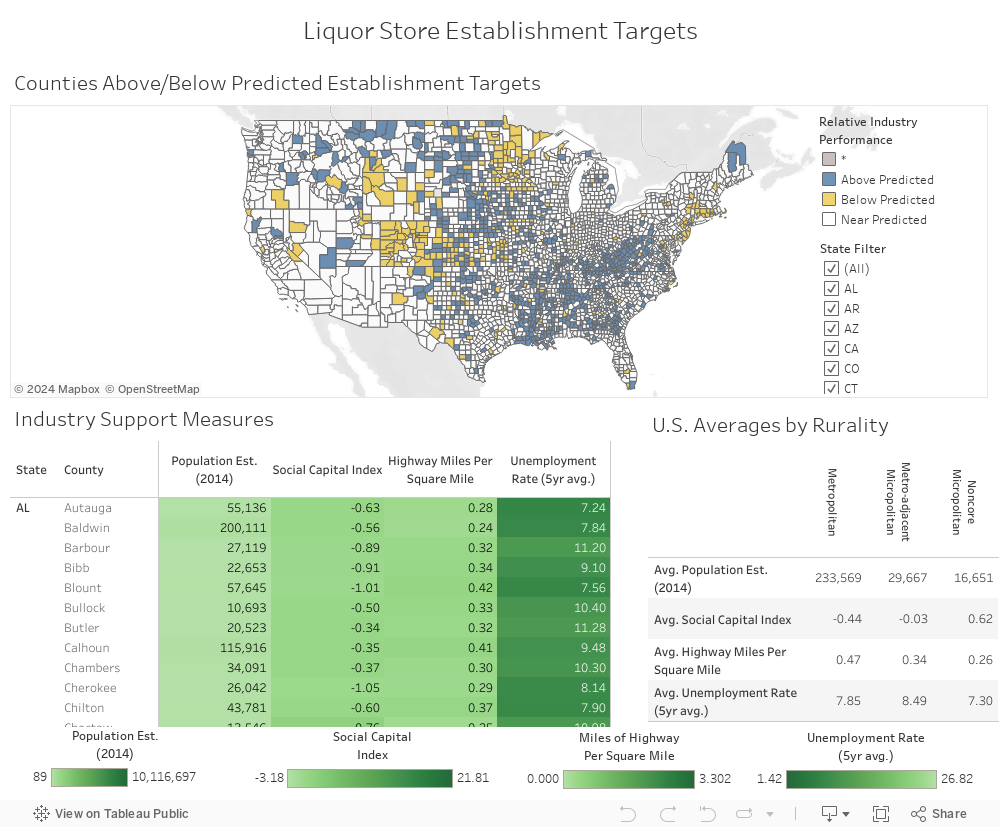
Some potential points to spur discussion:
- Social capital index has the most ubiquitous positive effect on retail establishment counts.
- While significant sales tax rate coefficients display mixed signs, higher property tax rates always lead to a lower probability of zero establishments, supporting previous findings in the literature that higher public amenities lead to higher retail demand.
For the detailed journal article from which this map derives, see Van Sandt, Anders, Craig Wesley Carpenter, Scott Loveridge, Rebekka Dudensing, and Linda Niehm. 2021. “Revealing U.S. Retail Industries’ Functional Hierarchy Through Demand Thresholds.” Under review.
This project was supported by the Agricultural and Food Research Initiative Competitive Program of the USDA National Institute of Food and Agriculture (NIFA), award number 2017-67023-26242.