Dairy Cattle Showmanship Guide
DOWNLOADMay 14, 2026 - Kendra VanOrder, Michigan State University Extension
 Print
Print Email
EmailDairy cattle showmanship focuses on how well the exhibitor presents and controls their animal, emphasizing confidence, knowledge, and skill. Whether you are showing a dairy cow or a heifer, the goal is to always present the animal to their highest ability. Excellent dairy cattle showmanship highlights the exhibitor’s ability to show their animal’s best features and hiding their flaws. Additionally, the ability to work safely, efficiently, and effectively with their animal while demonstrating knowledge, ring etiquette, and dairy industry standards are important.
Before the Show
- Make sure that your animal is clean and dry.
- Make sure that their hooves are clean.
- Make sure that your animal is fed and watered.
- Go to the show ring to look for holes or low spots so you can avoid putting the animal’s front feet in those places during your class.
- If you are not in the first class, watch a class or two so you know how the ring works, where to go, what the judge is expecting, etc.
- Remember: good showmanship starts at home with persistence during halter breaking and regular showmanship practice so you can show your animal safely and effectively. Come prepared to answer questions about your animal and its care during a showmanship class to demonstrate your knowledge and preparedness
Recommended Attire
The main goal of presenting yourself during showmanship is to look as professional as possible. Attire and appearance suggestions:
- A clean, white, button-down shirt that is tucked in.
- Clean, white jeans without holes and a belt.
- Belt buckles are fine to wear.
- Jeans should go over the top of your boots.
- Leather boots
- A number harness that is fitted and worn correctly with the extra strap in the back.
- If you have longer hair, pull it back so it is out of your face.
- Hats should not be worn
Dairy Cattle Showmanship Rules of Thumb
- Dairy cattle are walked clockwise around the ring.
- Stand on the left side of your animal, holding the halter in your left hand, keeping your fingers out of the ring of the halter.
- Hold the lead strap so it does not dangle in a comfortable way that is not looped too loosely or tightly in your left or right hand.
- If your animal has excess throat, use your right hand to pull their throat.
Tools You Will Need
- Leather Show Halter
- Number Harness – preferred, but not required
- If you choose to not use a number harness, make sure you have safety pins in your show box.
- Fly Spray – preferred, but not required
- Especially in the warmer temperatures, flies can cause cattle to move their legs and swish their tails which can make showmanship more difficult.
- Show Sheen – preferred, but not required
- Adding a little shine to your animal can help make them look more attractive in the show ring
Effectively Using the Show Halter
- Rope halters should not be used in showmanship.
- The nose piece should sit halfway between the eyes and the nose.
- Hold the halter about two to three inches away from the animal’s face.
- Lead the calf holding the lead strap with your palm down. When standing with your calf, hold the lead strap with your palm facing up.
Leading & Showing Dairy Cattle in the Show Ring
- Enter the ring walking forward in a quick fashion until all animals have entered the ring.
- Once all animals have entered the ring, face your animal and begin to walk backwards at a natural pace.
- Never sidestep.
- Hold your animal’s head at a comfortable height that gives the most appealing profile.
- Always give the judge the best view of your animal. Do not block the judge’s view.
- Keep circling the ring with the animal's head to tail and watch the judge for directions.
- If the judge approaches you, stop and pose your animal.
- Be sure to be aware of your animal while always keeping eye contact with the judge.
- When directed by the judge, pull your animal into the side-by-side lineup facing forward, walking quickly.
- Once you approach the lineup, pull in facing your animal and pose your animal when you have stopped your animal’s shoulder at the shoulder of the animal next to you.
- When stopped head to tail, provide one animal length between you and the animal in front of you
- If you need to circle your animal, make a large enough circle that you can return to your exact spot in line to ensure proper spacing and alignment of your animal.
- Continue to watch the judge, always making eye contact.
- Remember to remain calm, collected, and confident.
Setting Up Dairy Cattle in the Show Ring
Dairy Heifers
- When stopped in the ring, always be sure to set your animal to emphasize the positive qualities it possesses.
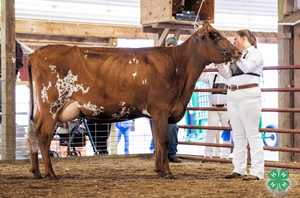
- Set your heifer so the rear leg closest to the judge is back further than the other rear leg with the front legs evenly square under her.
- When pulling into the lineup, heifers should have their front legs lined up evenly beneath them with their rear legs in a staggered, balanced position so the heifer is not underneath herself or stretched out.
- If you are the first person pulled into line, stagger the leg on the side of the leadsperson slightly further behind the other rear leg at an appropriate width as if the heifer is mid-step.
- If you are the last person in the lineup, switch the staging of the leg so the rear leg opposite the leadsperson is slightly further back.
- Hold your heifers head up while keeping her topline straight.
- With your right hand, grab and hold any excess throat, if needed.
- Once your heifer is set up in an attractive and ideal position, do not move her.
- When the judge steps in front of your animal, step to the side while facing forward to allow the judge to evaluate your heifer.
Dairy Cows
- Cows following similar guidelines, with minor differences.
- When positioning your cow, you must move your cow’s rear legs to be staggered with the leg closest to the judge slightly forward, exposing her udder for evaluation.
- Her front legs should be set square and lined up evenly beneath her.
- Otherwise follow all other guidelines outlined in the heifer section.
Dairy Cattle Showmanship Sample Questions and Answers
Sample Questions:
- What is ruminating?
- How many compartments are found in the stomach of a dairy animal?
- What is the length of gestation of a cow?
- What is freshening? What breed of dairy cow or heifer is this?
- What percent fat is whole milk?
- Answers:
- Chewing the cud.
- Four. They are the rumen, reticulum, omasum and the abomasum.
- When the cow has a calf, she freshens. This means she will give milk. 280 days Varies, but there are seven main breeds, the most common of which is Holstein. Holsteins are black and white and make up 90% of milking cows in the U.S. Other breeds include Red and White, Brown Swiss, Jersey, Ayrshire, Guernsey, and Milking Shorthorn. · About 3.5%, but it varies by breed.
Dairy Cattle Showmanship Sample Questions and Answers Sample Questions
- What is ruminating?
- How many compartments are found in the stomach of a dairy animal?
- What is the length of gestation of a cow?
- What is freshening? What breed of dairy cow or heifer is this?
- What percent fat is whole milk?
Answers
- Chewing the cud
- Four. They are the rumen, reticulum, omasum and the abomasum.
- When the cow has a calf, she freshens. This means she will give milk.
- 280 days
- Varies, but there are seven main breeds, the most common of which is Holstein. Holsteins are black and white and make up 90% of milking cows in the U.S. Other breeds include Red and White, Brown Swiss, Jersey, Ayrshire, Guernsey, and Milking Shorthorn.
- About 3.5%, but it varies by breed
Answering Questions
Many judges, but not all, will ask questions about your project, animal, and the dairy industry during showmanship. It is important to remember that the sample questions listed above with their corresponding answers are only examples of what judges can ask in a showmanship class.
- Other possible question topics areas to know:
- Age of your animal
- What your animal gets fed
- The animal’s pedigree
- Dairy industry and byproduct facts and information
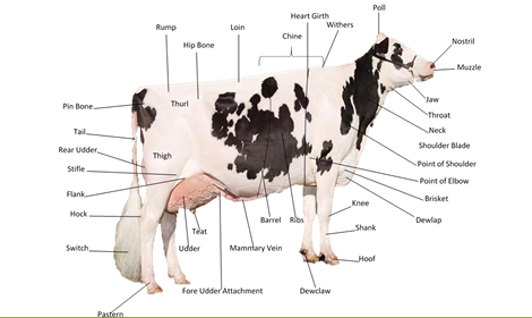
- The parts of your animal
- The PDCA Unified Scorecard
- The types of phenotypic and/or genotypic characteristics you like about your animal, what phenotypic characteristics you might want to change about your animal, how you highlight the best pieces of your animal, and how you try and hide the least desirable features.