


Timely planting is critical for maximizing winter wheat yield in Michigan
 Print
Print Email
EmailRecent Michigan research shows that timely planting remains the single most important management factor for maximizing winter wheat yield, while higher seeding rates can only partially offset yield losses from late planting.

Michigan wheat growers often face a difficult balancing act in the fall. Soybean harvest delays, wet field conditions and competing field operations can push wheat planting later than planned. When planting is delayed, growers frequently ask whether increasing seeding rate can recover lost yield potential.
To answer that question, we evaluated the response of winter wheat to a wide range of planting dates and seeding rates over three growing seasons at the MSU Research Farm in Mason, MI. The results convey two important messages: planting on time remains critical for achieving high yields, and while seeding rate adjustments are important, they cannot fully compensate for delayed planting.
Why planting date is important
Winter wheat yield potential is established long before spring green-up. Wheat planted on time produces more roots and tillers in the fall, leading to increased winter survival and higher head density that ultimately determines yield.
Our study evaluated five planting periods ranging from mid-September to mid-November and five seeding rates ranging from 0.8 to 2.4 million seeds per acre. Across all three years, yield consistently declined as planting was delayed (Figure 1). Yield losses were 7-10% when wheat was planted by early October. However, yield loss increased to 17-21% when planting was delayed to mid-October, and 24-33% when delayed to late October. Planting in mid-November resulted in yield losses of 24-47%, dependent on annual weather conditions.
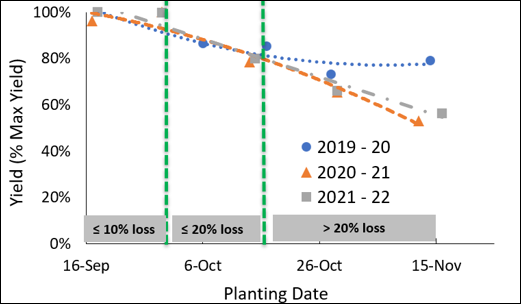
These findings highlight just how rapidly yield potential can decline once planting moves beyond the optimum window. The primary reason for these yield losses was a reduction in the number of grain-bearing heads per acre.
In the photo above, wheat plants were dug on December 11. By this time, soil and air temperatures are cooling, plants are beginning to harden off so significantly more growth before winter would not be expected. Note that plants in the first two planting dates have adequate fall tillering. As you move to the middle plant date, there are no tillers formed yet and when you get into November, wheat has germinated and barely emerged or did not yet emerge. Later planted plants have poorly developed root systems and may not survive the winter well. Wheat needs to be planted early enough to allow for tillers to form in the fall, as they contribute significantly more to yield than spring tillers. Tillers translate to heads. Head density is a key yield component of wheat.
In this trial, as planting was delayed, head density declined by roughly one-third to nearly one-half compared with wheat planted during the optimal window. While grain size and protein content varied somewhat among years, the strongest and most consistent relationship with yield was the number of heads produced.
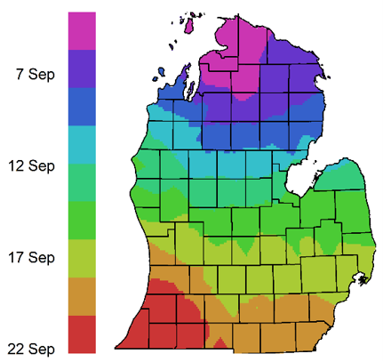
Although Hessian fly is no longer a pest concern in Michigan wheat production, the Hessian fly-safe date remains a useful guideline for determining the optimum planting window. Wheat planted 7-10 days after this date typically has sufficient time for fall establishment and tiller development while avoiding excessive fall growth. Wheat should not be planted before the fly-free date. Excessive growth and development in the fall can lead to fall disease or insect infestations and increased lodging risk in the summer, which lowers yield potential. While the fly-free date is a good guide, weather may change ideal planting dates earlier or later on the calendar.
Timely soybean harvest can help protect wheat yield potential
Because most Michigan wheat acres follow soybean, management decisions in the soybean crop can influence wheat establishment. When soybean harvest is delayed by uneven maturity, green stems, or late-season weed pressure, harvest aids (desiccants) may improve harvest efficiency and help facilitate timely wheat planting. Recent Michigan State University research showed that harvest aids can help facilitate soybean harvest when applied at the appropriate growth stage, although they should not be considered a substitute for sound agronomic management (e.g., timely soybean planting and use of optimal maturity group). Applications made before physiological maturity (R7) can also reduce soybean seed weight and yield, making proper timing essential.
If you grow dry beans, consider planting your wheat on those acres. Typically, dry beans are harvested 10-14 days earlier than soybeans. This helps provide a wider window for timely wheat planting.
Can higher seeding rates make up for late planting?
Traditional extension recommendations for seeding rates have been to increase seeding rates when planting is delayed. Results from this research suggest that while this remains true for late-planted wheat, the maximum rates can be lowered. Another key takeaway from this research is that increasing seeding rate cannot completely recover yield potential lost from late planting. The old adage of “if I can’t plant on time, I will just increase my seeding rate” isn’t quite true anymore.
Increasing seeding rate helped maintain stand density and reduce the penalty associated with late planting, but it did not restore yields to the level achieved by wheat planted on time.
The takeaway is straightforward: if given the choice between planting on time at a moderate seeding rate or planting late at a high seeding rate, planting on time is the better strategy.
Adjust seeding rate as planting is delayed
Although seeding rate could not eliminate yield loss from delayed planting, our research confirmed that seeding rates should increase as planting is pushed later into the fall (Figure 2, Table 1).
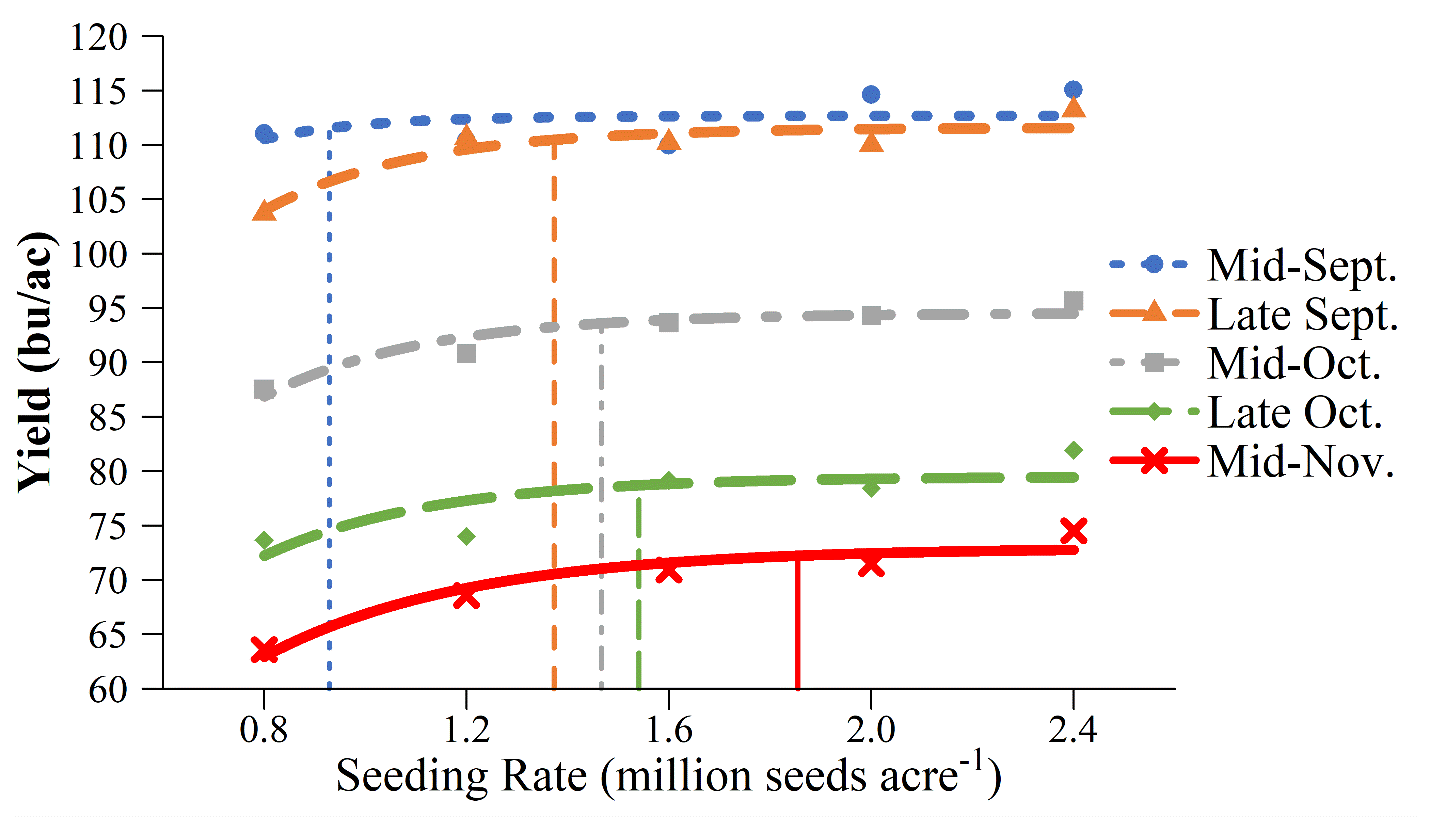
Table 1. Recommended seeding rate for different planting timings. Seeding rates should be increased when planting no-till (~10%) and in heavy clay soils (~20%).
|
Planting time |
Yield Potential |
Recommended seeding rate (million seeds/acre) |
|
Mid- to late September |
Maximum |
1.0 - 1.2 |
|
Early to mid-October |
5-10% lower |
1.2 - 1.4 |
|
Mid- to late October |
10-20% lower |
1.4 - 1.6 |
|
November or later |
>20% lower |
1.6 - 1.8 |
Results suggest that wheat planted during the optimal window may require fewer seeds than many growers currently use because favorable fall conditions allow plants to produce additional tillers and greater root mass, which improves water and nutrient uptake, winter survival and provides a solid foundation for spring growth. However, as planting is delayed into October and November, opportunities for fall root and tiller development diminish, making higher seeding rates increasingly important.
Practical recommendations for Michigan growers
- Plant as close as possible to the recommended planting window, generally within a few days after the Hessian fly-safe date for their location.
- Avoid unnecessary planting delays, even if that means adjusting soybean planting and harvest logistics or changing field operations.
- When planting on time, lower seeding rates should be considered, compared to historical seeding rate recommendations
- Planting late requires increasing seeding rates to 1.8 million seeds per, but yield will be lower than timely planted wheat
- Recognize that higher seeding rates reduce, but do not eliminate, yield penalty associated with delayed planting.
- When planting no-till, seeding rates should be adjusted up 10%.
- Seeding rates should be increased by 20% when planting in heavy, clay soils to compensate for reduced stand establishment rates.
For more details on maximizing winter wheat yield and profitability through planting date and seeding rate management, please read our research article, Crop, Forage and Turfgrass Management, authored by Copeland, J.P., D. Pennington and M.P. Singh. 2023.
This article was first published in the Michigan Wheat Wisdom Newsletter.