Prevent late blight on tomatoes
 Print
Print Email
EmailLate blight found on potatoes in Michigan and can infect tomatoes.
Late blight (clonal lineage/genotype US-23) on potatoes was discovered in St. Joseph County in southwest Michigan and confirmed by a private consultant on Aug. 12, 2026. Late blight is a disease that most commonly affects potatoes, but can affect tomatoes when the weather is cool, rainy and humid.
The late blight pathogen is caused by Phytophthora infestans which is a different Phytophthora than the Phytophthora capsici that commonly causes a root and fruit rot of peppers, cucumbers, squashes, pumpkins,and melons. The late blight pathogen can move from infected potatoes to healthy tomato plantings via airborne spores.
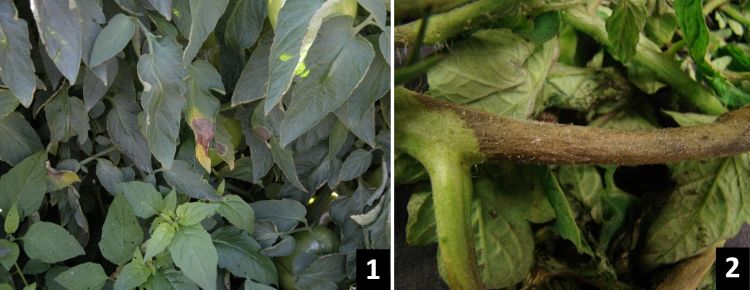
Late blight hasn’t been troublesome for Michigan’s tomato growers in recent years but could cause havoc as we enter this latter part of the growing season. Late blight symptoms include blighting on all aboveground parts of the tomato plant. Lesions on leaves often appear dark and oily with production of sporangia (also known as seeds of the pathogen) occurring on the undersides of the leaves resulting in a whitish/purplish appearance especially when conditions are wet and humid. These sporangia can be carried long distances from diseased plants to healthy plants via wind currents and storm fronts. Blackened lesions on the stems also occur and are typical of late blight disease.
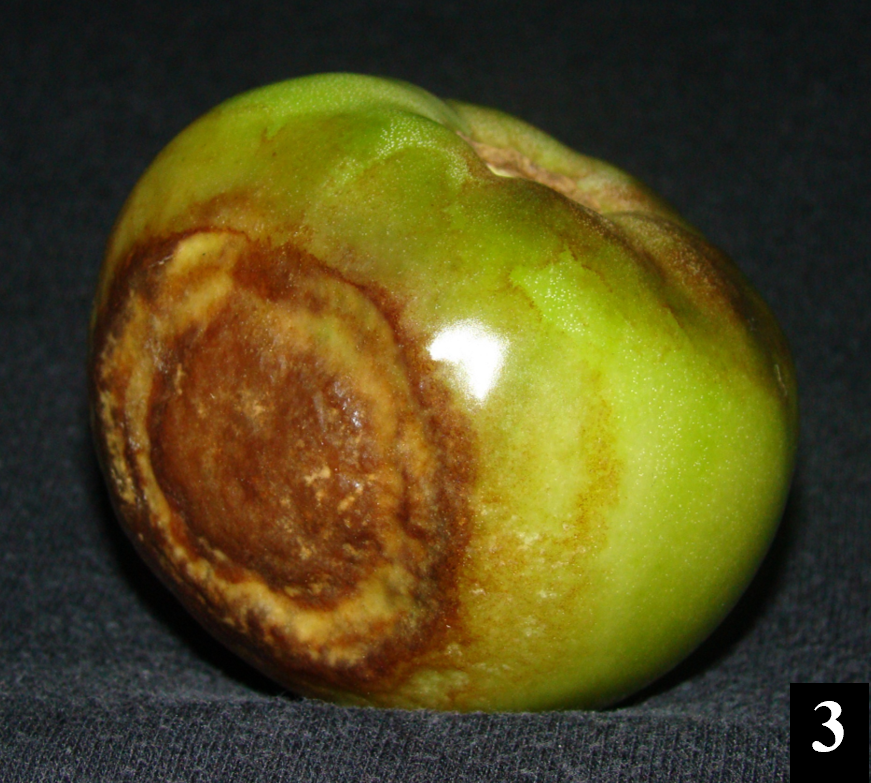
Late blight affects green and ripe tomato fruit. The blighting on the fruit appears as dark, greasy areas that enlarge rapidly, encompassing the entire fruit. During wet and humid conditions, white masses (sporangia and threads) of the late blight pathogen can be seen on the diseased leaves and fruit.
Between cropping seasons, the fungal-like pathogen survives on volunteer and abandoned potatoes in cull piles. Control measures include eliminating all potato/tomato cull piles and destroying volunteer potato plants that grow from overwintered tubers. Infected potato plants established from diseased seed potatoes are another source of late blight. Most tomato varieties are susceptible to late blight. ‘Mountain Magic’ is an example of a late blight resistant tomato variety developed at North Carolina State University.
There are several highly effective fungicide sprays that can be used to protect tomato plants from late blight. Homeowners and organic growers have limited tools available and are not always able to hold off the disease once it starts. Conventional growers who use fungicides as part of their overall integrated pest management (IPM) program fare better as many of the fungicides used for Alternaria, Septoria and Anthracnose (i.e., Bravo, Quadris, Tanos and Manzate) also provide some protection against late blight. If the late blight disease increases across growing regions, and the weather is cool and rainy, the addition of late blight specific fungicides to the spray program will likely be needed to control the disease and protect the crop.
My program hasn’t conducted tomato late blight fungicide trials recently, but the results from our older trials still apply and are summarized below. One of these tomato late blight trials compared single fungicide products (Table 1). Although growers should always alternate among different fungicides based on their mode of action (i.e., FRAC code), it is valuable to know which products are most effective and therefore should be used when late blight has been found in the state and cool and rainy weather conditions prevail.
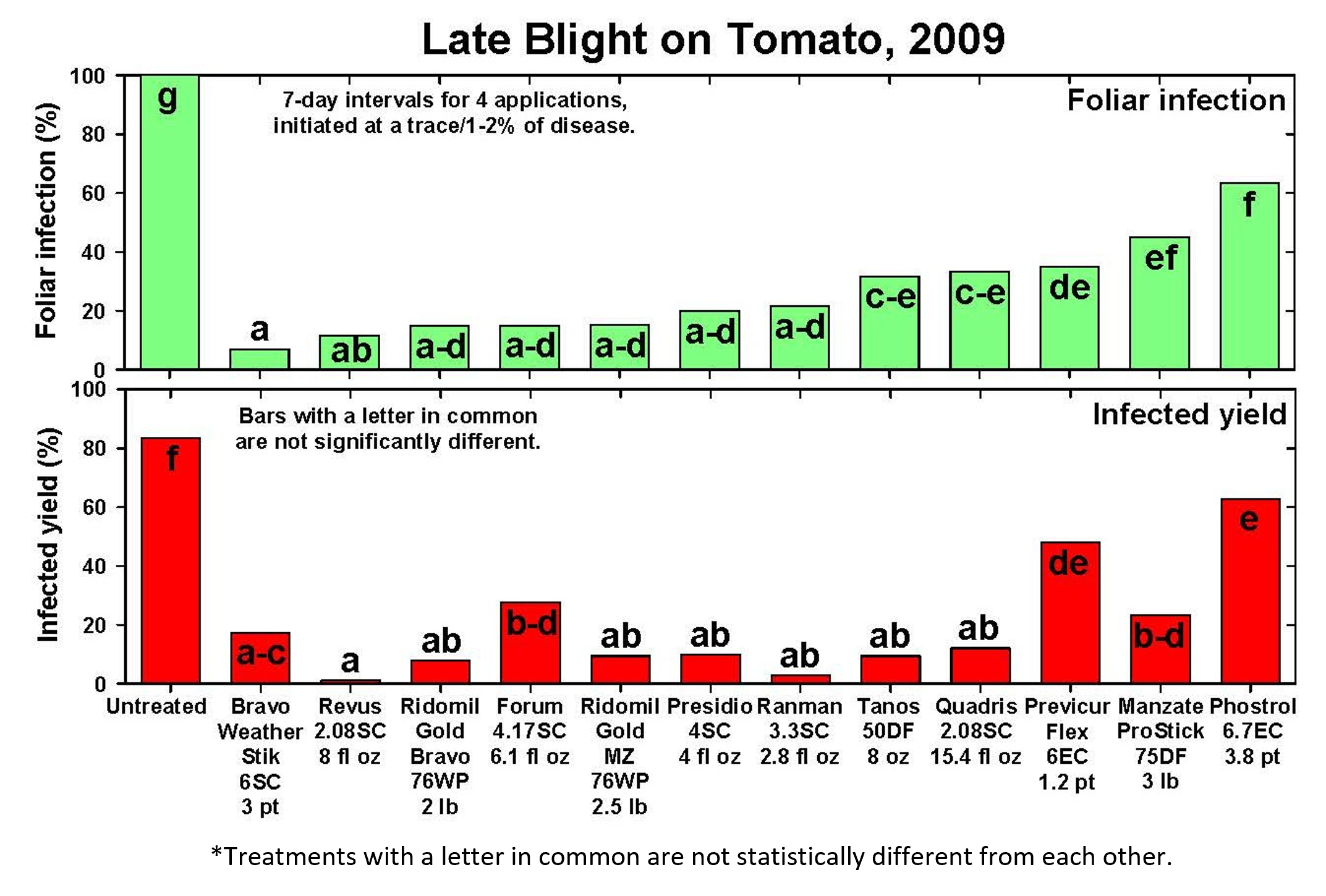
When late blight threatens, it is best that late blight fungicides be applied preventively prior to the development of disease symptoms. In our research trial (Figure 1), fungicide sprays were applied after a trace (1-2%) of disease was detected in our research plot, using a CO2 backpack sprayer equipped with three XR8003 nozzles. The sprays were reapplied every 7 days. The sprayer was operated at 50 psi at the boom and calibrated to deliver 50 gal/A. Plots were evaluated after 4 weeks for foliar infection (%). Yields were taken from the inner six feet of the treatment row.
Table 1. Fungicide products previously tested for the control of tomato late blight
|
Product |
Active ingredient |
Registered for tomatoes |
|---|---|---|
|
Bravo Weather Stik |
chlorothalonil |
yes |
|
Forum/Acrobat |
dimethomorph |
yes |
|
Manzate Pro Stik |
mancozeb |
yes |
|
Phostrol |
postassium phosphate |
yes, Phytophthora spp. |
|
Presidio |
fluopicolide |
yes |
|
Previcur Flex |
propamocarb |
yes |
|
Quadris |
azoxystrobin |
yes |
|
Ranman |
cyazofamid |
yes |
|
Revus 2.08SC |
mandipropamid |
yes |
|
Ridomil Gold Bravo |
mefenoxam/chlorothalonil |
yes |
|
Ridomil Gold MZ |
mefenoxam/mancozeb |
yes |
|
Tanos |
famoxadone/cymoxanil |
yes |
Plants that were not protected with fungicide (control) were completely defoliated by the late blight pathogen. The fruit from the unprotected plants also became diseased and 84% showed blight (Photo 3). Most of the fungicides included in this trial limited the advance of late blight but did not fully eradicate it. Revus protected both the foliage and fruit from disease. Using this product, combined with other effective fungicides, can prevent the development of late blight. Several other treatments were also helpful and included Ranman, Ridomil Gold Bravo, Ridomil Gold MZ, Bravo Weather Stik, and Presidio.
Keep in mind that the late blight strain that has been found in Michigan is Ridomil-sensitive. In this study, applications of Previcur Flex did not adequately protect the tomato foliage (35% infection) or the fruit (48% of the yield infected) from late blight. Similarly, Phostrol applications were not as helpful as other products in limiting disease.