


Material substitution can increase the potential environmental impact of packaging systems
 Print
 Email
Life cycle assessment shows that material substitution for packaging alone can increase potential environmental impacts, while lightweighting, recycling, and product protection can offer effective insights into the packaging system
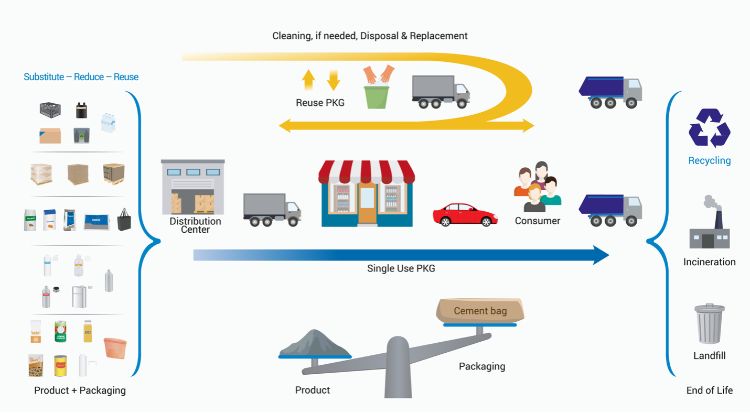
New research suggests that replacing polyethylene (PE) packaging with paper, glass, aluminum, or steel often does not reduce environmental impacts across a product’s life cycle.
Building on previous research, the study, published in Environmental Impact Assessment Review, evaluated five common packaging applications and found that PE packaging often had lower potential impacts across indicators including global warming potential, water scarcity, land use, acidification, and eutrophication.
Researchers from Michigan State University, Trayak, and ExxonMobil found that environmental performance depends on material quantity, transportation packaging, recycling, reuse, and the package’s ability to protect the product.
“Packaging’s environmental impact is often framed as a question of which material is best, but our results show that this approach is too narrow,” said Rafael Auras, co-author and a professor at the Michigan State University School of Packaging. “We need to consider the complete packaging system and the product being protected.”
Switching materials can have unintended consequences
The researchers initially scaled the analysis to a hypothetical replacement of approximately 3 million metric tons of annual U.S. PE packaging demand with alternative materials—paper, glass and metal. The results for each packaging system studied indicated that a change from PE packaging to an alternative could increase greenhouse gas emissions by a factor of three to four times, as well as have up to five times higher acidification impacts and as much as 29 times higher freshwater eutrophication impacts. The alternatives to PE packaging also generally required more water, land, and other resources.
The authors emphasize that these findings apply to the applications, indicators, and assumptions evaluated, and do not mean PE is preferable in every application.
Considering the whole packaging system provides additional insights
Packaging systems often include primary packaging, secondary packaging for grouping or distribution, and tertiary packaging for transportation. Yet the most optimized primary packaging isn’t necessarily wrapped in the most optimized secondary or tertiary packaging. And adding these components can sometimes reduce or even reverse the differences between primary packaging options.
Similarly, the systems approach becomes even more important when the product is included. For most of the 47 packaging systems examined, the product accounted for more than half of the combined product-and-packaging environmental impact in many of the categories studied. In these cases, assuming complete functional equivalence when some packaging may prevent leakage or breakage better than others, may lead to the wrong conclusions.
“The package has an environmental footprint, but it also performs a critical function, protecting the product,” said lead author Dr. Elizabeth Avery of Trayak. “If changing the package increases product damage or waste, those losses can offset the potential environmental benefit we expected from the packaging change.”
Damage breakeven points showed that, for pallet wrap, dog food, cement, juice and sauces, relatively small increases in product damage or spoilage could reverse the environmental advantage between options.
Reduce, reuse and recycle
Reducing packaging weight, or lightweighting and downgauging, generally reduced impacts, particularly for some multimaterial formats. The researchers cautioned that weight reduction should not compromise product protection.
Reuse produced more complex results. Reusable glass and metal formats could have lower environmental impacts than single-use versions of the same material, but transportation, washing, and reuse cycles strongly influenced packaging performance.
Increasing recycling and incorporating post-consumer recycled material generally produced similar or lower environmental impacts across the indicators evaluated.
The researchers also examined a hypothetical scenario in which recycled PE feedstock from plastic-waste pyrolysis replaced virgin PE feedstock. Under the study’s assumptions, even a small 40kta stand-alone pyrolysis unit may reduce water, fossil resource, and land-use impacts by up to 30%, while other indicators, including global warming potential, were similar within the study’s 10% comparison threshold. The authors stress that this scenario is hypothetical and does not represent current operating assets of any of the authors.
Informing packaging policy
The findings have implications for packaging policies, including extended producer responsibility, recycled-content requirements, reuse targets, and initiatives to reduce packaging waste.
The researchers recommend using life cycle assessment to identify trade-offs among material selection, emissions, recycling, reuse, transportation, and product protection. “Packaging decisions may result in important trade-offs and a life cycle assessment approach can provide insights into those trade-offs,” said lead author Dr. Elizabeth Avery of Trayak. “Substitution, reduction, reuse, and recycling are all tools. The challenge is determining which combination provides the lowest environmental impact potential for a particular packaging system while still protecting the product.”
A panel of independent experts reviewed the study’s findings for conformance with internationally recognized ISO life cycle assessment standards. The researchers conclude that packaging decisions should be based on function and system-level environmental performance, not material choice alone.


