‘It isn’t the cow. It’s the how.’: How MSU research advances regenerative ag in grazing systems
 Print
Print Email
EmailLed by Dr. Jason Rowntree, MSU researchers are working with farmers to quantify how regenerative grazing systems can strengthen land, livelihoods and long-term resilience.
*This story is part of a series highlighting the impact of MSU AgBioResearch’s work with Michigan agriculture and natural resources told through our stakeholders' perspectives. Through partnerships with the State of Michigan and industries, MSU AgBioResearch is finding solutions to some of the timeliest problems facing our state. To view the entire series, visit agbioresearch.msu.edu.
In addition to the written story, listen to the below podcast with MSU AgBioResearch Director George Smith and Jason Rowntree, MSU C.S. Mott Professor of Sustainable Agriculture, on Spotify, Apple Podcasts and YouTube.
EAST LANSING, Mich. — “We’re standing on the solution in Michigan to protect our state for decades ahead when it comes to economics, when it comes to food security and when it comes to our environment and biodiversity.”
What’s the solution Dr. Jason Rowntree is referring to?
Agriculture.
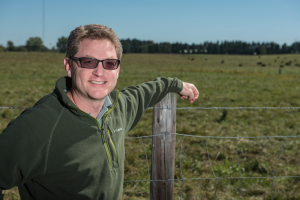
It’s a belief the C.S. Mott Professor of Sustainable Agriculture in Michigan State University’s Department of Animal Science has held since he first built his research program 16 years ago. Examining how beef cattle grazing systems can positively impact the land and farm profitability, he’s turned this belief into a principle for what has grown to be the MSU Center for Regenerative Agriculture.

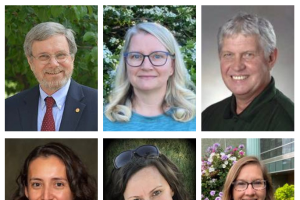
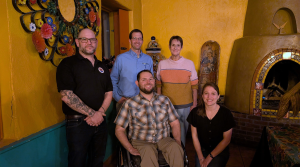
Along with Dr. Rowntree and his research on regenerative grazing systems, the center, which is supported by MSU AgBioResearch, has expanded to include MSU experts who can address regenerative agriculture from a variety of backgrounds. This group includes Dr. Rowntree serving as the grasslands and animal science advisor, Dr. Bruno Basso serving as the row crop and modeling advisor, Dr. Emily Silver serving as the natural resources and social sciences advisor, and Ian Olson serving as the supply chain advisor.
This multifaceted approach is what makes it stand out compared to other forms of sustainable agriculture, Dr. Rowntree said.
“Regenerative ag, to me, is outcome-driven,” he said. “It's about quantifying outcomes. Today, there are so many check-the-box labels and programs for food. And in some cases, we really don't know if the intended outcome of increasing sustainability was achieved."
In regenerative agriculture, it doesn’t matter how farmers get to their desired outcomes.
What matters is that they do.
The MSU Center for Regenerative Agriculture was created to help farmers understand what practices work best for their farms and which ones need to be put in place to achieve goals around building agricultural resilience, increasing production and profitability, and restoring the land and the environment around it.
“Here are the tools in the toolbox,” Dr. Rowntree said. “Your farm is different from every other farm. ‘Farmer A’ may go about it completely different than ‘Farmer B,’ and neither of them are wrong. It’s about enhancing soil health, resilience and water cycling while improving profitability and productivity.”
For regenerative agriculture to be an outcome-driven approach, it’s important for farmers to have the capacity and knowledge to know what their outcomes are. This point has been another foundational component to Dr. Rowntree’s research.
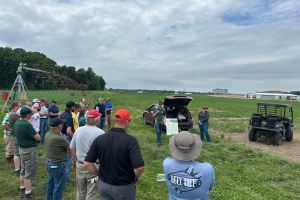
Working with farmers across the state, his team now monitors over 50 Michigan farms to assess the management practices of their grazing systems and offer strategies for how to improve them from environmental, productivity and profitability standpoints.
Beyond Michigan, he began co-leading a $19 million project at the end of 2021 quantifying the outcomes of regenerative grazing systems across the nation’s pastures and rangelands. The project, entitled, “Metrics, Management, and Monitoring (3M): An Investigation of Pasture and Rangeland Soil Health and its Drivers,” is now in its fifth year. Funded by the Foundation for Food & Agriculture Research and the Noble Research Institute, as well as the Jones Family Foundation, Greenacres Foundation and ButcherBox, this is a collaborative effort bringing together researchers from 11 nonprofit organizations, private research organizations and public universities in the U.S. and United Kingdom.
It’s projects like this one, Dr. Rowntree said, that show the power of partnerships and land-grant university research in the context of regenerative agriculture.
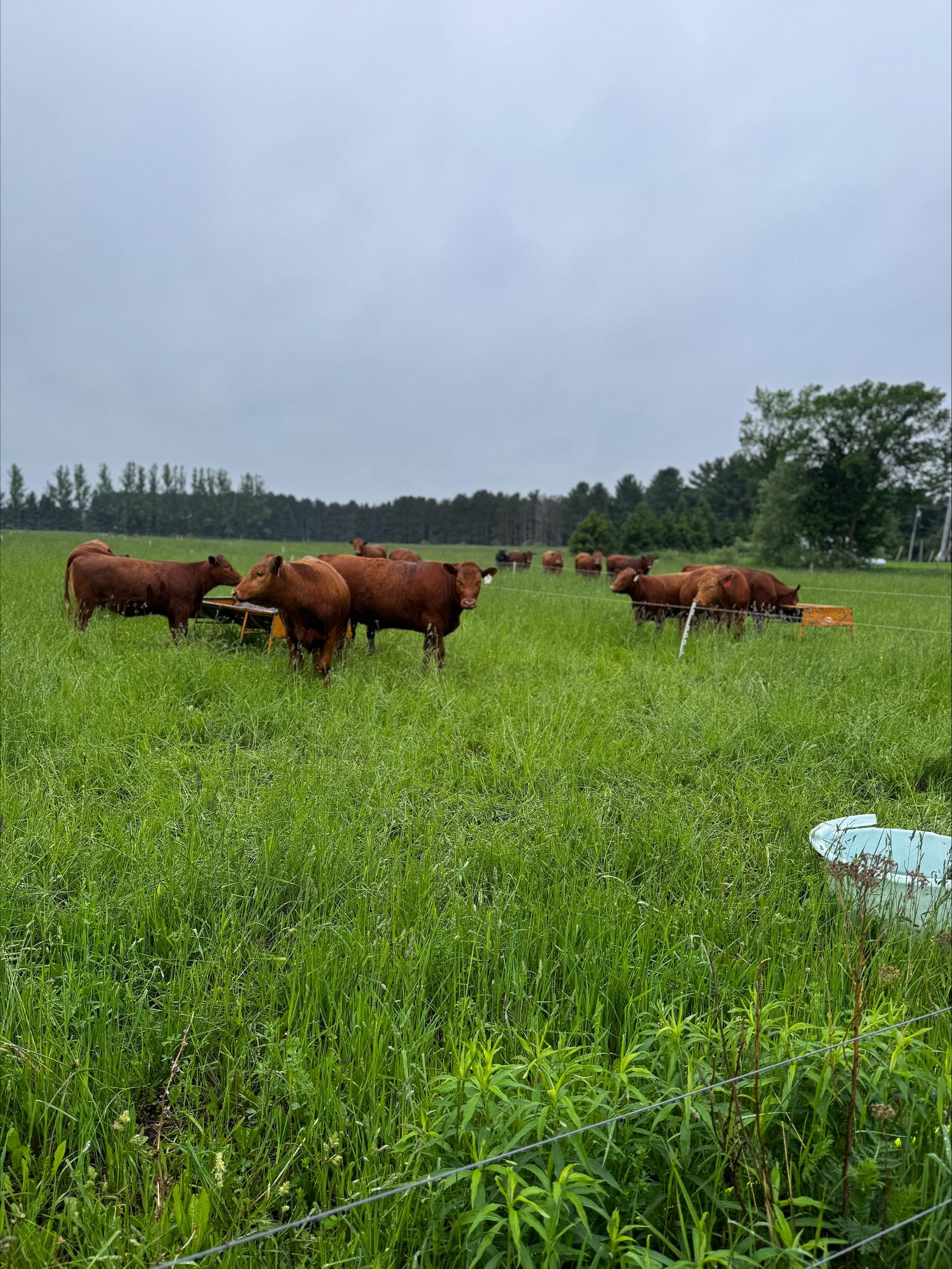
At the MSU Lake City Research Center in Lake City, Michigan, where Dr. Rowntree is the faculty coordinator, he said his team has been measuring enteric methane in grazing systems for as long as anyone in the country. He said his team’s work spanning over 10 years suggests that cattle are emitting 17%-25% less methane year per year than what national formulas are computing.
“If you think about that and you think about a beef cattle pledge to lower emissions by 30%, we might already be doing that if we use better math,” he said. “That’s where we in academia and we as researchers can bring that knowledge to the table, because very few entities have this longitudinal data that spans well over a decade to be able to have these conversations and say, ‘Hey, it isn’t the cow. It’s the how.’”
As many businesses continue aligning their operations to meet environmentally sustainable goals, incorporating regenerative ag techniques can open market opportunities for farmers as well, Dr. Rowntree said. While acknowledging that many of the decisions farmers make come down to if they make sense financially, he added that regenerative agriculture offers ways to reduce input costs that benefit farmers’ bottom lines.
Abby Bowser can attest to that. She and her husband, Brooks, own Bowser Family Farms in Homer, Michigan, where they currently run about 75 head of cattle and finish about 30 pigs each year. They started farming together over a decade ago using conventional techniques, but they eventually switched to regenerative practices and connected with Dr. Rowntree along the way. Findings from research he’s involved in, such as from the 3M project, are helping them understand what needs to be done to advance their operation.
Dr. Isabella Maciel, a systems researcher at the Noble Research Institute, is the co-director of the 3M project. She first came to know Dr. Rowntree as a postdoctoral researcher at MSU studying grazing management systems. Max Jones of the Jones Family Foundation also got to know Dr. Rowntree by way of the 3M project when they carved out its initial framework.
Hear from them below on how Dr. Rowntree and MSU are moving the needle in regenerative agriculture.
How does MSU research currently support your goals?
- Bowser: This research validates us in our mission, because Dr. Rowntree and the MSU Center for Regenerative Agriculture have the same mission. It feels like we have a partner in these new methods, but they’re not new ways of thinking at all. They’re extremely old ways of thinking. I grew up on a farm, and my grandpa and great grandpa were all farmers, and a lot of the ways we’re thinking about the land are the ways my grandpa and great grandpa would’ve thought about it. Regenerative agriculture is something that makes complete sense in your head and heart because you can watch it and see it every day. You can go out into the pasture and be like, “There’s life out here.”
- Jones: The mission of the Jones Family Foundation is to bridge the gap between human and landscape health and function. It’s a difficult bridge to build if we can’t accurately measure the ecosystem function components of agricultural landscapes. I’d say that the research MSU is conducting in this space is very important for the ag industry as a whole. We’re several important steps closer toward understanding the dynamics of the ecosystems we work and live within and how those systems impact our operations and lives.
What outcomes or benefits do you expect from MSU research?
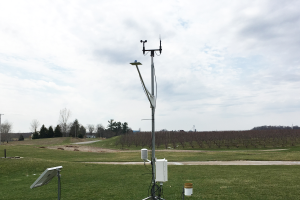
- Bowser: Real data points on carbon is a huge one for us because that’s such a big topic being talked about right now. Being able to understand what the future of carbon might look like is critical, and having a flux tower (a tower that tracks the carbon dioxide exchange between an ecosystem and the atmosphere) to measure carbon has been valuable because I know that’s going to be the next commodity of some sort. The other outcome that’s been helpful is the long-term monitoring the center does, where researchers come out and monitor one spot of our farm over a long period of time. That’s been nice for us to check the diversity of our plant species and ecosystem. The researchers from the center give us a score, and we’ll hopefully see that score increase over time. Overall, this research just proves that the less we do on the land, the better we’ll be in the long term.
- Maciel: I think I would start with the producer-based science. For the 3M project, we’re working with intensive research hubs such as the Lake City Research Center and others in Wyoming and Oklahoma, but we’re also working with 59 producers across the U.S. So, I think with this applied research being done on farms and not just controlled university settings, we’re showing the world how producers are doing regenerative agriculture and what their outcomes are.
The second outcome I expect will be the metrics that industries can use. Soil carbon is one. There’s currently a lack of methodology and sampling when it comes to soil carbon. We’re collecting an unbelievable amount of soil across these regions, so I think we’ll be able to give more answers to that. Another metric is greenhouse gas emissions. At almost 99% of the sites where we have carbon flux towers, they’re showing that the grazing systems are sinks of carbon. This is important news because people think raising beef cattle destroys the environment, but our data shows that many of these systems are taking in more carbon than they’re releasing.
Rowntree also wants to know the social and financial impacts ranchers have when practicing regenerative agriculture, so I think one last outcome I expect is improving the profitability of ranchers. As a rancher, you want to see your land getting better, but you also need to have some return as well. That is very important.
Can you share an example of when MSU research has positively affected the work being done in regenerative agriculture?
- Bowser: I talked about the carbon flux tower, which is extremely important. What I’ve also really liked about this research is the social well-being part of it. Researchers sat Brooks and I down and listened to us, asking us questions about our mental health and where we’re at emotionally. That’s something that’s interesting and not many people have studied, in my opinion. Farming is a hard lifestyle. It’s hard on you. It puts a strain on your marriage and your finances. This research has brought to light that all of that is important. You don’t have to just grit your teeth and stick it out. We listen to ourselves when everything is pointing toward needing to make a change, and through this study, we’ve been validated in knowing that’s also an important thing to do for everything to go well.
- Jones: The producers who are participating within the 3M project are receiving world-class data that’s helping them make more informed management decisions to better their operations and lives. That’s a big deal.
How can MSU research help to position regenerative agriculture to thrive moving forward?
- Maciel: One of the big outcomes from the 3M project will be creating a tool where producers can add basic information about their ranch — where they’re located, what kind of soil they have and so on — and by selecting different approaches to grazing management, they’ll be able to see what the impacts are on their productivity, finances, land and greenhouse gas emissions. This tool will be based on all the data we’re collecting and will continue to collect over the next year, and by gathering this data from different regions in the U.S., we’ll be able to make it applicable for producers across the entire country to use.
- Jones: It’s been my experience that people react positively toward incentives. Regulations, on the other hand, offer far too much constraint and tend to have negative long-term effects as individuals learn how to work around a system full of regulatory compliance. If we have a clearer understanding of ecosystem function, through better quantification of the processes being measured, then I have no doubt that ecosystem services can become a viable and sustainable cash source for operations within land and resource management. Operators should be incentivized to make different management decisions. This paradigm shift in management strategy will predictably have more positive outcomes for overall landscape health because the value in the ecosystem service they’re providing will become recognized by sustainable markets with appropriate price discovery. This speaks to the opportunity that operators have in agriculture to provide the most positive impact on the health of our people and the landscapes that should sustain us.
What would you say to legislators and other decision-makers to advocate on behalf of continued funding for the work being done at the MSU Center for Regenerative Agriculture? Why is this work important to fund?
- Bowser: Research like this is essential for the future of the entire planet, not only for the ag industry, but also for the environment and all our natural resources. Having funding that supports research and farmers is not something that we can quit or cheap out on. Future viability of farmland should be problem No. 1 that’s addressed, especially as it relates to U.S. soil. With the things we’ve already done to our soil, having research like this using real data to point out how we’ve affected the soil from conventional management practices is super important, as well as understanding there are other science-backed ways to go about it. For farmers, we can get stuck in our own worlds and our own lands and fields, and we can forget that what we’re doing affects the masses. And when you have legit research like what Dr. Rowntree is doing, it makes all of us crazy regenerative ag farmers seem more legit too.
- Jones: Simply put, what’s more important than the health of those who elected you? Human health is directly correlated to a landscape’s ability to provide healthy and sustainable sustenance. As a nation, we can do better at a legislative level. Producers are willing and able to make massive strides in this endeavor, but the oppressive nature of regulations coupled with short-term subsidies to act as Band-Aids for a broken system have our producers fighting with both hands tied behind their backs. As a representative, do the right thing. Look deep into these critical issues our nation is facing in food sustainability, and support agriculture in a way that can truly provide meaningful change for generations to come.
Michigan State University AgBioResearch scientists discover dynamic solutions for food systems and the environment. More than 300 MSU faculty conduct leading-edge research on a variety of topics, from health and agriculture to natural resources. Originally formed in 1888 as the Michigan Agricultural Experiment Station, MSU AgBioResearch oversees numerous on-campus research facilities, as well as 15 outlying centers throughout Michigan. To learn more, visit agbioresearch.msu.edu.