


After the last cluster: Postharvest vineyard management for Michigan growers
 Print
Print Email
EmailWhat happens after harvest can determine how the vineyard performs next year.
Harvest is one of the most visible endpoints of the vineyard season, but in Michigan it should never be considered the end of vineyard management. Once the final cluster leaves the block, the vineyard enters a short but extremely important transition from fruit production to reserve accumulation, wood maturation, cold acclimation and dormancy. That transition is especially important in Michigan because the state combines a Great Lakes, modified continental climate with highly variable soils, topography, cultivars and training systems. A low-cordon vertical shoot positioning (VSP) Pinot noir vineyard in northwest Michigan is biologically and structurally different from a high-wire Marquette vineyard in the southwest. Both differ substantially from Concord or Niagara trained to high-cordon or divided-canopy systems.
Low-cordon VSP is a typical system for upright-growing Vitis vinifera cultivars such as Pinot Gris and Riesling. High-wire cordon is more commonly associated with cold-climate hybrids such as Marquette and Marechal Foch, whose shoots tend to grow more procumbently or downward. This distinction should remain in mind throughout postharvest management because the location of perennial wood, the direction of shoot growth, vine capacity, cold tolerance and replacement strategy all affect what the grower should look for after harvest.
Historic Michigan research is particularly informative here. In long-term experiments involving nine cultivars and four training systems, Michigan State University (MSU) researchers compared low head, high head, low cordon and high cordon systems. High-cordon vines generally exceeded low-cordon vines for vine size, yield, fruit sugar accumulation and bud and cane cold hardiness. The experiments also demonstrated that increasing permanent wood changed vine carbohydrate dynamics and overall vine performance. These results should not be interpreted as meaning that high cordon is universally superior, but they demonstrate that training system is a physiological treatment, not merely a way of holding vines off the ground.
|
Vineyard type |
Common Michigan architecture |
Important postharvest characteristics |
|---|---|---|
|
Vitis vinifera |
Low-cordon VSP, Guyot-VSP, sometimes divided systems |
Greater winter-injury and crown-gall concern; upright growth; intensive canopy positioning; fruit-quality and ripening constraints often critical if vines are not well managed during the summer. |
|
French-American and cold-hardy hybrids |
Frequently high-wire cordon, sometimes VSP depending on cultivar growth habit |
Generally greater cold hardiness; often more vigorous; downward/procumbent growth can favor high-wire systems; crop regulation can be critical in highly fruitful cultivars. Overcropping tendency. Canopy management more challenging. |
Moreover, “hybrid” should never be interpreted as one physiological category. Vidal, Chambourcin, Traminette, Marquette and Frontenac differ greatly in cold tolerance, vigor, disease susceptibility, fruitfulness and growth habit. The same caution applies to vinifera. Pinot noir, Riesling and Cabernet Franc cannot necessarily be managed identically. The guiding principle for the postharvest season should therefore be treating the vineyard according to the biology of the cultivar and the architecture of the training system, not simply according to the calendar.
The Michigan postharvest window: valuable, but not equally valuable for every cultivar
After fruit removal, the vine does not immediately stop functioning. Healthy green leaves can continue assimilating carbon, while carbohydrates and nitrogen are redistributed toward roots, trunks and other perennial organs. Those reserves become important the following spring because early shoot development begins before the new canopy can fully support itself through photosynthesis. MSU research in Chardonnay has demonstrated that functional postharvest leaves contribute to carbohydrate accumulation and that well-watered vines can continue producing new roots after harvest, whereas severe postharvest water stress accelerates leaf loss and reduces new-root formation. The length and importance of this postharvest period, however, differ strongly among Michigan cultivars. An early-harvested hybrid or early vinifera may retain several weeks of healthy canopy after the fruit has been removed. A late-harvested Riesling or Cabernet Franc may have only a short period before natural senescence, frost and cold temperatures largely terminate canopy function.
This distinction is particularly important when comparing hybrids and vinifera. Many cold-hardy hybrids can tolerate winter temperatures substantially below those tolerated by vinifera. Michigan references place most vinifera cultivars in tender to moderately tender categories, although Riesling, Cabernet Franc and Pinot noir may be somewhat hardier. Many traditional hybrids fall into moderately hardy categories, while cultivars derived substantially from V. riparia, including several northern cold-hardy hybrids, can tolerate considerably lower midwinter temperatures.
Consequently, maintaining good reserve status and avoiding late vegetative growth are important for all cultivars, but the consequences of incomplete acclimation can be much more severe in a susceptible Chardonnay or Merlot block than in a well-acclimated Frontenac or Marquette block.
Training system further modifies the response. In low-cordon VSP vinifera, the perennial cordon and fruiting zone are relatively close to the ground. The system facilitates vertical shoot positioning and fruit-zone manipulation, but the permanent structure can be lost when trunks or cordons suffer severe winter injury. In high-wire hybrids, the cordon is substantially higher and shoots grow downward.
There is generally less need to repeatedly position shoots vertically between catch wires, but excessive vigor can produce a dense hanging curtain that shades the interior canopy and interferes with airflow and spray penetration. The postharvest objective for both systems is the same, maintain functional mature foliage without stimulating renewed growth, but the visual signs of imbalance are different.
Postharvest scouting: walk the vineyard before winter hides the evidence
One of the most valuable postharvest operations requires almost no specialized equipment: spend time walking the vineyard. This should not be a drive along the headlands. It should be a structured row-by-row vineyard audit conducted while shoot growth, foliage, disease symptoms, fruit-zone architecture and differences among vines remain visible. The vineyard after harvest represents the final biological result of the management program used during the summer. Pruning determined potential shoot and crop number. Shoot thinning established canopy density. Irrigation and nutrition influenced growth. Leaf removal modified fruit-zone conditions. Crop thinning altered source:sink balance. Disease management protected (or failed to protect) the fruit and foliage.
The objective after harvest is to connect those management inputs to their consequences. The questions should differ according to the system.
|
What to examine |
Low-cordon/VSP vinifera |
High-cordon/hybrid systems |
|---|---|---|
|
Shoot distribution |
Were shoots evenly spaced and properly positioned vertically? |
Was the downward curtain uniform, or did shoots pile into dense zones? |
|
Catch wires |
Did they maintain canopy shape? Are clips/wires damaged? |
Often less important; inspect cordon wire and any supporting wires carefully. |
|
Fruit zone |
Was exposure sufficient but not excessive? |
Did the hanging canopy create excessive fruit-zone shade? |
|
Hedging |
How many top and lateral hedging passes were needed? |
Was downward growth excessively long or touching ground vegetation? |
|
Disease |
Was dense VSP interior foliage associated with mildew/Botrytis? |
Did overlapping downward shoots reduce airflow or spray penetration? |
|
Cordons |
Winter injury, trunk disease, dead spurs and cordon decline |
Dead cordon sections, excessive permanent wood, structural weakness |
A high-wire hybrid canopy should not be evaluated using the same visual criteria as VSP Chardonnay. A well-managed VSP canopy is expected to form a relatively narrow vertical plane. A high-wire system is deliberately allowed to form a downward curtain. The question is whether each architecture achieved its intended balance.
Classify every weak vine, but interpret weakness according to cultivar and training system
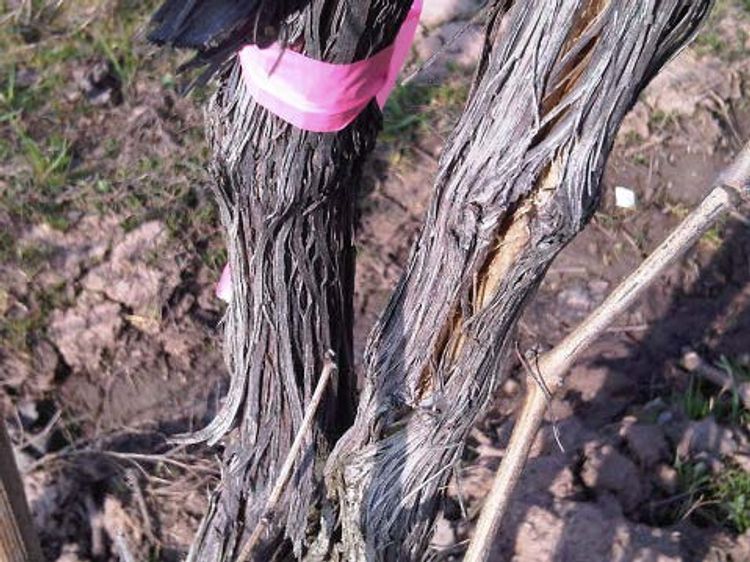
During the postharvest walk, classify vine positions as healthy, weak, suitable for trunk renewal, requiring complete removal or missing. The important step is diagnosis. A weak vinifera vine with poor cane maturation and trunk swelling after a severe winter raises immediate concern about freeze injury and crown gall (Figure 1). A weak high-wire Marquette vine on a sandy ridge may instead have experienced water stress despite being genetically cold hardy. A weak Concord vine in an otherwise vigorous high-capacity block may indicate trunk injury, phylloxera-related root problems, nutrient imbalance or localized soil conditions.
Training architecture can help reveal causes. In low-cordon VSP, weak sectors are often visually obvious because one portion of the vertical canopy fails to fill the trellis. In high-wire systems, a dead or weak cordon section may be partially hidden by long shoots originating from adjacent sections. It is therefore important to inspect the actual origin of the shoots rather than judging canopy continuity from a distance.
That same issue becomes important when counting missing vines. A high-wire vineyard can appear visually complete even when neighboring vines have expanded into empty positions. Postharvest scouting should therefore be based on original vine positions, not simply whether the wire has foliage on it.
Count missing vines and place nursery orders early
Vine loss should be quantified every year. Even relatively small percentages of missing vines can represent a surprisingly large number of production units, particularly in modern Michigan vineyards planted at relatively high vine densities. For a vineyard planted at 8 feet between rows and 4 feet between vines, each vine occupies: 8 ft × 4 ft = 32 ft²/vine. With 43,560 square feet in one acre: 43,560 ft² ÷ 32 ft²/vine = approximately 1,361 vine positions per acre. A 5-acre vineyard therefore contains theoretically: 1,361.25 vines/acre × 5 acres = approximately 6,806 vine positions. The implications of even modest vine mortality are substantial:
|
Missing vines |
Approximate missing vines/acre |
Approximate missing vines in 5 acres |
|---|---|---|
|
1% |
14 |
68 |
|
3% |
41 |
204 |
|
5% |
68 |
340 |
|
10% |
136 |
681 |
At this planting density, losing only 5% of the vine population means approximately 68 missing vines per acre. Across a 5-acre vineyard, that represents approximately 340 missing vine positions. This is an important number to visualize. A vineyard with 5% mortality may still appear relatively complete when viewed down the rows, particularly in vigorous high-wire systems where neighboring vines can extend shoots or cordons into open spaces. However, the vineyard has actually lost one vine out of every 20, together with its root system, crop-bearing capacity and contribution to uniform vineyard architecture.
For this reason, the postharvest vine census should become an annual management operation. Missing vines, vines scheduled for complete removal because of trunk disease or crown gall, and unsuccessful young replacements should all be counted and mapped before nursery orders are placed. Replacement needs should ideally be recorded as cultivar × clone × rootstock × number of vines, together with the exact row and vine position.
For grafted Vitis vinifera, maintaining the intended clone-rootstock combination is particularly important. For own-rooted cold-hardy hybrids, clean and correctly identified nursery material remains equally important even though rootstock selection is not involved. At an 8 × 4 foot spacing, allowing mortality to accumulate becomes especially costly because the vineyard was originally designed around a relatively high density of independent root systems.
Permanently stretching neighboring vines into these gaps gradually changes the biological architecture of the vineyard and makes uniform pruning, crop loading, canopy management and fruit maturation increasingly difficult. For vinifera, vine replacement is often particularly important because chronic winter injury, crown gall and trunk disease can gradually reduce vineyard population. Cold-hardy hybrids usually experience less freeze-related vine mortality, but that does not justify tolerating gaps. Missing vines still reduce uniformity and complicate mechanical pruning, crop estimation and harvest.
Training system affects replacement logistics. A young vine entering a low-cordon system has a shorter vertical distance to reach the fruiting wire and can often be integrated into the canopy relatively quickly. A replacement vine destined for a high-wire cordon must first establish a long, straight trunk to a substantially higher wire before permanent cordons can be developed. This can extend the period before the replacement occupies its intended canopy space. For this reason, waiting until gaps are numerous is particularly undesirable in mature high-wire blocks.
Stretching vines into gaps: high cordon and low cordon are not identical
Extending a neighboring cane or trunks temporarily while a young replacement develops can be appropriate in both systems. Making that extension permanent is different. In low-cordon VSP, stretching a neighboring vine generally means increasing the length of cordon or fruiting cane assigned to one root system. Maintaining appropriate shoot density over the enlarged space requires additional nodes and shoots. If the vine does not have the capacity to support those additional shoots and clusters, crop load increases disproportionately. In high-wire cordon, the visual problem can be less obvious because long downward-growing shoots can easily occupy an open section. A hybrid vine may appear capable of covering 12 or even 18 feet of trellis, particularly on a vigorous site.
Canopy coverage alone is not evidence of physiological balance. A high-wire vine occupying excessive trellis space may become highly vegetative because of reduced competition, highly cropped because too many fruitful nodes are retained, or both. Historic Michigan training-system research is relevant here. High-cordon vines often developed greater vine size, yield and perennial structure than corresponding low-cordon vines. That additional capacity can allow some high-cordon cultivars to occupy more space successfully, but it should not be interpreted as unlimited capacity. The appropriate diagnostic remains the relationship among yield, shoot growth and pruning weight.
Vine balance: interpret numbers according to cultivar and architecture
The Ravaz index remains useful: Ravaz index = yield per vine ÷ dormant pruning weight per vine. A general wine-grape reference near 5–8 is useful as a starting point, but it should not be treated as a universal Michigan target. For premium vinifera in short-season sites, particularly Pinot noir or other cultivars where complete fruit and wood maturation are critical, the desirable range may lie toward the lower end. Highly productive hybrids can often support different crop loads, and Concord/Niagara systems are managed under a very different economic and physiological framework.
The same applies to pruning weight per foot of canopy. Values near 0.3–0.4 lb/ft can be useful for moderate-vigor VSP vines, but directly imposing that reference on a high-wire Marquette or Geneva Double Curtain Concord block would be inappropriate.
|
Diagnostic |
Low-cordon VSP vinifera |
High-cordon hybrids |
|---|---|---|
|
Shoot density |
Often 4–5 shoots/ft useful starting point |
Interpret according to downward curtain density and cultivar vigor |
|
Pruning weight |
0.3–0.4 lb/ft can be useful reference for moderate VSP |
Often naturally greater; compare primarily within cultivar/site |
|
Ravaz index |
Commonly interpreted conservatively in short-season premium wine production |
Cultivar specific; many hybrids can support higher crops |
|
Primary risk of undercropping |
Excessive vigor, shading and delayed acclimation |
Very vigorous downward curtain and excessive shoot length |
|
Primary risk of overcropping |
Delayed maturity, weak wood maturation, reduced reserves |
Delayed maturity despite cold hardiness; small canopy relative to crop |
Trunk diseases: architecture determines how easily a vine can be rebuilt
Trunk diseases should be identified while canopy symptoms are still visible. In low-cordon grafted vinifera, trunk renewal is particularly valuable because the root system and scion can often be retained if disease remains above the origin of a healthy basal shoot. A new shoot can be trained rapidly toward the relatively low fruiting wire. In high-cordon systems, renewal requires training the new trunk farther vertically before the cordon can be reconstructed. This can add time to recovery. However, vigorous hybrid cultivars may produce sufficiently strong renewal shoots to rebuild rapidly if disease has not entered the basal vine.
For both systems, infected wood should be removed well below visible vascular necrosis. Published trunk-disease guidance supports cutting approximately 10–20 cm or more beyond visible discoloration, depending on the disease complex. Inspect the cross-section after every major cut. A visually healthy canopy above diseased permanent wood is not a reason to retain the wood.
Conversely, a dead cordon is not automatically a reason to remove the entire vine if a healthy trunk or renewal shoot remains. The architecture should influence how the vine is rebuilt, but disease biology determines whether rebuilding is justified.
Crown gall: primarily a vinifera concern, but not exclusively
The distinction between vinifera and hybrids is particularly important for crown gall. MSU reports that V. labrusca and many hybrid cultivars generally possess greater natural resistance to crown gall than V. vinifera. Grafted Chardonnay, Cabernet Franc, Pinot noir and other susceptible vinifera therefore deserve particularly careful postharvest trunk inspection after winters associated with freeze injury. Cold-hardy hybrids are not immune, but their greater cold hardiness and, in many cases, greater crown-gall resistance reduce the frequency with which freeze injury initiates serious disease.
Training height alone does not prevent crown gall. The important structures are the trunk base, graft union and tissues injured by freezing.
For low-cordon vinifera, multiple trunks can provide useful insurance. If one trunk develops galling, a younger trunk can maintain the cordon while a replacement is generated. The same multiple-trunk concept can be used in high-trained vines, but rebuilding a high cordon takes longer because the renewal trunk must reach the upper wire. MSU recommends two to five trunks of differing ages where crown gall risk is significant. Infected vines that are removed should have as much diseased root material removed as practical because the pathogen can survive in vine and root debris for years.
Fall hilling over the graft union is primarily relevant to grafted vinifera and other susceptible grafted material. It is generally unnecessary for own-rooted cold-hardy hybrids because there is no graft union requiring preservation; if an own-rooted hybrid trunk is winter-killed, new shoots arising from the root system remain genetically identical to the cultivar. That distinction should be very clear in a Michigan postharvest program.
Fertilization: cultivar type changes interpretation more than the nutrient-removal table
Fruit physically removes nutrients regardless of cultivar, so nutrient-export calculations remain useful across vinifera and hybrids. Management interpretation differs. A vigorous high-wire hybrid may produce much greater shoot growth and crop than a moderate VSP Pinot noir vine. Applying the same nitrogen (N) rate to both blocks simply because soil tests are similar would ignore their different capacities and production objectives. Approximate fruit N removal remains relatively modest.
|
Yield |
Approximate N exported in fruit |
|---|---|
|
3 tons/acre |
~9–11 lb N/acre |
|
4 tons/acre |
~12–14 lb N/acre |
|
5 tons/acre |
~15–18 lb N/acre |
|
6 tons/acre |
~17–22 lb N/acre |
These values are budgets, not fertilizer prescriptions. For a low-cordon vinifera vineyard, especially one requiring repeated hedging or showing late lateral growth, routine postharvest N is difficult to justify because excessive late vegetative growth can compromise acclimation and increase canopy-management requirements.
For a vigorous high-wire hybrid, caution may be even more important. Many hybrid cultivars have naturally high vegetative capacity and can produce long downward-growing shoots. Excess N can turn a manageable curtain into a dense mass requiring repeated trimming and producing poor internal light and spray penetration. A weak hybrid, however, should not automatically receive N simply because hybrids are expected to be vigorous. Poor establishment, drought on coarse soils, root problems or crop overload may be the true cause. Concord and Niagara nutrition should likewise be interpreted according to their established balanced-pruning and yield systems rather than using premium-wine targets.
The correct postharvest N rate can therefore be zero for any of these groups when vine size and nutrient status indicate adequate supply.
Potassium: the enological consequences matter most for wine grapes
Approximate potassium (K) removal is substantial:
|
Yield |
Approximate K removed |
K₂O equivalent |
|
3 tons/acre |
~15 lb K |
~18 lb K₂O |
|
4 tons/acre |
~20 lb K |
~24 lb K₂O |
|
5 tons/acre |
~25 lb K |
~30 lb K₂O |
|
6 tons/acre |
~29 lb K |
~35 lb K₂O |
The distinction between cultivar groups becomes particularly important when interpreting consequences. For vinifera and wine hybrids, excessive berry K can increase must pH through interactions with organic acids. That is particularly relevant in Michigan, where natural acidity is an important component of regional wine style. Therefore, a potassium application to Pinot noir, Riesling, Cabernet Franc, Traminette or Marquette should consider both soil/tissue status and fruit pH history.
For Concord and Niagara, juice-processing specifications and yield economics may place somewhat different emphasis on fruit chemistry, but unnecessary K application still has no agronomic justification. The fertilizer source and rate should therefore be block specific, not cultivar-group specific by default.
Phosphorus (P) removal remains relatively low regardless of whether vines are trained high or low.
|
Yield |
Approximate P removed |
P₂O₅ equivalent |
|
3 tons/acre |
~1.7 lb P |
~3.9 lb P₂O₅ |
|
4 tons/acre |
~2.2 lb P |
~5.1 lb P₂O₅ |
|
5 tons/acre |
~2.8 lb P |
~6.4 lb P₂O₅ |
|
6 tons/acre |
~3.4 lb P |
~7.7 lb P₂O₅ |
A high-wire hybrid does not require more P merely because it has a larger canopy, and a VSP vinifera vine does not require less simply because the cordon is lower. Soil and tissue analysis remain the correct basis. The same applies to magnesium, boron and zinc. Genetic differences can change uptake and visible symptoms, but management should respond to measured nutrient status rather than assumptions based on cultivar class.
Water after harvest: cultivar hardiness does not eliminate soil limitations
Hybrid vines are often more cold hardy than vinifera, but cold hardiness should not be confused with drought tolerance. A Marquette vineyard on coarse northern Michigan sand can suffer substantial water deficit even though the cultivar itself is very winter hardy. Likewise, vinifera on heavier soils can suffer from excess water and poor aeration rather than drought.
Training system also changes water demand indirectly because large high-wire canopies may have considerably more leaf area than narrow VSP canopies. A high-wire hybrid carrying a large crop and extensive curtain can therefore continue using substantial water after an early harvest. Conversely, a late-harvested VSP Cabernet Franc block may be approaching natural senescence soon after fruit removal and have little remaining postharvest demand.
Irrigation should consequently be based on soil moisture, functional leaf area and weather, not simply cultivar classification. Once irrigation ends, winterization procedures are essentially the same across systems, but high-wire vineyards should be inspected carefully for drip lines displaced by long shoots, harvest equipment or wildlife, while low-wire VSP blocks often have laterals and emitters closer to machinery operating in the fruiting zone.
Disease scouting: hybrids or PIWIs are not automatically disease resistant
One of the most important distinctions to make is that hybrid does not mean disease-proof. Disease resistance varies widely among hybrid cultivars. Newer PIWI or disease-resistant cultivars may carry specific resistance genes, while older French American hybrids can remain susceptible to important Michigan diseases. Concord, Niagara, Frontenac, Chambourcin, Vidal and Marquette should therefore not be placed into one disease category.
Vinifera generally requires the greatest disease-management intensity in Michigan, particularly for powdery mildew, downy mildew, Botrytis and sour rot. Michigan State University Extension scouting programs have repeatedly emphasized the high disease sensitivity of European wine grapes under Michigan humidity. Training architecture modifies disease pressure. In low-cordon VSP, disease often develops where shoots are excessively dense and interior leaves and clusters remain shaded. Catch wires can compress shoots into a narrow wall if shoot density is excessive. In high-wire systems, the downward curtain can provide excellent natural separation when shoot density is appropriate.
Very vigorous vines can develop overlapping shoots, laterals and a dense lower curtain that reduces airflow and spray penetration. Therefore, neither high nor low cordon is inherently “more disease resistant.” The relevant question is whether the system created an open, spray-accessible canopy for that cultivar.
Trellis inspection: look at what carries the load in each system
Trellis inspection should be system specific. A low-cordon VSP vineyard has multiple components that directly control canopy architecture: fruiting wire, catch wires, catch-wire clips, line posts and often movable foliage wires. A broken catch wire may not threaten the structural survival of the trellis, but it can materially reduce canopy quality the following year.
A high-wire cordon system places much greater functional importance on the upper cordon wire. That wire supports permanent wood and the entire downward canopy. End-post and anchor integrity are therefore critical.
High-wire vines can also exert considerable long-term load because they often develop more perennial wood. Historic Michigan work found greater permanent wood and generally greater vine size under high-cordon systems than low-cordon systems.
A Geneva Double Curtain requires inspection of additional crossarms and two separated fruiting curtains. Crossarm damage, wire displacement or unequal tension can distort the architecture of the entire row.
After harvest, trellis inspection should ask not merely “Is the wire broken?” but “Does this component maintain the intended canopy architecture?”
Vine ties, trunks and renewal wood
Low-cordon systems generally require careful inspection of ties around trunks and young cordons near the lower wire. Because the fruiting zone is close to the trunk transition, constricting ties can quickly become structural problems. High-wire systems require particular attention to trunk straightness and support because the trunk is longer and supports the fruiting structure at greater height. A damaged high-wire trunk represents a greater structural rebuilding commitment than a comparable low-wire trunk.
For vinifera, maintaining one or more renewal shoots near the base can be valuable insurance against winter injury or crown gall. For own-rooted cold-hardy hybrids, basal renewal can be even simpler because shoots emerging from below ground retain the cultivar genotype. In grafted vinifera, shoots originating below the graft union are rootstock suckers and cannot replace the scion. That difference should always be considered before selecting renewal wood.
Winter protection differs substantially between own-rooted hybrids and grafted vinifera
For grafted vinifera, preserving living scion tissue above the graft union can determine whether a winter injury event requires trunk renewal or complete vineyard replanting. Fall hilling over the graft union can therefore be an important Michigan risk-management strategy in vulnerable sites.
For own-rooted hybrids, the biological situation is different. There is no graft union separating scion from rootstock.
If aboveground trunks are winter-killed but the root system survives, basal shoots can regenerate the same cultivar. Consequently, soil hilling specifically to preserve a graft union has much less relevance in an own-rooted Marquette or Frontenac vineyard. The same distinction applies during scouting: a sucker arising below the graft in Cabernet Franc is not Cabernet Franc; a basal shoot from an own-rooted Marquette vine is Marquette.
Do not rush into pruning—but the reason differs by cultivar
Delayed final pruning is particularly valuable in cold-sensitive vinifera because growers can assess actual bud mortality before deciding how many buds to retain. MSU continues to recommend assessment of winter freeze injury and adjustment of pruning strategies following damaging cold events. Cold-hardy hybrids may experience less bud injury under the same temperature event, but they should still be assessed following unusual cold. Their greater cold hardiness reduces risk; it does not eliminate it.
Training system again matters. On low-cordon VSP, compensatory pruning may involve retaining additional spurs, longer canes or greater node numbers along a relatively short fruiting zone. On high-wire cordons, growers may retain additional nodes along long permanent arms or adjust mechanical pruning severity. In all cases, bud survival should inform pruning rather than assuming every winter is normal.
Winter pruning completes the postharvest diagnosis-but compare like with like
Pruning weight remains one of the best ways to quantify vine size. However, comparisons should be made within comparable systems. A pruning weight of 0.4 lb/ft may indicate a well-balanced VSP vinifera vine. The same value may have a different meaning in a high-wire hybrid expected to develop greater wood and canopy. Historic Michigan work demonstrated precisely this point: training height and amount of perennial structure changed vine size and performance across multiple cultivars.
The most scientifically useful comparison is therefore: the same cultivar, on the same training system, at the same site, across multiple years. That turns pruning weight into a management record rather than a borrowed universal threshold.
Harvest crates, sprayers, machinery and sanitation: biology differs, sanitation does not
The distinction between hybrid and vinifera becomes much less important when dealing with food-contact equipment. A dirty harvest bin is a dirty harvest bin regardless of whether it carried Pinot noir, Marquette or Concord. Bins, buckets, trailers, sorting equipment and harvesting tools should be cleaned, rinsed, sanitized when appropriate, thoroughly dried and stored protected from wildlife and contamination.
The same is true for sprayer winterization. However, the evaluation of sprayer performance should consider canopy system. A sprayer configuration calibrated for a narrow VSP wall may not provide equivalent deposition into a large high-wire curtain or Geneva Double Curtain. Postharvest is therefore an ideal moment to compare disease maps with sprayer configuration.
If disease was concentrated on the interior side of high-wire curtains, air volume or nozzle orientation may require adjustment. If VSP disease was concentrated in the canopy center, excessive shoot density may be limiting penetration regardless of sprayer output. Equipment sanitation is universal. Application technology is architecture specific.
A Michigan postharvest scorecard should identify cultivar and training system
The block record should begin with cultivar, rootstock where applicable, training system and fruiting-wire height because all subsequent numbers need that context.
|
Category |
Low-cordon/VSP emphasis |
High-cordon/hybrid emphasis |
|
Vine population |
Winter injury, crown gall, trunk disease, gaps |
Gaps may be hidden by neighboring curtains; inspect original vine positions |
|
Trunk renewal |
Usually shorter path to fruiting wire |
Longer trunk must be rebuilt to upper wire |
|
Shoot density |
Shoots/ft and VSP positioning |
Curtain density and overlapping downward shoots |
|
Pruning weight |
lb/vine and lb/ft very useful |
Compare within cultivar and high-wire system |
|
Crop load |
Ravaz index plus harvest maturity |
Ravaz index plus cultivar fruitfulness and maturity |
|
Leaf removal |
Fruit-zone opening near low cordon |
High fruit-zone geometry; often different equipment/settings |
|
Hedging |
Top/lateral passes |
Downward shoot trimming/undercutting |
|
Winter protection |
Critical for many grafted vinifera |
Often less critical for own-rooted cold-hardy hybrids |
|
Crown gall |
Major concern in susceptible vinifera |
Generally lower risk but still scout |
|
Disease |
Often intensive program |
Cultivar specific; resistance cannot be assumed |
|
Trellis |
Catch-wire system + fruiting wire |
Upper cordon wire + end assemblies |
|
Replacement |
Clone × rootstock especially important |
Cultivar source and adaptation; often own-rooted |
A Michigan postharvest calendar with cultivar and training-system distinctions
|
Timing |
Low-cordon vinifera |
High-cordon hybrids |
|
Immediately after harvest |
Protect useful canopy; scout crown gall, trunk disease, maturity variability and VSP density |
Protect useful canopy; evaluate crop load, curtain density, shoot length and hidden gaps |
|
While foliage remains green |
Avoid late N/water stimulation; preserve mature leaves |
Avoid unnecessary stimulation of already vigorous vines; assess whether curtain remains functional |
|
Before leaf fall |
Count replacements by clone/rootstock; identify trunk renewal; assess graft-union protection |
Count true vine positions; identify cordon/trunk renewal; inspect long permanent structures |
|
After leaf fall |
Repair catch wires, fruiting wires and VSP hardware |
Repair cordon wire, anchors, end posts and high-wire hardware |
|
Before severe winter cold |
Hill graft unions where warranted; protect renewal trunks |
Generally less graft-union concern for own-rooted cold-hardy material |
|
Midwinter |
Monitor bud LT and winter injury carefully |
Monitor after unusual extremes; cultivar hardiness still varies |
|
Pruning |
Adjust node retention to injury and vine size |
Adjust spur/node number to cultivar fruitfulness and curtain capacity |
|
Before bud break |
Complete replacements and VSP repair |
Complete replacements, cordon reconstruction and high-wire repair |
The Michigan principle: cultivar, site and architecture must be considered together
Michigan viticulture should not be divided simply into “wine grapes” and “other grapes.” A low-cordon Pinot noir vineyard and a high-cordon Marquette vineyard may occupy the same slope and experience the same weather yet respond very differently because the vines differ in growth habit, cold hardiness, disease susceptibility, crop potential and canopy architecture. The same management practice can therefore have different consequences. Excess nitrogen in Pinot noir may produce an excessively dense VSP canopy, repeated hedging, delayed wood maturation and increased disease pressure. The same N excess in Marquette may produce an extremely long high-wire curtain that reaches the vineyard floor and becomes difficult to spray.
Winter temperatures that injure Chardonnay trunks and initiate crown gall may have little effect on a fully acclimated cold-hardy hybrid. A missing vine in VSP creates an obvious canopy gap. A missing high-wire vine may disappear visually because neighboring shoots occupy the space, even though the block has lost a root system and production unit.
That is why the postharvest period should not produce a single vineyard-wide statement such as: “The vineyard was too vigorous.” It should produce a diagnosis such as: “Riesling Block 3, low-cordon VSP: approximately eight shoots per foot, four hedging passes and dense lateral growth; reassess N supply and early shoot thinning.”
Those statements connect cultivar, architecture and site. That is what turns scouting into viticulture.
Every Michigan vineyard season remains an experiment involving genotype, environment and management. Postharvest is the moment when the grower can finally examine how those three components interacted. The goal is not simply to place vines into dormancy. It is to enter winter knowing which vines are balanced, which vines are failing, which training-system components need repair, where the crop exceeded vine capacity, where canopy architecture increased disease pressure, which vines need replacement, and what should be done differently when growth starts again.
Harvest finishes the crop. Postharvest management finishes the diagnosis. And the diagnosis must always be made in the context of the cultivar, the site and the training system.